Car Wrap Price in Australia: What Does a Full Wrap Actually Cost?
Many buyers report uncertainty about what a fair car wrap price actually looks like before they request their first quote. That’s understandable, not because installers are dishonest, but because the variables behind any wrap quote are genuine and numerous. Without a benchmark, you can’t tell whether a $4,500 quote is reasonable or inflated.
Quotes vary because vehicle size, film type, complexity, and prep requirements all move the number significantly. This guide gives you realistic 2026 wrap for car price ranges, full vinyl, partial, bonnet and roof, and paint protection film, across Australian cities, plus the cost drivers behind every quote. Know the numbers before you call anyone. That’s the principle behind resources like NameTheCost.com, which is built to give Australian consumers independent pricing benchmarks before they commit to any trade or service spend.
What a car wrap costs in Australia right now
Full vinyl wrap price ranges across major cities
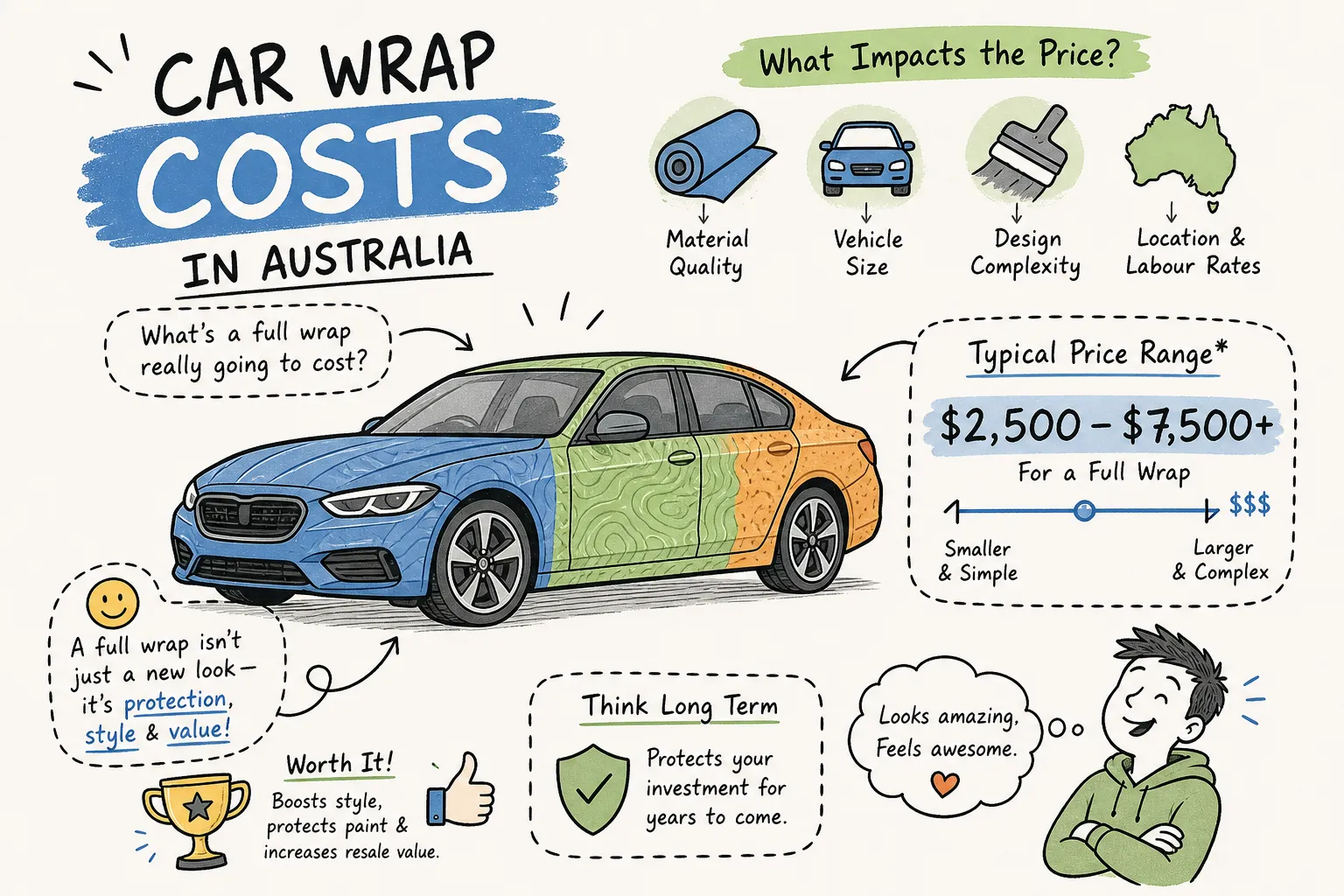
The headline range for a full vinyl wrap on a standard passenger vehicle in Australia is $2,500 to $7,000. Prestige SUVs, large 4WDs, and vans can push beyond that to $8,000 or $10,000. The table below gives you a city-by-city read, though the honest truth is that city location matters less than vehicle size and film quality when it comes to what you’ll actually pay.
| City | Full vinyl wrap | Partial wrap | Bonnet / roof wrap | Full-body PPF |
|---|---|---|---|---|
| Sydney | $3,000, $7,000 | $300, $1,200 | $450, $900 | $5,500, $8,500+ |
| Melbourne | $3,500, $5,500 | $300, $1,200 | $450, $900 | $5,500, $8,500+ |
| Brisbane | $3,000, $6,500 | $300, $1,200 | $450, $900 | $5,500, $8,500+ |
| Perth | $3,000, $6,500 | $300, $1,200 | $450, $900 | $5,500, $8,500+ |
| Adelaide | $3,000, $6,500 | $300, $1,200 | $450, $900 | $5,500, $8,500+ |
Partial, bonnet, and roof wrap pricing
Partial wraps run $300 to $1,200 depending on coverage. Bonnet and roof blackout jobs specifically sit in the $450 to $900 range, a popular choice if you want a visual upgrade without the full-wrap budget. These jobs deliver real impact at a fraction of the cost, but be specific when you quote: a single-panel bonnet is priced differently to a bonnet-plus-roof combo, and some installers bundle them while others don’t.
Full-body PPF costs
Paint protection film is a separate category entirely. Full-body PPF coverage runs $5,500 to $8,500 or more in Australia, and it is priced above vinyl for a reason: PPF is a protection product, not a styling one. The material is thicker, the installation is more exacting, and the purpose is to shield your paint from stone chips, scratches, and UV degradation at the surface level. Don’t compare its price to vinyl without comparing its purpose.
Wrap for car price: vehicle size and film brand
How vehicle size shifts the total bill
Surface area is the single biggest driver of vehicle wrap pricing. A small hatchback sits at the low end of the full-wrap range. A medium sedan sits in the middle. An SUV, ute, or van trends to the top end and beyond. The table below reflects typical 2026 Australian pricing by vehicle size.
| Vehicle size | Low estimate | Mid estimate | High estimate |
|---|---|---|---|
| Small car / hatchback | $2,500 | $3,200 | $4,000 |
| Sedan / mid-size car | $3,000 | $4,000 | $5,000 |
| SUV / 4WD | $3,500 | $5,000 | $6,500 |
| Van / ute | $4,000 | $5,500 | $7,000+ |
Premium film brands vs budget vinyl
Film choice is the second major cost driver. Premium cast films from brands like 3M, Avery Dennison, and Oracal cost roughly two to five times more per square metre than budget calendared vinyl. In practical terms for a full wrap, that material gap alone can add $300 to $600 or more to the final price. Cast vinyl is thinner, more conformable, and engineered to adhere to curved panels and complex body shapes without lifting or creasing. Calendared vinyl is thicker and less flexible. It works fine on flat or gently curved surfaces but can struggle with aggressive body lines, which is common on modern Australian vehicles. For anything other than a flat-sided van or basic panel work, cast film is the more practical choice even if it costs more upfront.
Labour and removal fees that rarely appear on the first quote
How installers price their labour
Labour is almost never itemised clearly on a first quote. Installers may price either by job or by the hour: many full-wrap quotes are bundled as a single job price, while removals and more complex installs are often charged hourly once the difficulty becomes apparent. Either way, the underlying calculation reflects installation time, crew requirements, and how much trim or panel disassembly is involved. A simple small car install is genuinely faster and less complex than a full SUV or van. The labour component for a large SUV can run $300 to $500 more than for a small hatchback, even when the film cost difference is already accounted for separately. Ask any installer whether their quote separates materials and labour, or whether it’s a single bundled price, that distinction tells you a lot about how transparent their pricing is.
Old wrap removal and vehicle prep charges
Wrap removal is one of the most commonly missed line items. If your car already has a wrap, expect to pay $500 to $1,200 for professional removal on a standard vehicle, and potentially $1,500 to $2,000 or more if the film is old, sun-damaged, or difficult to pull cleanly. Aged vinyl and baked-on adhesive take significantly longer to remove, and many installers charge by the hour once the difficulty becomes apparent. Surface preparation, decontamination, clay bar treatment, and light correction before new film goes on, can also appear as a separate line item of $300 to $800 on detailed quotes. If your base quote seems unusually low, prep and removal are the first places to check.
The extras that inflate the final bill
Design, custom cuts, and specialty film upgrades
Standard colour wraps usually have no design fee attached. Custom graphics, inlays, or plotter-cut patterns are different. Design or consultation charges for custom work typically run $0 to $100 for simple jobs, while bespoke graphic work can cost more depending on complexity. Custom plotter cuts add roughly $30 to $100. Specialty finishes such as chrome, satin, brushed metal, or colour-shift film add $50 to $250 depending on coverage. Always ask upfront which of these are included in the base price and which are separate. Door jambs, boot shuts, and fuel flaps are also commonly excluded from a base full-wrap quote, so confirm coverage before you sign anything.
GST, warranty, and post-install correction
GST catches people out when comparing quotes from different installers. Some shops advertise pre-GST pricing and some don’t, which makes side-by-side comparisons misleading if you don’t check. Add 10 per cent to any ex-GST quote to get the real number. Warranty coverage varies by shop: standard defect coverage is often included, but extended warranty packages can cost an additional $60 to $150. Post-install correction for lifted edges, small bubbles, or alignment issues is typically $25 to $150 per panel when it falls outside the warranty window, so understanding what the warranty actually covers matters before you decide which installer to use.
Vinyl wrap vs PPF: which one suits your car?
What PPF costs and what it genuinely protects
PPF at $5,500 to $8,500 or more is not a styling product, it is a protection product. The film guards against stone chips, scratches, and UV damage at the paint level. For a car that covers highway kilometres regularly or is being kept as a long-term asset, the investment can meaningfully preserve resale value and avoid costly paint repairs down the track. Note that Australia-specific PPF lifespan data are limited; manufacturer warranties and international performance data suggest PPF outlasts vinyl in durability, but local conditions vary. Factor that uncertainty in when budgeting.
When vinyl wrap is the smarter call
Vinyl wrap at $2,500 to $7,000 is primarily a styling product that also happens to protect the paint underneath it. For colour changes, fleet branding, or temporary personalisation, vinyl is the right tool. The practical trade-off is lifespan: vinyl typically lasts 5 to 7 years under normal Australian conditions, while PPF is engineered for longer protection life at a higher cost. Match the product to the purpose. If you want to change the colour of your car or brand a vehicle, vinyl is the answer. If you want to protect a paint finish you intend to keep, PPF is the answer.
How long your wrap lasts under Australian conditions, and what it costs to maintain
Expected lifespan for vinyl and PPF in the Australian climate
Australia’s UV index and ambient heat load are genuinely hard on wrap film. Good-quality cast vinyl in a shaded or undercover environment typically lasts 5 to 7 years. In full-sun, high-UV environments, outdoor parking in Queensland or Western Australia, for instance, deterioration can begin in 2 to 3 years, particularly on horizontal panels like the bonnet, roof, and boot. Budget calendared vinyl shortens this further, often showing fade or edge lift within 1 to 3 years in harsh conditions. Factor lifespan into the cost-per-year calculation, not just the upfront price. A $3,500 premium wrap that lasts 7 years works out cheaper than a $2,000 budget wrap that needs replacing in 3.
Routine care and repair costs over the wrap’s life
Day-to-day maintenance costs are low if you do it right. Hand washing or brushless facilities, no harsh chemicals, and undercover parking where possible are the three main requirements. Monitor for lifted edges and address them early, a small lift that is ignored tends to spread, turning a cheap spot repair into a larger job. The bigger financial decision arrives at the 5 to 7 year mark, when you decide whether to re-wrap, switch to PPF, or return to bare paint. Having that decision mapped out in advance, rather than scrambling when the wrap starts to fail, saves money and stress.
How to get a wrap for car price quote you can trust
You now know what realistic vehicle wrap pricing looks like in Australia. That puts you in a position to evaluate any quote you receive. Get three quotes minimum, and use this checklist to confirm what each one actually covers before you sign anything. You can also search “wrap quote near me” to find and compare nearby installers for in-person assessments.
- Base film and installation cost (bundled or itemised separately?)
- Film brand, grade, and whether it’s cast or calendared
- Vehicle size category used for pricing
- Removal of existing wrap if applicable (separate charge or included?)
- Surface prep and decontamination charges
- Design, custom cut, or specialty film upgrade fees
- Whether the quoted price includes or excludes GST
- Warranty coverage and what it actually applies to
The benchmark ranges in this guide are your reference point. An installer who quotes well outside these figures on either end deserves a direct question about why. The lowest quote is not always a deal, and the highest quote is not always quality. Use these wrap for car price benchmarks when you request quotes, the right one is the quote that accounts transparently for your specific vehicle, your chosen film, and every line item involved.
That’s the core principle behind NameTheCost.com: before you commit to any trade or service spend in Australia, knowing what fair pricing looks like puts you in control. Bookmark independent pricing resources before you start calling, not after you’ve already signed.