Dental Implants Cost in Australia: What You’ll Really Pay in 2026
Dental implants cost in Australia varies more than most patients expect, and many Australians walk into a consultation without a clear sense of what fair pricing looks like. That puts them at an immediate disadvantage. They can’t tell whether a quote is reasonable, whether components are missing, or whether a “great deal” is actually just a low number that excludes half the treatment. At NameTheCost.com, we apply the same principle to dental costs that we apply to tradie quotes, legal fees, and vet bills: know your benchmark before you spend a dollar.
This article gives you honest 2026 pricing across treatment types, a component-by-component breakdown of what a genuine implant quote should include, city-by-city comparisons, and a clear picture of what Medicare and private insurance will actually do for you. No fluff, no clinic advertorial, just numbers.
Dental implants cost in Australia: what a single tooth replacement really runs in 2026
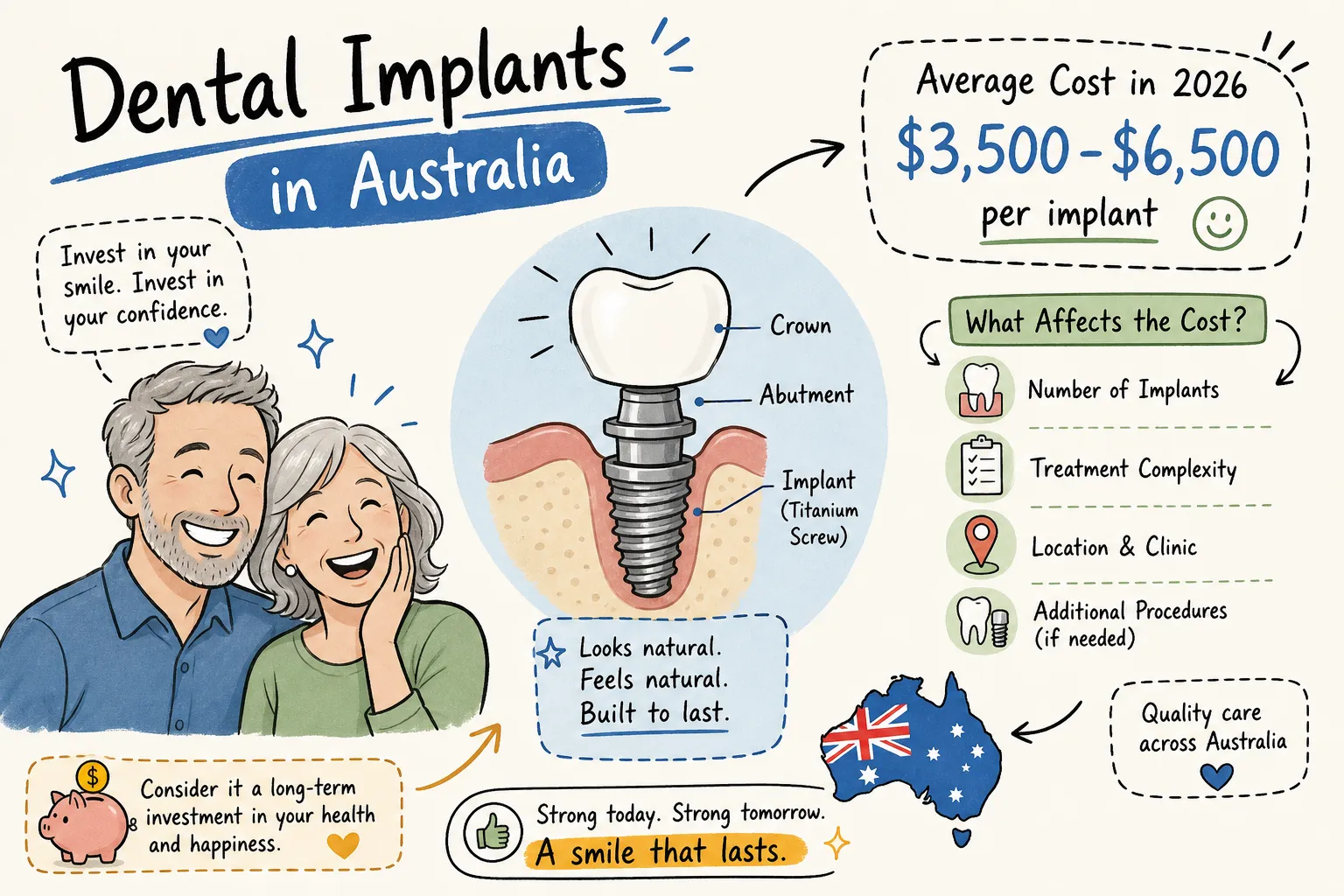
A complete single-tooth implant (fixture, abutment, and crown) typically runs between AUD $4,500 and $6,000 at a general dental practice in 2026. Some all-inclusive packages start around $3,999, and complex cases at specialist practices can reach $8,500 or more. That’s the honest range before any qualifications are added. It’s worth noting that some price guides have recorded averages closer to $3,700 for straightforward cases, so the figure you receive will depend heavily on clinic type and location.
The spread exists for real reasons: clinic type, implant brand, crown material, whether bone grafting is required, and where in the country you’re sitting. None of that is an excuse for vague pricing, it’s context that helps you interpret a quote you’ve received or are about to receive.
Why “cheapest” quotes often hide real costs
Advertised prices of $2,500 or $2,999 for a dental implant commonly quote only the titanium fixture, which is just one of three major components. The abutment and crown are separate line items, and when you add them, the total climbs well past that headline number. A $2,500 ad is not a lie exactly, but it’s not a tooth either. You need all three parts to have a functional replacement.
When complexity pushes costs higher
Several scenarios add meaningfully to the base price. Bone loss at the implant site requires a graft before or during placement, which adds roughly $1,000, $1,500 for a straightforward case and $2,000, $4,000+ when bone loss is significant. Patients requiring general anaesthesia rather than local will pay more for the surgical component. Referral to an oral surgeon or periodontist adds specialist fees on top of the general dentist’s involvement. For cases involving multiple missing teeth, each implant carries its own fixture, abutment, and crown costs.
What’s actually inside an implant quote
The most useful thing you can do before comparing clinics is understand what a complete implant quote should contain. Many Australians receive a three-line quote and a twelve-line quote from two different clinics and assume the cheaper one is better value. Often, the cheaper one is just less complete.
The fixture, abutment, and crown explained
- The implant fixture
- The titanium post placed into the jawbone. It typically costs $800, $4,500 depending on the brand and whether the surgical placement fee is bundled into this line item or listed separately.
- The abutment
- The connector that sits between the fixture and the visible tooth. Expect to pay $400, $1,000.
- The crown
- The visible tooth portion, ranging from $1,200 to $3,000 or more depending on material. Porcelain-fused crowns sit in the mid-range; high-quality zirconia crowns are at the upper end and are generally more durable long-term.
The extras that quietly inflate the total
A CBCT or 3D scan is commonly used for planning and bone assessment and is often listed separately at $150, $500. The surgical placement fee, when itemised apart from the fixture cost, runs $500, $3,500 depending on clinic type and complexity. Bone grafting, if needed, adds $500, $3,000 for most cases. When a quote looks unusually low, these are almost always the items left off or buried in fine print.
All-inclusive vs itemised pricing: what to ask for
Some clinics price implants as a single bundled fee; others itemise every component. Neither approach is inherently dishonest. The problem arises when you try to compare a bundled quote from one clinic against an itemised quote from another. Always request an itemised breakdown, even from clinics that prefer to quote a single figure. Ask specifically what brand of fixture is used, what material the crown is, whether the surgical fee is included, and what the quote excludes. That’s the only way to make a fair comparison.
All-on-4 cost in Australia and full-arch treatment: the bigger numbers
Full-arch implant treatment is a major financial commitment and the numbers should be treated as such. In Australia in 2026, All-on-4 treatment typically costs $20,000, $35,000 per arch. Premium clinics using zirconia bridges push toward $45,000 per arch. For a full mouth replacement covering both arches, that means a realistic outlay of $40,000, $70,000 for most Australians.
What the per-arch price usually includes
A genuine all-inclusive All-on-4 quote should cover four implant fixtures, the prosthetic bridge, diagnostic scans, surgical placement, sedation where applicable, and provisional teeth worn during the healing phase before the final prosthesis is fitted. Clinics that advertise $15,000 or $18,000 per arch are frequently quoting only part of this. The final prosthesis, sedation, and sometimes the scans can be listed as additions. Always ask exactly what that per-arch number includes before treating it as a comparable figure.
Acrylic vs zirconia bridges and why it affects cost
The material used for the prosthetic bridge is the single biggest variable in full-arch pricing. Acrylic or PMMA bridges sit at the lower end of the market, typically $20,000, $25,000 per arch. Milled zirconia bridges are considerably more durable, more resistant to staining and chipping, and more expensive at $28,000, $45,000 per arch. This isn’t simply a price difference, it’s a longevity and maintenance trade-off. Acrylic bridges often need replacement within five to ten years; a quality zirconia bridge is intended to last decades.
How city location affects dental implant prices in Australia
Sydney consistently sits at the upper end of implant pricing nationally. For a single implant including all components, Sydney practices typically quote $4,500, $7,000. Melbourne and Brisbane generally run $500, $1,500 lower at comparable practices. Perth is broadly similar to Sydney at most clinics, though the range is wider and more clinic-dependent.
Why Sydney tends to cost more
The primary drivers are higher commercial rents, specialist referral costs, and operational overheads that get passed on to patients. Higher pricing in Sydney doesn’t automatically mean better clinical outcomes, it reflects what it costs to run a practice there. That said, access to experienced implant surgeons and specialist equipment is often greater in Sydney, which matters for complex cases.
Regional vs metro pricing
Regional clinics can offer lower prices for straightforward single-tooth implants, and for uncomplicated cases, they’re worth considering. The trade-off becomes relevant for complex treatment. Full-arch implant procedures require specialist surgical teams, cone beam CT scanners, and often on-site or accessible prosthodontic labs. If a case is straightforward, regional providers can be a reasonable option. If it involves significant bone loss, multiple arches, or any complexity, metro access to a specialist team is more important than saving a few hundred dollars on overheads.
What Medicare and private health insurance actually cover
Medicare does not cover dental implants for Australian adults as a routine matter. That’s the short answer. The longer answer involves a narrow exception for hospital-based oral surgery tied to a medically necessary procedure, such as jaw reconstruction following trauma or treatment linked to a documented medical condition. This pathway is genuinely uncommon, requires substantial documentation, and is assessed case by case rather than as a standard entitlement.
Private health insurance can contribute under major dental or prosthodontic extras cover, but the numbers are modest. Most funds rebate $500, $1,500 toward a single implant, subject to annual major dental limits that commonly sit between $1,000 and $2,500 per person. Waiting periods of 12 months or more typically apply before major dental claims are accepted, and some funds impose separate waiting periods specifically for implants.
How to check your private insurance coverage before you start
Call your insurer before you book a consultation, not after. Ask specifically about your major dental annual limit, whether implants are listed as a covered item, and what the prosthodontic benefit schedule looks like. Confirm any waiting periods and request pre-approval in writing once you have a treatment plan from your dentist. Your dentist’s itemised treatment plan, complete with procedure codes, is essential for any claim.
The Medicare medical necessity pathway
This option exists for a small group of patients. It requires that the implant treatment be delivered in a hospital setting and be tied to a documented medical necessity, not elective cosmetic preference. Supporting documentation includes specialist referral letters, a clinical treatment plan showing medical justification, and itemised invoices. If your situation genuinely involves trauma, cancer-related jaw surgery, or another qualifying medical condition, speak to your GP and oral surgeon about whether this pathway applies. For the vast majority of patients seeking implants to replace a missing tooth, it won’t.
How to compare quotes and keep costs manageable
Getting multiple quotes is sensible, but only if you’re comparing the same scope of work. A quote that includes the fixture, abutment, crown, scans, placement fee, and follow-up appointments is a different document to one that lists a fixture price and nothing else. Request itemised quotes from every clinic you approach and ask each one to specify the fixture brand, abutment type, crown material, and what is explicitly excluded from their fee.
Implant financing options in Australia
Many Australian implant clinics offer in-house payment plans, typically spread over 12, 24 months. Some also accept third-party medical financing arrangements. Before signing anything, confirm whether the arrangement is interest-free or interest-bearing, what the total repayment cost is over the full term, and whether there are early exit fees. As a general rule, an in-house interest-free plan from a reputable clinic is worth investigating before committing to a third-party product that adds interest to an already significant outlay. Check terms carefully and compare the total cost of each option, not just the monthly repayment figure.
Legitimate cost-reduction options
Australian university dental school clinics, which operate under qualified specialist supervision, offer implant treatment at reduced rates in some cases. This can be a viable option for patients who are not in a hurry and have a straightforward presentation, but check directly with the relevant institution, as programme availability and eligibility criteria vary. Some private clinics run promotional pricing on specific treatment types at certain times of year, which is worth asking about directly. Patients with private health cover should review their extras tier before starting treatment; upgrading to a higher major dental limit before a waiting period begins can yield meaningful savings on future claims.
Dental tourism is worth addressing directly. The logistical realities are worth naming: follow-up care, warranty claims, and complication management become significantly more difficult to navigate across international borders. For a treatment that involves osseointegration over several months and potential long-term complications, proximity to your treating clinic matters. Weigh any apparent savings against the practical cost of return travel, time off work, and limited recourse if something goes wrong.
The numbers in summary
In short, dental implants cost in Australia in 2026 typically falls between $4,500 and $6,000 for a complete single-tooth replacement at a general practice, with some straightforward cases averaging closer to $3,700. All-on-4 full-arch treatment runs $20,000, $35,000 per arch, with premium zirconia options reaching $45,000. Sydney sits at the upper end of the pricing spectrum, with Melbourne and Brisbane running $500, $1,500 lower at comparable clinics. Medicare won’t cover routine implant treatment for adults, and private insurance can help modestly under the right policy, but rarely covers more than a fraction of the total cost.
Walking into any consultation without a sense of what fair pricing looks like is the most common way Australians end up overpaying for dental implants. When you don’t have a benchmark, every quote sounds plausible and every upsell seems reasonable. The same applies to any significant out-of-pocket expense, a home renovation, an emergency vet bill, or a legal fee. At NameTheCost.com, we publish independent cost guides across all of these categories so Australians can walk into any consultation knowing exactly what they should and shouldn’t be paying.