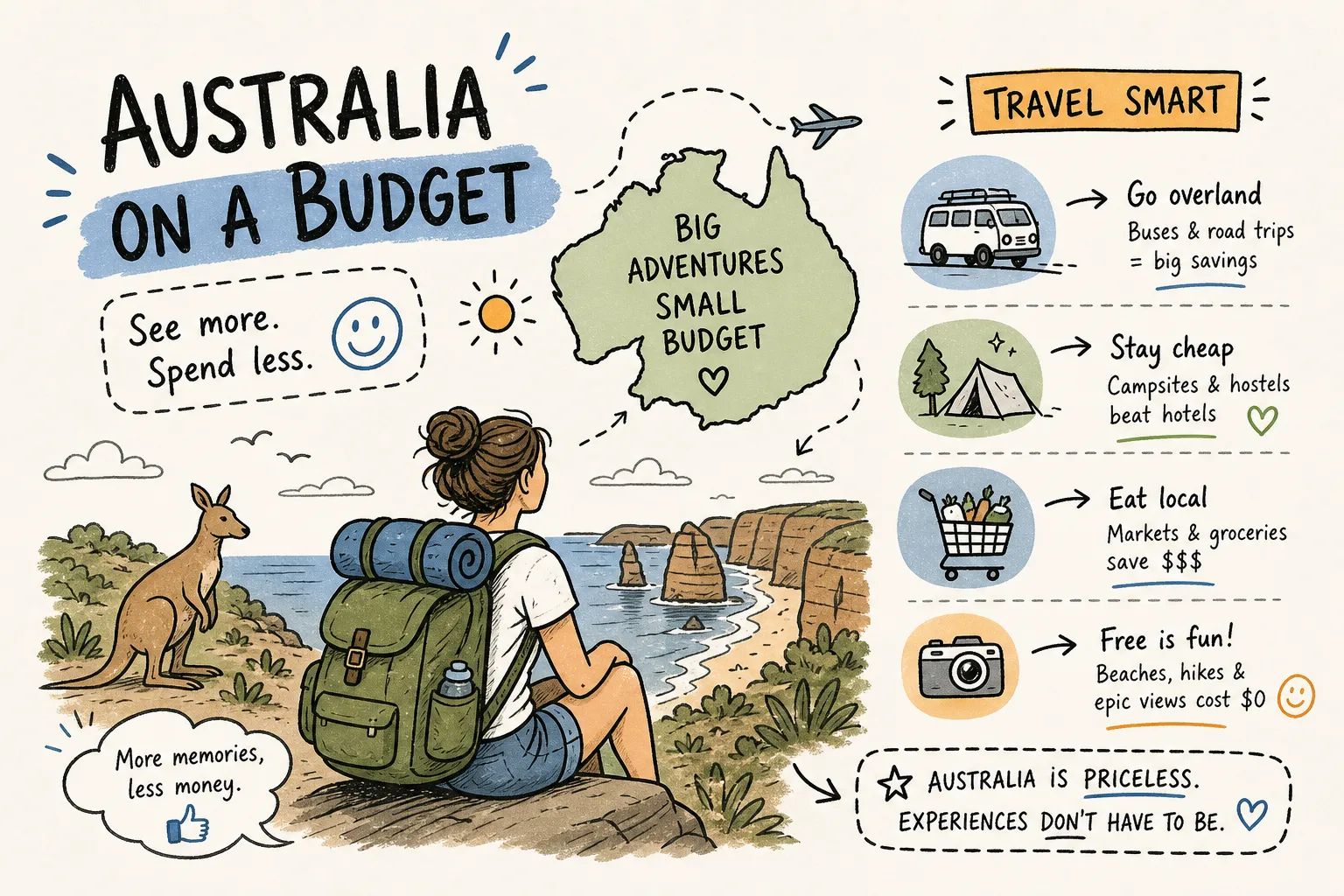
Cheap Travel Australia: How to See the Country Without Blowing Your Budget
Australia is enormous, and many travellers underestimate what a trip will cost before they even leave home. Some guess at a number, pick it too low, and spend the whole trip stressed. Others build in a vague buffer that quietly doubles the cost of every booking decision. Cheap travel in Australia is absolutely achievable, but it rewards people who plan with real numbers rather than rough estimates.
This is not a generic “book in advance and pack light” article. It covers the four variables that actually determine what a trip costs: when you go, how you get around, where you sleep, and what you do when you get there. Get those four things right and the budget largely sorts itself out.
Set a realistic baseline before you touch any booking site
What it actually costs to travel cheaply in Australia in 2026
The daily cost ranges for 2026 are clearer than most travellers expect once you look at them properly. Backpackers and budget travellers sit at roughly AUD 70, 110 per day. Mid-range travellers, staying in private rooms and eating at restaurants more often, are looking at AUD 155, 240. The comfort end of the market runs AUD 310, 400. Each tier breaks down across the same four buckets: transport, food, accommodation, and activities.
For backpackers, that typically means AUD 10, 25 on local transport, AUD 20, 40 on food, AUD 25, 60 on accommodation, and AUD 10, 30 on activities. The catch is that Sydney and Melbourne sit at the top of every range. Build your budget around city averages without accounting for the regional legs of your trip and you will overshoot consistently. A week in Sydney will cost more than a week driving through regional Queensland or Tasmania, and that gap is significant.
Why starting with a cost guide changes everything
Most travellers open a flight search or start scrolling accommodation platforms before they have any sense of a baseline. That approach locks you into reactive decisions, every price looks reasonable because you have nothing to compare it against. A baseline tells you what your trip should cost before anyone is trying to sell you something.
NameTheCost.com publishes Australian travel cost guides built around current pricing information to help travellers set an independent reference point before they start comparing. The approach is simple: understand what things genuinely cost first, then start booking. Without that starting point, every quote looks fair until you are already committed to it.
Travel off-peak and cut your accommodation costs by up to 50%
When off-peak actually means cheaper in Australia
Australia’s climate is not uniform, which means off-peak timing is not the same everywhere. For most of southern and eastern Australia, including Sydney, Melbourne, Adelaide, and Hobart, the main off-peak window is June through August. For tropical destinations like Cairns, Darwin, and the Whitsundays, the logic flips: the wet season running November to April is quieter and cheaper, while the dry season from May to October is peak.
The shoulder seasons of March to May and September to November deliver meaningful savings with more manageable crowds, particularly on the east coast. These are often the best-value windows for travellers who want reasonable weather alongside lower costs. Peak season in most eastern and southern destinations runs December to February, and that is when prices across all four cost categories are highest.
The real savings when you shift dates
Shifting from the December to February peak window into the June to August off-peak period can cut domestic airfares by 20 to 40 per cent and accommodation rates by 35 to 50 per cent. A five-night city trip for two people can save AUD 1,000, 2,000 in accommodation costs alone by moving dates. That is not a rounding error, that is a significant portion of the entire trip budget.
Date flexibility is the single highest-leverage decision in a travel budget. It costs nothing to move dates, and the savings are immediate. Before committing to any departure window, check what the same itinerary costs across two or three different month options. The difference is often striking.
Cheap travel in Australia: ways to get around without overspending
Domestic flights: the airlines and routes that consistently deliver the lowest fares
Jetstar leads on price for point-to-point domestic travel, coming up as the cheapest option in close to half of fare searches, according to aggregated fare comparison data. Virgin Australia is the other consistent low-fare competitor. Routes like Sydney to Ballina from AUD 55, Melbourne to Launceston from AUD 59, and Sydney to Gold Coast from AUD 65 regularly appear among the cheapest domestic fares available. Qantas occasionally surfaces bargains during promotions, but its headline domestic sale fares typically start higher than Jetstar and Virgin.
The key lever is not just which airline, but when you book. July tends to be among the lowest-fare months for domestic travel, and airline sale periods, particularly mid-year promotions and Boxing Day sales, are where the genuine bargains appear. Set a fare alert on a flight comparison tool and be ready to act quickly when a sale goes live. Cheap fares during sale periods sell fast and are not restocked.
Coach and campervan: when they make more sense than flying
For travellers with time and flexibility, coach travel delivers a lower per-trip cost than flying on many routes, especially where budget flight savings shrink after baggage fees and airport transfers. Greyhound’s Sydney to Melbourne route comes in around AUD 113, 135 depending on booking timing, which is broadly comparable to budget flights once all-in costs, bags, transfers, and airport time, are factored in.
Campervans change the maths for groups and couples. At AUD 120, 400 per day all-in, including hire, fuel, insurance, and campsites, the number is high in isolation. But it replaces both transport and accommodation simultaneously. For a two-week road trip with two people splitting costs, the per-person daily total can be competitive with budget flights plus hostel stays, and you get the flexibility of travelling on your own schedule.
Budget accommodation across Australia’s major destinations
Cheap accommodation in Australia: a city-by-city rate guide
Sydney hostel dorm beds sit at roughly AUD 45, 80 per night. Budget hotel chains like ibis and Travelodge run AUD 160, 280 in central Sydney. Other capitals, including Melbourne, Brisbane, Perth, and Cairns, sit slightly lower, with dorm beds generally in the AUD 35, 75 range and budget private rooms from around AUD 120, 220. These figures are indicative estimates; rates vary by season and availability.
For travellers who want to push costs lower, campsites at caravan parks typically cost AUD 40, 50 per night for a powered site. National park camping drops to AUD 6, 38 per person depending on the state and facilities. Many designated rest areas are free to camp at, though some locations charge a small permit or access fee, check with the relevant state parks authority or local council before assuming no cost applies.
The gap between the cheapest and most expensive accommodation option in any given city can be AUD 200 per night or more. Choosing where you sleep does more to shape the total budget than almost any other single decision.
How to stretch your accommodation dollar further
Staying in smaller towns and regional centres rather than CBD locations cuts rates significantly and often puts you closer to the natural attractions that make Australia worth visiting. Longer stays of five nights or more unlock weekly rates at most hostels. House-sitting and work-exchange programmes are well-established options for longer-term budget travellers willing to exchange a few hours of daily work for free accommodation. These are not obscure hacks, they are practical tools that experienced budget travellers use consistently.
Queensland offers an additional advantage for those travelling cheaply in Australia: the Translink network covers trains, buses, trams, and ferries at a flat 50-cent fare, making city and regional day travel in south-east Queensland unusually cheap. That kind of local transport subsidy adds up quickly over a week-long stay.
Free and cheap things to do by region
East coast highlights that cost almost nothing
The east coast concentrates Australia’s most-visited attractions, and many of the best carry no entry fee. Sydney’s Bondi to Coogee coastal walk, the Art Gallery of New South Wales (permanent collection free), the harbour foreshore, and the Blue Mountains lookouts are all free. Brisbane’s South Bank Parklands, the Streets Beach lagoon, Mount Coot-tha lookout, and the Queensland Gallery of Modern Art (free entry for permanent collection) are among the strongest no-cost days out in any Australian capital. Melbourne’s NGV permanent collections, Hosier Lane, the Royal Botanic Gardens, and the Yarra riverside are equally accessible without spending a dollar.
The trap on the east coast is paid day tours, particularly reef tours out of Cairns, which run AUD 150, 250 per person. These experiences are legitimate highlights, but stacking three or four in a week will blow a backpacker budget quickly. Budget for them selectively rather than treating them as automatic itinerary items. In Cairns itself, the Esplanade, the free lagoon pool, and the Botanic Gardens provide genuine quality without any entry fee.
Beyond the east coast: cheap experiences in WA, NT, and Tasmania
Western Australia’s wildflower season from August to October and the Pinnacles Desert are free-access experiences that rarely get mentioned in east-coast-focused budget guides. Fremantle’s markets, street art precinct, and beaches require no entry. Darwin’s Mindil Beach Sunset Market is one of the country’s great free evening experiences. In Tasmania, much of the island’s landscape is the attraction itself: the majority of the most impressive walks and lookouts carry no cost, and the overall cost of living is lower than on the mainland, making it an underrated destination for backpacking Australia cheaply.
A no-nonsense action plan to lock in your cheapest trip
The order to book everything in
Start with your baseline. Use NameTheCost.com’s travel cost guides to confirm what your trip type realistically costs before any booking decisions are made. Then lock in transport first, since flights and coach passes carry the most volatile pricing and the best fares disappear quickly. Book accommodation next, prioritising off-peak dates and regional stays over city centres. Activities come last and should be evaluated against free alternatives at each destination.
Avoid the common mistake of building an itinerary around paid experiences and then trying to fit a budget around it. That approach works in reverse. Set the budget first, identify the free and low-cost options that fill most of the itinerary, then allocate a specific line item for paid highlights you genuinely want.
A sample two-week backpacker budget for cheap travel in Australia
Fourteen days at a realistic AUD 90 per day average on the ground equals AUD 1,260 in daily expenses covering accommodation, food, local transport, and activities. Add domestic flights or a coach pass and budget AUD 300, 600 depending on routing. A two-week east coast trip sits within AUD 1,500, 2,000 for travellers who plan deliberately. That total rises with every city-heavy day you add, which is exactly why building your baseline before you start booking is the most important move you can make.
The bottom line
Travelling Australia cheaply is not about deprivation. It is about knowing your numbers before you start and making the high-leverage decisions deliberately. Timing, transport, and accommodation together explain the vast majority of the cost difference between an AUD 70-per-day trip and an AUD 300-per-day trip.
Use the research available to you, including NameTheCost.com’s travel cost guides, to set your baseline before you open a single booking tab. Then lock in transport, then accommodation, then activities. The country is worth seeing properly. You do not need to overpay to do it.