Car Rego Cost in Australia: A State-by-State Guide for 2026
The rego renewal notice arrives in the mail and many Australians do one of two things: pay it without looking, or feel vaguely uneasy about the number and pay it anyway. Neither is ideal. Your car rego cost is not a single flat charge, it is several fees stacked together, calculated differently depending on which state you live in, what vehicle you drive, and sometimes even where in that state you park it at night.
At NameTheCost.com, we track the real cost of recurring living expenses across Australia, and car rego costs sit near the top of the list of expenses people consistently underestimate or misunderstand. This guide breaks down every component of the fee structure, compares what each state charges for a standard passenger vehicle in 2026, and explains what actually moves the number up or down for you specifically.
By the end, you will know what you are paying for, whether your state includes CTP in the published figure, which concessions you may be missing, and exactly where to get a firm quote before the renewal deadline hits.
What makes up your car rego bill
The headline number on your renewal notice is not one thing. It is a bundle, and understanding the components is the only way to make sense of state-to-state comparisons.
The base registration fee covers the administrative act of recording your vehicle on the state database. NSW sets it at $82 annually. QLD structures it by cylinder class, starting at $303.10 for electric and small-engine vehicles. This fee is often the only figure people focus on, but it rarely tells you much about what you will actually pay in total.
The component that creates the real variation between states is the motor vehicle tax or road tax. WA calculates this by the vehicle’s tare weight, charging $29.76 per 100 kg (rounded up to the nearest 100 kg). QLD and Tasmania base it on the number of engine cylinders. The ACT adjusts fees according to vehicle emissions. Depending on your jurisdiction, this charge or the CTP component can represent the largest portion of your total car rego cost, yet neither is consistently named clearly in general conversation about rego renewal costs.
On top of those two components, most states layer on smaller but real administrative charges. Queensland adds a registration administration fee ranging from $57.55 to $126.00 and a traffic improvement fee of $67.25. NSW charges $57 for standard number plates and a $15 administration fee. The NT adds a $15 registration administration fee and a $48 number plate fee when plates are first issued. These amounts rarely appear in published cost estimates but they do show up on the final bill.
Car rego cost by state: what each jurisdiction charges in 2026
The figures below are for a standard light passenger vehicle in private use. Where CTP is bundled into the total, that is noted. Where it is not, the comparison breaks down fast.
NSW has the most fragmented structure of any jurisdiction. The base registration fee is $82 annually, the motor vehicle tax sits on top calculated by tare weight, and then you add a CTP green slip purchased separately before renewal. The green slip alone averaged between $490 and $668 in recent periods depending on your insurer, vehicle, and location, so factor that range into any NSW car rego cost estimate. From 1 September 2026, NSW is offering a one-off $100 discount on annual registration for privately registered light motor vehicles, available on renewals processed between 1 September 2026 and August 2027, which is worth factoring in this cycle. Even so, the total registration renewal cost for a standard NSW sedan can exceed $700 once the green slip, motor vehicle tax, and administration fees are included.
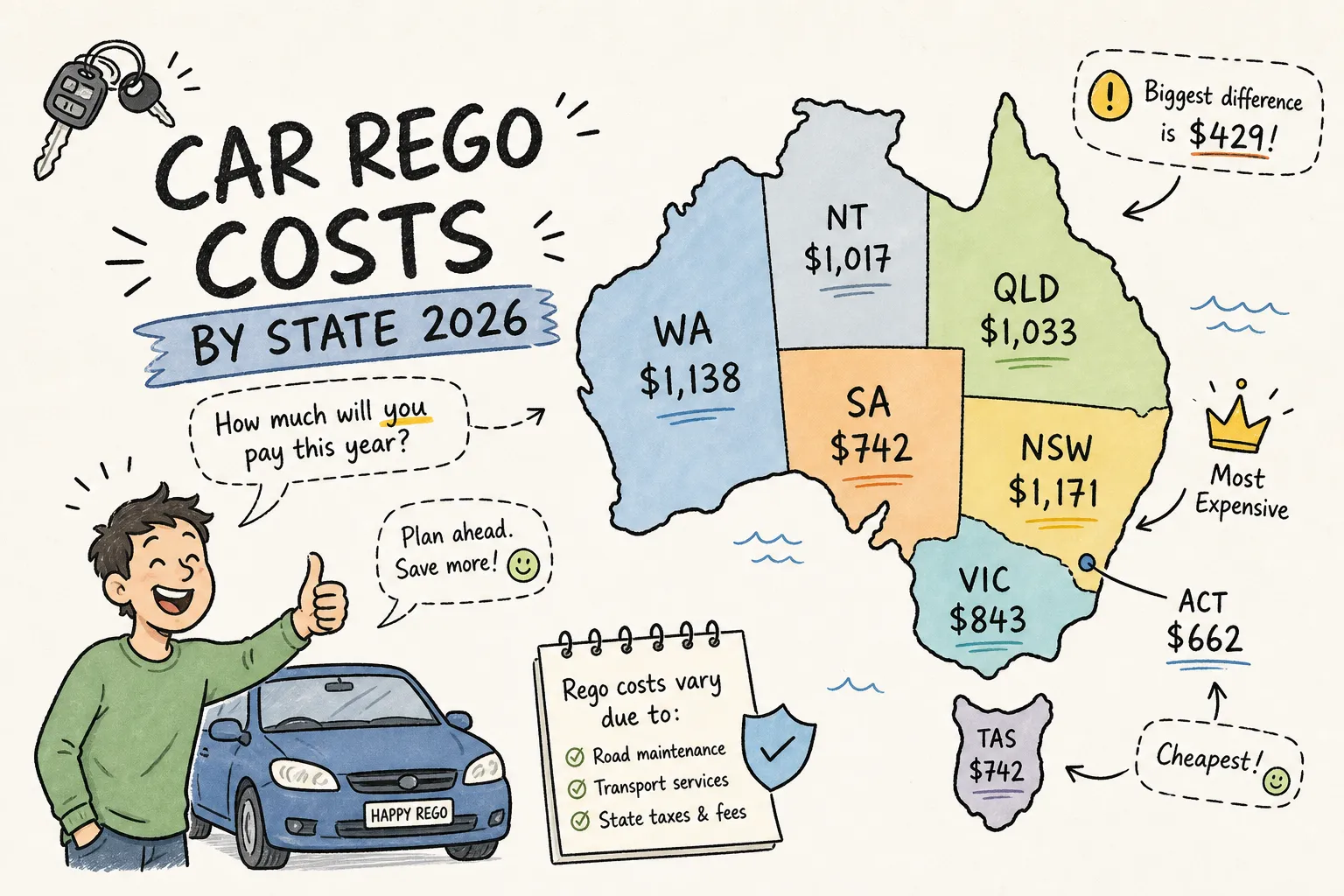
Victoria charges between $780.10 and $906.60 annually for standard passenger vehicles, varying by zone, with the TAC charge bundled in. This is a genuine all-in figure, which makes it easier to compare than NSW’s published amounts. Queensland runs from approximately $782 to $795 for electric or small-engine vehicles, up to $1,370 or more for larger cylinder classes, with CTP included in the total. Note that QLD’s CTP is technically a separate component within the renewal process, even though you pay it at the same time.
WA bases its licence fee on tare weight at $29.76 per 100 kg, with a $6.60 prescribed fee and a $9.70 admin charge added. A standard mid-size sedan sits around $493 to $510 all-in, an illustrative figure based on the WA Department of Transport’s tare-weight formula, with CTP bundled. SA charges $545 to $670 for a four-cylinder passenger vehicle depending on whether you are metro or country, and offers monthly, quarterly, and annual renewal periods. Tasmania calculates fees on a cylinder basis with the MAIB premium included, producing approximate annual totals in the $600 to $900 range.
The ACT is the most expensive jurisdiction on average, with annual costs running approximately $1,000 to $1,400 under an emissions-adjusted fee structure that includes CTP. The NT uses engine capacity as its primary variable with TPI insurance included, producing annual costs in the $700 to $1,000 range. Both territories have smaller vehicle populations than the eastern states, but their fee structures are meaningfully different and worth understanding if you live there.
CTP and your car rego cost: included or extra?
This is where most state-to-state comparisons fall apart. If you compare Victoria’s published annual rego figure directly to NSW’s published registration fee, you are not comparing the same thing. The difference comes down to whether compulsory third-party insurance is inside the number or outside it.
Victoria, WA, SA, Tasmania, the ACT, and the NT all include CTP (or its equivalent, the TAC charge, MAIB premium, or TPI insurance) inside the published renewal amount. When those states quote you a figure, that is your total. There is no separate insurance purchase required to complete renewal.
NSW and QLD work differently. In NSW, you must purchase a CTP green slip from an approved private insurer before you can renew your registration. The premium varies by insurer, vehicle type, driver profile, and region, it is not reflected in the $82 base fee, and it is not reflected in the motor vehicle tax. You need to price it separately and add it to your estimate. In QLD, CTP is collected as part of the renewal process and you can choose among approved insurers, but the premium is a distinct component from the base registration fee and traffic improvement fee. Always add CTP to your NSW or QLD estimate or any cost comparison you run is meaningless.
Why your rego costs more than your neighbour’s
Two people in the same suburb driving the same model car can pay different amounts at renewal. The attributes that shift vehicle registration fees within a state are specific and worth knowing before you assume your mate’s bill is the benchmark.
Weight and engine size are the two biggest variables. WA calculates directly from tare weight, so a heavier vehicle pays proportionally more. QLD and Tasmania use cylinder count as the primary driver: a six-cylinder pays significantly more than a four-cylinder or electric vehicle. The ACT adjusts fees based on emissions output, which means older, less fuel-efficient vehicles attract higher charges. Vehicle class also matters throughout the country: light goods vehicles, motorcycles, and heavy vehicles have separate fee schedules in most states.
Location within a state adds another layer. SA separates metro and country registration fees, with rural registration priced differently. Victoria uses a zone-based system that affects the TAC component. If you live outside a capital city or moved recently, your fee calculation may not match the standard published figures. Many states also apply reduced fees for historic or vintage vehicles used infrequently, which can represent a meaningful saving for classic car owners who only use the vehicle a few times a year.
Concessions and exemptions: what to claim before you pay
Concessions exist in most jurisdictions, yet many eligible Australians never apply for them, often because the qualifying criteria are not prominently advertised when the renewal notice lands.
The most widely available concessions across multiple jurisdictions apply to:
- Pensioner Concession Card holders (Services Australia issued)
- DVA Veteran Gold Card holders, with some states distinguishing between TPI, EDA, and general Gold Card categories
- Historic and vintage vehicle owners with limited-use registrations
The depth of the concession varies significantly. NSW is the most generous in published form: eligible pensioners receive a 100% exemption from registration fees and motor vehicle tax on one vehicle. The ACT waives the registration fee component entirely for PCC and qualifying DVA cardholders, though you still pay the MAI insurance premium.
Victoria and SA both apply a 50% reduction on the registration fee component, with Victoria extending a 100% reduction to DVA Gold Card holders issued for TPI or EDA. Queensland roughly halves the registration component for concession holders, though CTP and the traffic improvement fee remain unchanged. Tasmania offers a 100% motor tax exemption for eligible DVA TPI veterans, a 40% rebate on motor tax for non-commercial goods vehicles, and a $58 reduction on the MAIB premium.
The time to apply is before you renew, not after. Each state’s transport authority website has a concession eligibility checker or application form. Some discounts link automatically to your account if your concession card is already registered; others require a separate application each time or an initial setup. Checking once costs you nothing. Missing it costs you real money, every single year.
Getting your exact car rego cost before the bill lands
The ranges in this guide give you a solid benchmark, but your specific rego renewal cost depends on your vehicle’s exact attributes, your postcode, and your individual eligibility. Every Australian state and territory runs an online rego calculator or fee estimator through its official transport authority: Service NSW for NSW, VicRoads for Victoria, the TMR fee estimator for QLD, and equivalent tools in each other jurisdiction. These tools ask for your registration details, produce an itemised fee breakdown, and reflect any concessions already linked to your account. The whole process takes about two minutes and removes all guesswork from the renewal.
Use your state’s official rego calculator to get an exact car rego cost for your vehicle and postcode, then cross-check it against the state ranges in this guide to make sure nothing looks off before you pay.
Registration is one of several fixed annual costs that quietly erode your household budget without much scrutiny. If you want to see how your rego stacks up against other recurring expenses and make sure you are not paying over the odds on autopilot, NameTheCost.com publishes independent Australian cost guides across lifestyle categories, built for people who want an honest benchmark before they spend.
The bottom line
Car rego cost in Australia is not a single fee. It is a layered structure that varies by state, vehicle type, location, and individual eligibility. In NSW and QLD, the published registration figure does not include CTP, add it or any comparison you run is apples to oranges. In VIC, WA, SA, TAS, the ACT, and the NT, the figure you are quoted generally includes CTP and is the total you will pay.
Vehicle weight, cylinder count, emissions rating, and even your postcode can shift your registration renewal fees materially compared to someone driving an identical car in a different suburb or state. Concessions are available and often under-claimed. The fix is straightforward: run your details through your state’s official rego calculator, check your concession eligibility before you renew, and treat rego as a predictable annual line item rather than a surprise every time.
For ongoing benchmarking of what Australian living actually costs, visit NameTheCost.com, updated cost guides across lifestyle categories are published there if you need an ongoing reference point.