Average Wedding Cost in Australia 2026: Real Numbers
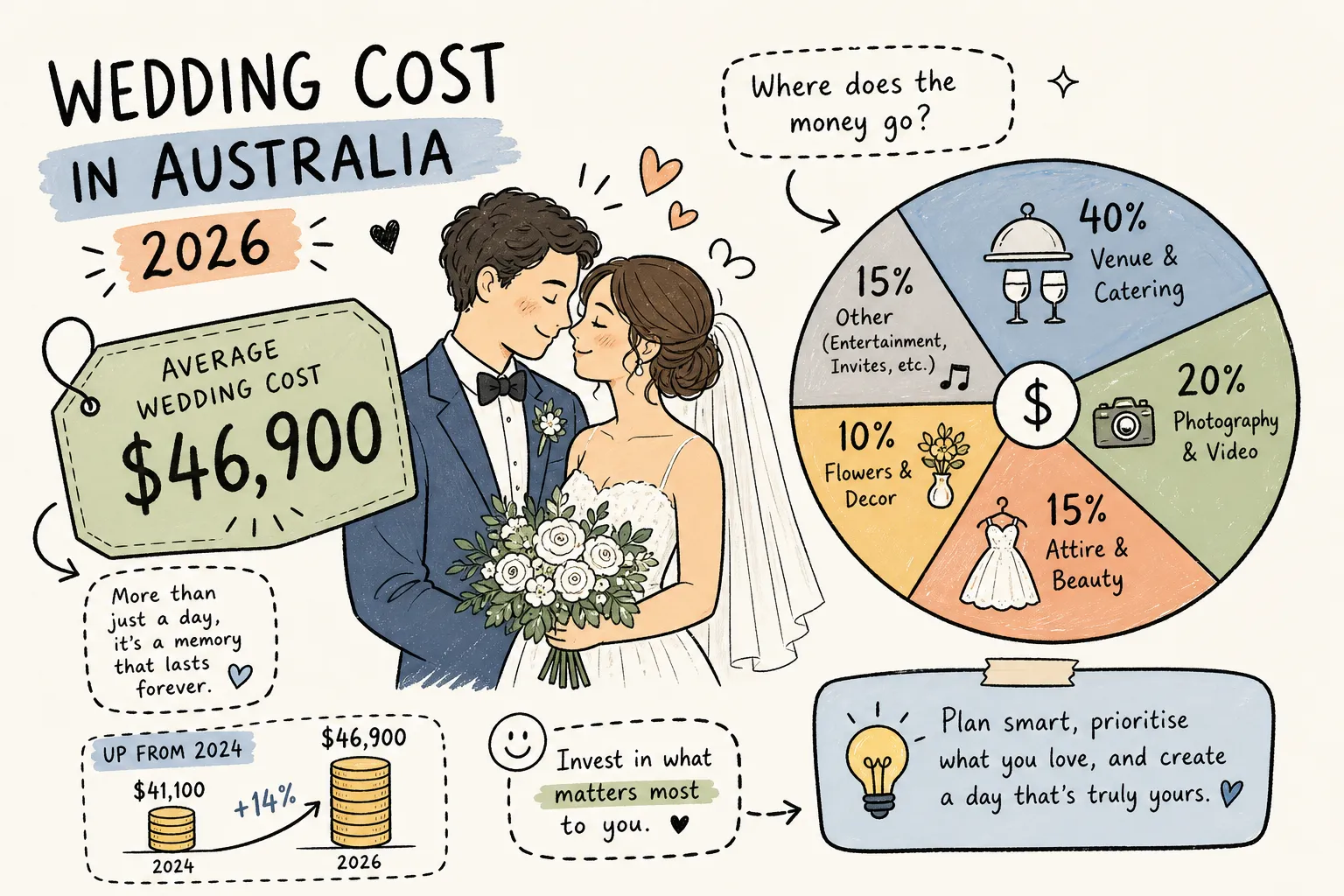
The average wedding cost in Australia in 2026 is $38,252, and it gets quoted everywhere right now. The figure comes from the Easy Weddings 2026 Australian Wedding Industry Report, picked up by the Sydney Morning Herald, Forbes Australia, and ABC News. It’s the number most couples encounter first when they start planning, and it’s commonly used as a universal benchmark, which can be misleading.
The problem is straightforward: it’s a mean average based on 85 guests. If you’re planning a 45-person celebration in regional Queensland, that benchmark doesn’t apply to you. If you’re planning 130 guests in inner Sydney, it understates what you’ll actually spend. Using it as a universal planning number is how couples end up blindsided at final invoice.
Some wedding directories that list venues and caterers also earn referral fees from those same vendors, worth keeping in mind when you’re reading their cost estimates. NameTheCost.com is an independent cost and pricing information resource with no referral commissions or vendor relationships, which means its figures aren’t shaped by commercial arrangements. Before you request a single quote, it’s worth having an independent benchmark. This article gives you the real national average, a state-by-state breakdown, a category-by-category cost audit, sample budgets by guest count, the costs most couples miss, and proven savings strategies with estimated dollar figures attached.
The $38,252 average and where it comes from
What the headline figure actually measures
The $38,252 figure is a mean, not a median. It’s calculated across weddings averaging 85 guests, which means it reflects a mid-sized sit-down reception with a full supplier lineup. Couples planning a 50-guest celebration will likely spend less. Couples planning a 120-guest sit-down in a capital city will likely spend more. The figure is useful as a national reference point, not as a personal budget.
How Australian wedding costs have shifted since 2019
Pre-pandemic figures varied across surveys, with some older guidance (such as MoneySmart’s estimates from the early 2010s) citing averages around $36,000. COVID wiped out large events entirely in 2020, cutting spend sharply as guest counts collapsed. The post-2021 rebound was driven by pent-up demand: venues filled fast, suppliers were booked out, and prices rose to reflect it. Since 2023, costs have plateaued at historically high levels, pushed up by food and labour inflation, venue consolidation reducing supply, and imported goods, including florals, décor, and dresses, repricing after supply chain disruption. The $38,252 figure reflects that plateau.
Why the figure your venue gives you may be different
Industry surveys capture completed wedding spend, including final invoices, not initial vendor estimates. Couples in NSW or VIC planning above-average events will sit well above the national figure. Those choosing a weekday celebration or a regional venue will often land well below it. The average is a starting point for research, not a quote.
Average wedding cost in Australia by state
Geography reshapes a wedding budget more than almost any other single variable. Here’s how 2026 averages break down by state and territory, according to the Easy Weddings 2026 Australian Wedding Industry Report:
| State / Territory | Average wedding cost (AUD) |
|---|---|
| NSW | $42,322 |
| VIC | $39,502 |
| WA | $35,961 |
| SA | $34,888 |
| NT | $33,750 |
| ACT | $32,915 |
| QLD | $32,645 |
| TAS | $25,423 |
NSW and VIC sit above the national average because of higher venue demand, urban labour costs, and the concentration of premium wedding suppliers in Sydney and Melbourne. Tasmania sits $16,899 below NSW, the clearest illustration of how much geography can move the number. That gap is larger than some couples’ entire wedding budgets.
Regional areas within each state add further variation. A Hunter Valley venue prices differently from a western Sydney function centre. If you have genuine flexibility on location, this comparison is a real budget lever, not just an interesting statistic.
Average wedding cost in Australia: category breakdown
The big three: venue, catering, and photography
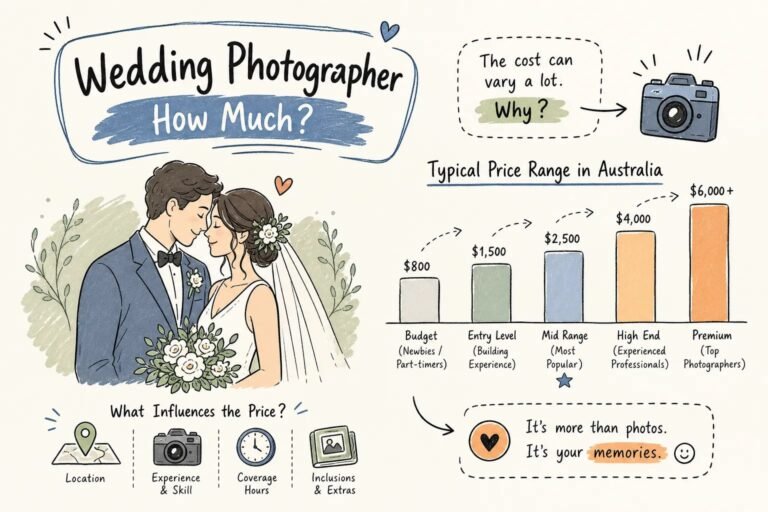
Venue and catering combined typically consume 40, 55% of total spend (Easy Weddings 2026). Using the $38,252 national average as a base, venue sits at roughly $6,150, $12,000 (18, 35% of budget) and catering at $6,840, $9,000 (20, 30%). Photography accounts for a further $3,420, $4,100 (10, 12%). Note that venue and catering are often the single biggest combined outlay, so it pays to nail those figures first before pricing out anything else.
Photography is the one category where cutting spend tends to produce the most lasting regret. Poor photos are permanent. Every other compromise is recoverable.
The mid-tier categories that add up fast
Florals typically run $2,450, $3,420 (7, 10% of budget). Attire, including the dress and suits, sits at $1,710, $3,420, and entertainment such as a DJ or live band runs a similar range. These figures are per-category estimates. Couples who personalise heavily in any one of these areas will push past the range quickly, sometimes significantly.
The smaller line items couples underestimate
Stationery sits at roughly 1, 3% of budget, or $340, $1,026. Transport runs 2, 3%. Accommodation varies from nothing to 8% depending on whether the couple covers guest travel or hotel rooms. These feel minor individually. Collectively, based on the component ranges, they can add several thousand dollars of unplanned spend if they’re not accounted for from the outset. The celebrant alone averages $875, $1,030 in 2026 and is frequently omitted from early budget estimates.
What your budget looks like by guest count
The $300, $600 per-guest rule of thumb
The most reliable pre-planning heuristic for an Australian wedding in 2026 is $300, $600 per guest once venue, catering, and supplier costs are distributed across attendees. Run that calculation before you request a single vendor quote. It gives you a realistic total to work from rather than a collection of individual line items that haven’t been stress-tested against each other.
Sample budgets for 30, 60, 100, and 200 guests
- 30 guests: $9,000, $18,000
- 60 guests: $18,000, $36,000
- 100 guests: $30,000, $60,000
- 200 guests: $60,000, $120,000
Smaller weddings don’t scale down proportionally. Fixed costs, your photographer, celebrant, and styling, don’t reduce with guest count, so the per-head figure typically rises for very small events. A 30-person wedding isn’t a cheap wedding by default. It’s a wedding with fewer guests and largely the same fixed supplier costs.
Why guest count is your most powerful budget control
Cutting ten guests from your list saves more money than almost any other single decision. At $300, $600 per head, that’s $3,000, $6,000 returned to your budget immediately. Most couples focus their negotiations on vendor line items when the guest list itself is where the real leverage is. Start there.
The costs that blindside couples
Vendor surcharges buried in the fine print
Saturday weddings commonly carry a venue surcharge of 15, 25% above weekday rates at major capital city venues. Public holiday loading applies to catering staff. Suppliers based outside your suburb charge travel fees. Receptions that run past the contracted finish time trigger overtime rates for waitstaff, bartenders, security, and sometimes your DJ or band. None of these appear in a vendor’s headline quote. Ask about each one explicitly before you sign.
Legals, admin, and insurance
Marriage registration, celebrant fees, and wedding insurance are three consistently underbudgeted line items. Wedding insurance in Australia costs roughly $200, $550 for a standard policy covering cancellation, supplier failure, attire, liability, and equipment hire. Most couples skip it. The ones who needed it invariably wish they hadn’t. As a guide, budgeting $1,500, $3,000 for the full administrative category, registration fees, celebrant costs, and insurance combined, is a reasonable buffer to build in from the start.
Day-of creep
Gratuities, emergency alterations, last-minute florals, corkage fees if you’re bringing your own alcohol, and décor hire extensions all appear on the final invoice without featuring on the original quote. Cake-cutting charges are worth flagging separately: they commonly run $2, $6 per guest and can catch couples off guard mid-list. Set a contingency of 10, 15% of your total budget specifically for this category. Call it the honest buffer. Every couple who skips it wishes they hadn’t.
Ten ways to cut $5,000 or more from your total
Change the day or season
A Friday wedding saves $2,000, $4,000 on venue hire compared to Saturday in most capital cities, based on typical discounts of 10, 20% for Friday bookings. Shifting to June, July, or August in most states produces similar savings on venue pricing without sacrificing quality. Neither compromise requires you to give up a venue you love. Ask your shortlisted venues for their weekday or off-peak pricing before you assume Saturday is the only option.
Tighten the guest list and reassess your catering format
Cutting 20 guests at $300, $600 per head saves $6,000, $12,000. That’s before you touch a single vendor quote. A cocktail-style reception instead of a sit-down meal reduces per-head catering costs meaningfully without reducing the quality of the experience for guests. Both decisions compound across every subsequent supplier quote you receive, because many costs scale with guest count.
Bundle vendors and negotiate package rates
Photographers who also shoot video, caterers who include staffing in their quote, venues that offer in-house styling: bundled packages reduce coordination overhead and often include pricing incentives that aren’t advertised. Ask directly, the worst outcome is a polite no, and the best outcome saves you hundreds or potentially thousands without changing your supplier lineup at all.
Know where not to cut
Photography and your celebrant are not the right categories for a budget swap. Substandard photography is the one regret you can’t undo after the day. A poorly run ceremony is something guests remember. Florals, stationery, and transport are where couples who want to reduce spend will find the most room without lasting consequence. Cut the fixable things. Don’t cut the permanent ones.
Average wedding cost Australia, what the numbers mean for your planning
The national average wedding cost in Australia is $38,252. The spread between NSW and Tasmania is $16,899. The per-guest rule runs $300, $600. Those three numbers give you a genuine planning framework before you speak to a single vendor.
The biggest planning mistake couples make is budgeting from vendor estimates rather than from an independent cost baseline. Vendor estimates are starting positions in a negotiation. An independent benchmark is what tells you whether the quote in front of you is reasonable. NameTheCost.com publishes cost guides across major Australian expenses as an independent resource, with no referral commissions shaping the figures. Check it before you sign anything.
Before you book the venue, audit your guest list. Not your florist. Not your caterer. Your guest list. That single decision does more work for your budget than every other saving strategy in this article combined.