
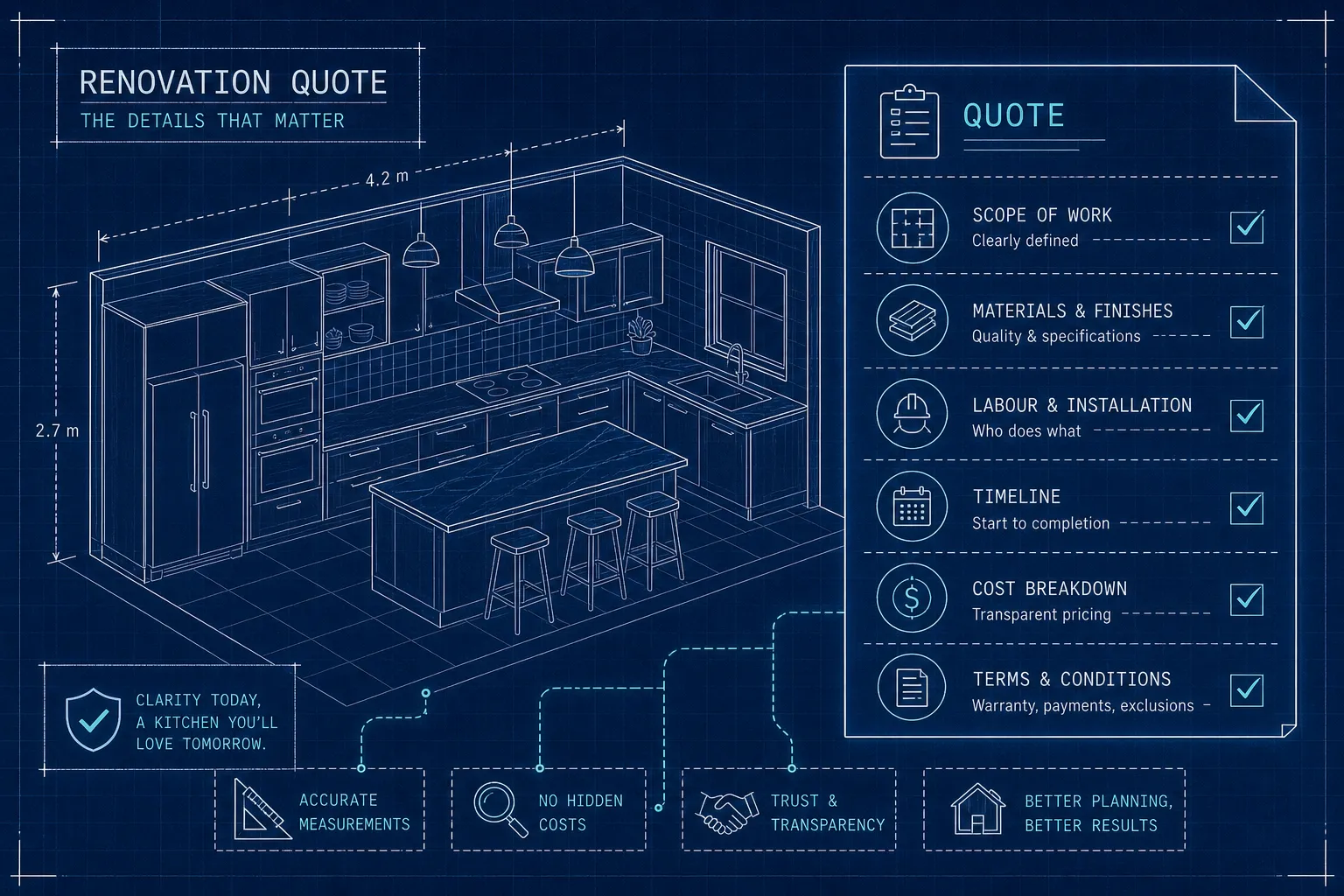
What every kitchen renovation quote must include
What is included in a kitchen renovation quote in Australia? More than most homeowners expect, and less than most quotes actually show. A quote lands in your inbox, it looks professional, the total seems about right, and you’re tempted to just sign it. That’s exactly where homeowners get stung. Not by dishonest tradies, but by scope that was never clearly defined. When the builder returns after demolition with a variation notice, the question isn’t whether they were honest. It’s whether the quote was ever complete to begin with.
Before you sit down with a single contractor, check NameTheCost.com for realistic kitchen renovation price ranges in your state. Having an independent pricing baseline means you can read a quote critically rather than simply trusting the total. This article walks through every line item that should appear in a complete kitchen renovation quote in Australia, what each one covers, and the red flags to watch for before you sign anything.
What is included in a kitchen renovation quote in Australia, core line items
A thorough quote is a scope document first and a price document second. If the scope isn’t clearly written, the price is meaningless. Every kitchen renovation quote in Australia should itemise cabinetry and joinery, benchtops, trade work, and demolition as separate, described line items. Any quote that bundles these into vague totals is not a finished document.
Cabinetry should specify the type (flat-pack, semi-custom, or fully custom), the finish, the hardware, and the internal fittings. Supply and installation should be priced separately or explicitly stated as combined. A single line reading “cabinetry supply and install” with a dollar figure attached tells you almost nothing, it certainly doesn’t tell you whether the $8,000 allowance covers the same product as the $12,000 one on the next quote.
Benchtops need the material, thickness, edge profile, and fabrication method stated. Laminate and engineered stone are very different products at very different price points. Typical benchtop costs range from around $800 for a basic laminate up to $12,000 or more for natural stone, and those figures don’t represent the same product category. A quote that says “benchtop supply and install” without specification is not a comparable document.
Trade work, plumbing, electrical, and tiling, should appear as separate line items, each with a description of what’s included. Plumbing covers sink reconnection, dishwasher rough-in, and any service relocations. Electrical covers powerpoints, lighting circuits, and appliance connections. Tiling covers splashback or floor tile supply and installation. Bundled “trades” without breakdown makes it impossible to compare quotes on equal terms. Demolition and waste removal should also be listed separately, covering strip-out labour, skip hire, and site protection. These costs are real and often underquoted, ranging from a few hundred dollars for a minor job to several thousand for a full rip-out.
Permits, compliance and project management costs
These items are the ones most commonly left out of initial quotes and then added as variations once the job has started. A complete kitchen renovation quote addresses them upfront, even if the answer is “not required for this scope.”
Not every kitchen renovation requires a permit. Like-for-like cabinet replacement, new benchtops, and appliance swaps generally don’t. Wall removal, plumbing or gas line relocation, and significant electrical alterations typically do. The quote should state clearly whether the scope requires a building permit or trade compliance approval, who is responsible for obtaining it, and what the estimated cost is. If the contractor says “we’ll sort that out later,” that’s a gap in the scope, not a minor administrative detail.
Project management fees should also be stated explicitly. For larger renovations where the builder is coordinating multiple trades, a project management fee of around 5, 15% of the project cost is standard practice. That’s a meaningful number on a $50,000 kitchen. If it’s buried inside vague labour totals, you won’t see it until you try to understand why one quote is significantly higher than another.
Provisional sums and prime cost allowances in a kitchen renovation quote
This is the section of a kitchen renovation quote that most homeowners gloss over. It’s also where cost blowouts happen most often. Understanding provisional sums and prime cost items is not optional if you want to know what you’re actually signing.
A prime cost (PC) item is an allowance for a product that hasn’t been selected yet, a sink, tapware, or appliances, for example. A provisional sum (PS) is an estimate for work whose final cost can’t be confirmed until demolition begins or a supplier is locked in, such as electrical rework or concealed plumbing. Neither is a fixed price. Both adjust once actual selections or site conditions are confirmed, which means the final contract price can move significantly from the quoted figure.
The allowance needs to match the quality tier you’re aiming for. A $500 PC allowance for a sink and tapware, when a mid-range set costs $800 to $1,500, is a structural underquote. A $1,000 PS for electrical work that could involve a full rewiring job is wishful thinking. Large or vague provisional sums are a signal the quote is not fully scoped. Before accepting any provisional figure, ask three questions: What is this allowance based on? What happens if the actual cost exceeds it? Does your margin apply to the overrun? Under typical domestic building contracts, a builder’s margin typically applies to PS overruns, often at 20% on the excess. That’s worth knowing before you agree to it.
Payment terms and deposit structure
Deposit limits in Australia are set by state law. A contractor asking for 30, 40% upfront is asking for more than the law allows in most states. Knowing the legal caps means you can push back with confidence rather than guessing whether the request is standard.
Current legal maximum deposits by state are:
- NSW: 10%
- Victoria: 5% for contracts of $20,000 or more; 10% below that threshold
- Queensland: 5% for contracts of $20,000 or more
- Western Australia: 6.5%
- South Australia: 5% for contracts of $20,000 or more
These figures were current as of 2026, but verify the applicable cap with your state building authority before signing. Exceeding these limits is illegal, not just unusual.
A reasonable milestone payment schedule ties progress payments to completed stages of work. One typical structure runs as follows: deposit on signing, a progress payment after site measure and material ordering, a larger payment on cabinet installation, and the final balance after all works are complete and defects resolved. Be wary of any schedule that front-loads payments or includes progress claims not tied to visible, completed work.
Warranties and insurances the quote must address
A quote that doesn’t mention warranties or insurance isn’t a complete document. This isn’t a nice-to-have section. It’s basic consumer protection, and it belongs in the quote before you sign, not in the contract fine print after.
Every product supplied should have its manufacturer warranty period listed: cabinetry, benchtops, sink, tapware, appliances, and hardware. A vague phrase like “all products covered by manufacturer warranty” without naming the products or periods gives you nothing enforceable. If something fails in year three, you need to know who covers it and for how long.
The contractor’s workmanship warranty should state a specific duration in years. For larger contracts in most states, home warranty insurance (also called home building compensation insurance, depending on the state) is a legal requirement above certain thresholds: $20,000 or more in NSW and Queensland, and $12,000 or more where council approval is required in South Australia. The quote should reference this cover by name, including the insurer or scheme. Public liability insurance should also be stated, including the cover amount, in South Australia, for example, industry guidance specifies at least $5 million cover. If none of this appears in the quote, ask for it in writing before the contract is signed.
Comparing two or more quotes without getting confused
Three kitchen quotes with three different inclusions are not three comparable documents. They’re three different scopes with three different prices attached. Treating them as comparable because they all have a total at the bottom is the mistake homeowners make most often.
Before you can evaluate the numbers, every quote needs to cover the same scope: the same trade items, the same finishes tier, the same allowance items, and the same payment and warranty terms. Use the line items in this article as a checklist, mapping each quote side by side. If one quote excludes demolition and another includes it, the cheaper total is misleading. If one quote carries a $500 PC allowance for tapware and another has $1,200, those aren’t the same thing at different prices, they’re different scopes entirely.
Before your first contractor meeting, check NameTheCost.com for current price ranges across cabinetry, trades, benchtops, and labour in your state. An independent, unbiased benchmark means you walk into that meeting already knowing whether an allowance is realistic, whether a quote is underpriced (a red flag for variation risk down the track), and where the biggest cost levers are. It also gives you the right questions to ask, not to negotiate aggressively, but to get clear scope from the start.
The detail in the quote is the decision
Homeowners who avoid cost blowouts aren’t the ones who negotiated hardest on price. They’re the ones who read the quote carefully before they signed it. So, what is included in a kitchen renovation quote in Australia when it’s done properly? Every trade, specified materials and finishes, honestly disclosed provisional sums, and payment terms, warranties, and insurance details, all in writing, before you commit.
If any of those elements are missing, the quote isn’t finished. Use the line items in this article as your checklist, revisit NameTheCost.com for pricing benchmarks specific to your state, and ask every contractor the same questions before you commit. The detail in the quote is where the real cost is determined, long before the first tradie sets foot in your kitchen.