Body Corporate Fees in Australia: What Do You Actually Pay?
Body corporate fees catch a lot of buyers off guard. Not because they’re hidden, but because most people treat them as a footnote rather than a real cost of ownership. They are not optional, nor are they fixed, and they vary more than most people expect, from a few thousand dollars a year for a modest walk-up block to well over $20,000 for a premium high-rise.
By the end of this article, you’ll know what strata fees actually pay for, what fair looks like by state and building type, how your individual levy is calculated, and what warning signs to look for before you sign anything. If you’re trying to build an honest picture of what a property will cost to own over the years you hold it, NameTheCost.com is an independent Australian resource that presents its own analysis of exactly those kinds of ongoing costs, with no advertising revenue or referral commissions in the mix.
What body corporate fees actually pay for
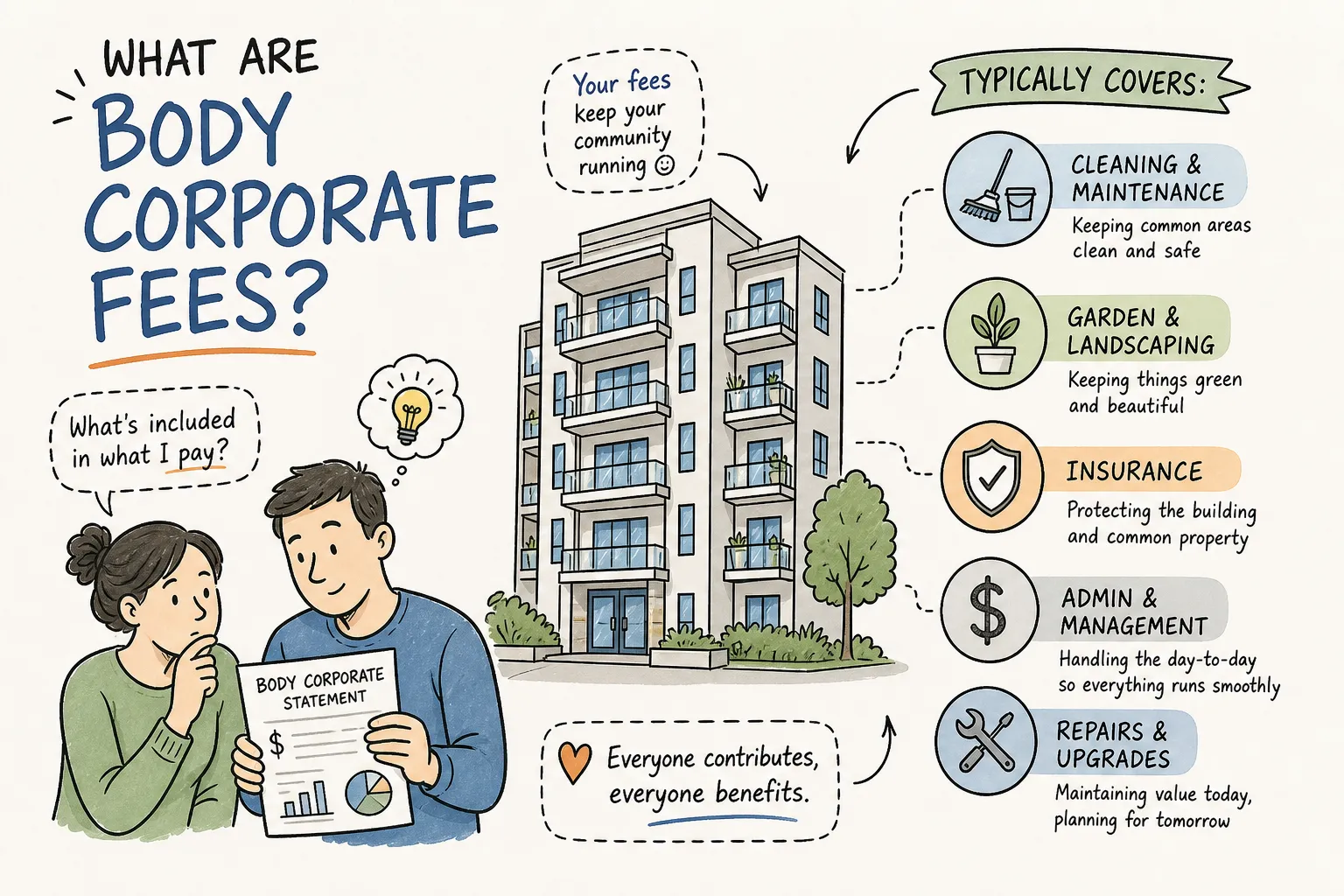
Body corporate fees aren’t one undivided sum. They fund two separate pools of money with different jobs, and understanding the difference changes how you assess the financial health of any strata scheme.
The admin fund: day-to-day running costs
The administrative fund covers everything that keeps the building running from month to month. Building insurance is typically the largest single line item, followed by shared utilities, cleaning and gardening, minor repairs, compliance costs, and strata management fees. As a commonly cited industry benchmark, cleaning and gardening accounts for around 10, 15% of the total budget, while strata management fees alone typically represent 15, 25% of total annual expenditure. This fund is essentially the building’s operating account.
The sinking fund: preparing for the big-ticket work
The capital works fund, also called the sinking fund, is the long-term reserve. It covers roof replacement, lift refurbishment, exterior painting, structural repairs, and major asset replacements when they reach end of life. There is no universal mandated split between the two funds across Australian states. Each scheme sets its own budget based on building age, condition, and a capital works forecast. A healthy sinking fund balance is one of the clearest signs of a well-managed scheme.
What you’ll realistically pay by state in 2026
The honest answer is that strata fees vary enormously depending on where the property is and what the building offers. There is no single national average that means much, but the market ranges below give you a genuine working benchmark. Treat these as informed market bands rather than official figures, no state publishes a clean average for every building type.
Queensland and the Gold Coast: the clearest data available
Queensland has the most consistently published ranges. Low-rise walk-up buildings in Brisbane and surrounds typically run $2,000, $4,000 per year. Mid-rise apartments come in at $4,500, $7,000, and high-rise towers range from $7,000, $12,000 and above, with prestige riverfront buildings sometimes reaching $15,000, $20,000. The Gold Coast sits noticeably higher: mid-rise schemes average $7,000, $12,000 per year, while resort-style high-rise towers can exceed $25,000 at scheme level.
New South Wales and Victoria: wider ranges, familiar patterns
NSW apartment owners generally pay $4,800, $10,000 per year in total levies, though it’s worth noting that strata management fees alone are $250, $550 per lot annually, just one component of that total. In Victoria, owners corporation fees are comparable: a standard apartment typically lands between $4,400, $9,600 per year, with Melbourne mid-rise complexes ranging $7,200, $20,000 depending on facilities. South Australia sits lower, with management fees alone at $180, $420 per lot, making it among the more affordable states for strata costs overall.
How your levy is calculated
Levies aren’t arbitrary. They follow a formula based on your lot’s share of the scheme, and once you understand it, the numbers make sense.
Lot entitlement: what it is and why it matters
When a strata scheme is first registered, each lot is assigned a unit entitlement value. This reflects the relative size or value of your lot compared to others in the building. A penthouse carries a higher entitlement than a ground-floor studio. Your levy is your lot’s entitlement as a proportion of the scheme’s total entitlement, multiplied by the approved annual budget. It’s a proportional cost-sharing system, not a flat fee.
A worked example: 1-bed, 2-bed, and penthouse
Take a realistic 50-lot scheme with a $100,000 annual budget and 400 total entitlement points. A 1-bed unit with an entitlement of 8 pays $2,000 per year, or $500 per quarter. A 2-bed with an entitlement of 10 pays $2,500 per year, or $625 per quarter. A penthouse with an entitlement of 20 pays $5,000 per year, or $1,250 per quarter. Two apartments in the same building, paying very different levies. This is why entitlement schedules matter when comparing properties, not just the levy figure quoted in a listing.
How to spot a poorly managed scheme before you buy
The levy figure in a listing tells you almost nothing on its own. The strata report tells you what matters.
What to request before you exchange contracts
Before signing anything, request the strata inspection report, the last two years of meeting minutes, the current budget, and the sinking fund balance and capital works forecast. Disclosure obligations vary by state, in Queensland, New South Wales, and Victoria, for example, vendors are generally required to provide key strata documents, but you should confirm the specific requirements in the state where the property is located. A scheme with a sinking fund balance that falls well below the capital works forecast is a scheme that is likely to issue a special levy within the next few years. That cost lands on whoever owns the lot at the time, which may well be you.
Warning signs that should change your offer or your mind
Watch for these patterns in the financials:
- A sinking fund balance that is significantly below the building’s age-appropriate benchmark (a commonly used rule of thumb: $5,000, $10,000 per lot for buildings aged 10 to 20 years, $12,000+ per lot for buildings over 30 years old)
- A pattern of deferred maintenance visible in the meeting minutes
- A history of special levies for costs that should have been covered by the sinking fund
- High levy arrears among owners, which signals both financial stress and management weakness
A scheme where most of the budget flows to insurance and management, with very little building up in capital reserves, is living on borrowed time. The repair bill will come. The question is whether it lands on the current owner or the next one.
The legal reality of unpaid body corporate fees
Missing a levy payment isn’t just a financial inconvenience. It triggers a formal recovery process that escalates quickly and costs considerably more than the original debt.
How the recovery process works across Australia
In Victoria, the process is structured under the Owners Corporations Act 2006. It starts with a Fee Notice, followed by a Final Fee Notice if payment isn’t made within 28 days, and then an application to VCAT or the Magistrates’ Court. In Queensland, unpaid contributions are recoverable as a debt. If arrears run for two years, the body corporate is legally required to begin recovery proceedings within two months, and reasonable recovery costs including legal fees are claimable. Across all states, the standard path is: notice, demand, legal action, court judgment, and enforcement. Interest accrues throughout the process.
What it means if you inherit arrears at settlement
Unpaid levies on a lot can follow the property through settlement in some circumstances. Before exchanging contracts, confirm the levy account is clear. If arrears exist, negotiate for them to be paid by the vendor before settlement or adjust the purchase price accordingly. A strata inspection report and a conveyancer who knows what to look for will save you considerably more than their combined fee. This is not an area to skip due diligence.
Budgeting for ongoing levies: before and after settlement
Body corporate levies are mandatory and ongoing, variable in amount and subject to change under the scheme’s annual budget process, but never optional. They belong in your financial planning from day one, not as an afterthought once you’ve already committed to a purchase.
How to factor levies into your purchase decision
Treat annual levies the same way you treat council rates and building insurance: as a recurring cost that affects your true holding cost and rental yield. A low purchase price paired with a $12,000 annual levy in a poorly managed scheme is often a worse financial outcome than paying more for a property with $4,000 in annual levies and a healthy sinking fund. If you’re buying as an investor, regular administrative fund levies are generally tax deductible in the 2025, 26 financial year; special levies for capital improvements are typically treated as capital works and are not immediately deductible, confirm the specific treatment with a qualified accountant or refer to current ATO guidance. Run the full numbers before you commit.
Where NameTheCost.com fits into your research
Most buyers spend hours comparing purchase prices and mortgage rates but give almost no time to the ongoing ownership costs that compound over years of holding a property. NameTheCost.com is an independent Australian resource covering the real costs of property ownership, fees, maintenance, and professional services, without advertiser influence or referral bias. It’s a practical reference point for benchmarking what you should expect to pay before you talk to any agent or strata manager.
The bottom line on body corporate fees
Strata levies are not a footnote in a purchase decision. They are a significant and ongoing part of the cost of owning a property in a body corporate scheme. The range is wide: a few thousand dollars a year for a modest low-rise block, well over $15,000 for a premium high-rise. What matters is understanding what you’re paying for, whether the scheme is financially sound, and how the levies are likely to move over the years you hold the property.
Read the strata report. Check the sinking fund. Understand the entitlement schedule. When comparing listings, make body corporate fees a first-order item in your calculations, and if you want an independent benchmark for what the ongoing costs of property ownership should actually look like, that’s exactly what NameTheCost.com is built for.