Financial Advisor Costs for Retirement Planning in Australia
If you are looking for a financial advisor for retirement planning in Australia (also referred to as a financial adviser under local convention), you have probably discovered that fair pricing is remarkably hard to pin down. That information gap is expensive. It leads people to either pay too much for advice that does not match their situation, or avoid seeking professional retirement planning help altogether because they assume it is out of reach. This article is a cost guide. By the end, you will know the real numbers, the credentials to verify, and the exact questions to ask before you commit to anything.
The research behind this piece comes from published regulatory guidance, industry fee surveys, and the independent pricing analysis that NameTheCost.com produces for Australians navigating professional service costs. No referral commissions. No adviser partnerships. Just the numbers.
How much does a financial advisor for retirement cost in Australia?
The most common fee structure for a retirement plan is a fixed project fee, and the benchmark range in 2026 is $3,300 to $6,600 for a standard Statement of Advice. A comprehensive engagement covering superannuation, income streams, tax, and estate planning considerations can reach $12,000. These figures reflect the real scope of work involved in producing a personalised, compliant retirement strategy. Implementation fees on top of the SOA typically add another $1,100 to $5,500, depending on how many accounts or products are involved. A reasonable all-in estimate for a thorough plan with implementation is $6,000 to $8,000.
Hourly rates are the third model, used mainly for limited-scope or single-issue advice. Expect $200 to $550 per hour depending on the adviser’s experience and firm type. If you only have one question to answer, such as whether to consolidate two super accounts, a single-issue engagement can be resolved for $1,500 to $2,500 total. That is significantly cheaper than commissioning a full retirement strategy, and for a straightforward situation, it is usually sufficient.
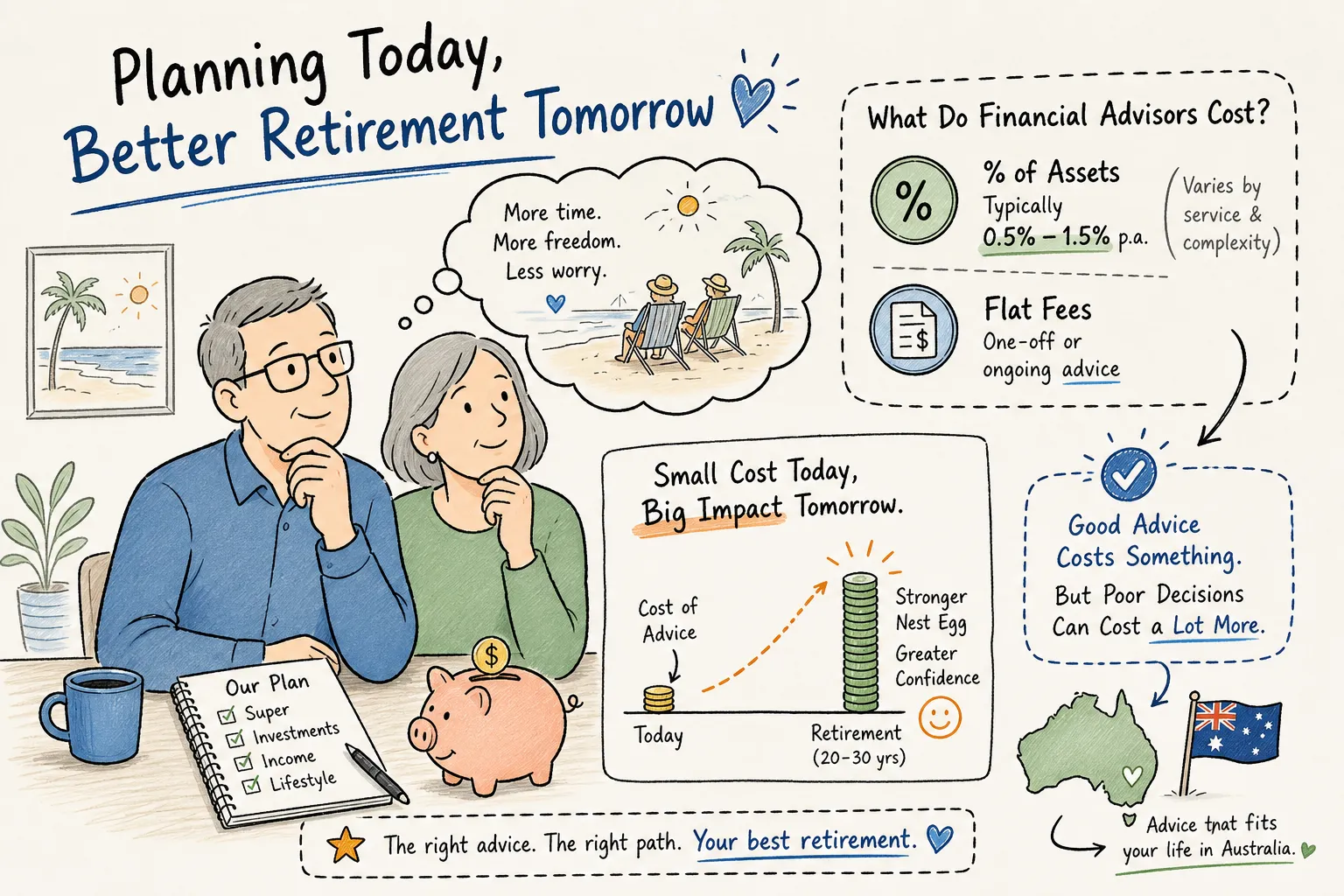
Asset-based fees, where the adviser charges 0.5% to 1.5% per annum of your investable assets, apply mainly to ongoing portfolio management arrangements. For most people approaching retirement with a defined super balance, a fixed-fee model is more predictable and usually cheaper. The exception is someone with a complex, actively managed portfolio who wants continuous oversight; in that case, an asset-based retainer can make sense. Know which model applies before you walk into the room.
What drives the price up
Scope is the single biggest cost driver. An adviser who covers superannuation strategy, transition planning, account-based pension setup, tax implications, and basic estate planning considerations will charge significantly more than one who addresses a single topic. The complexity of your financial position matters too: multiple super funds, a defined benefit scheme, investment properties, and business interests all add time.
Whether the fee includes implementation or whether implementation is quoted separately is also critical to understand upfront. Large institutional advisory firms tend to charge more than independent boutique practices, though neither automatically delivers better advice. A fee-for-service financial advice model, where you pay a fixed or hourly rate rather than an asset-based percentage, is worth asking about specifically, as it removes potential conflicts of interest tied to portfolio size.
What a statement of advice covers and why it matters
A Statement of Advice is not a brochure or a generic template. It is a formal legal document that an adviser must give you before implementing any personal advice. The SOA must outline the strategies recommended, the basis for each recommendation, any conflicts of interest the adviser holds, how the adviser is remunerated, and the risks involved. A well-prepared retirement SOA covers your superannuation strategy, projected income in retirement, tax treatment of pension payments, and a timeline for moving through each phase of retirement. If it does not address your specific circumstances in detail, it is not fit for purpose.
The choice between a one-off SOA and an ongoing retainer matters more than most people realise. A one-off plan suits someone with a straightforward financial position who is close to retirement and needs a clear roadmap rather than hand-holding. An ongoing retainer, typically priced at $3,000 to $6,000 per year, includes annual reviews, updates when legislation changes, and ongoing access to the adviser throughout the year. It is the right model for someone with a more complex super structure, significant assets in accumulation, or a longer runway to retirement who wants regular accountability. Do not pay for ongoing advice if your situation does not require it.
Credentials and licences to verify before you commit
Every licensed financial adviser in Australia who provides personal advice to retail clients must appear on the ASIC Financial Advisers Register as a relevant provider. This is a non-negotiable starting point. Search by name, adviser number, or ABN at moneysmart.gov.au, confirm the status is current and active, and check which AFSL holder authorises their advice. Advisers do not hold an AFSL directly in most cases; they operate under a licence held by their firm or licensee. If someone cannot be found on the register, do not proceed.
As of 2026, the professional standards for financial advisers in Australia require an approved bachelor’s degree or equivalent, passing the ASIC financial adviser exam, completion of a supervised professional year for newer entrants, and 40 hours of continuing professional development each year. Advisers must also comply with the Financial Planners and Advisers Code of Ethics. There is an additional requirement for tax-related advice: from 1 January 2026, advisers providing tax financial advice to retail clients for a fee must be a qualified tax relevant provider. If tax strategy is part of what you need, ask specifically whether the adviser meets this standard. It is a direct question with a direct answer.
If something goes wrong with advice you receive, the complaint pathway runs through AFCA, the Australian Financial Complaints Authority. Complain to the adviser or their firm first. If unresolved, escalate to AFCA. ASIC can also be notified if you believe the adviser has breached their obligations, though ASIC does not resolve individual disputes. For serious losses, private legal action remains an option. Knowing this pathway in advance is part of being an informed consumer.
Superannuation advice: what a financial advisor for retirement actually covers
A transition to retirement income stream, commonly called TTR, allows someone who has reached their preservation age to access part of their super as a regular income stream while still working. Advisers most commonly recommend TTR as an income top-up strategy: reduce your working hours, replace some of the lost take-home pay with TTR pension payments, and continue building super through salary sacrifice contributions into accumulation. The tax treatment is a key part of the appeal, because payments from a TTR pension are tax-free from age 60.
The rule most people do not know before their first meeting: a TTR income stream requires regular annual payments between 4% and 10% of the account balance. Lump-sum withdrawals are not available under TTR until a further condition of release is met, such as retiring or reaching age 65. TTR is a structured income flow strategy, not a way to access a cash lump sum. Advisers who present it as the latter are misrepresenting the product. If a lump sum is what you need, the conversation is about whether you have met a full condition of release, not about TTR.
Account-based pensions apply once you have fully retired or otherwise satisfied a release condition. Payments are tax-free from age 60, minimum annual drawdown rules apply (increasing with age), and there is no upper limit on withdrawals or restriction on lump sums. Your adviser should map out the sequencing between TTR and an account-based pension as part of your SOA, including when the transition occurs and what changes at each stage. Sound superannuation advice at this juncture is where a good independent financial adviser earns their fee.
Questions to ask and what to bring to the first meeting
The questions you ask in the first meeting tell an adviser how informed you are. They also tell you whether the adviser is worth the fee. Start with the basics: how are you paid, and do you receive any commissions or product-linked remuneration? Are you aligned with a particular product provider or fund? What does your typical retirement client look like in terms of assets and complexity? These questions are not aggressive; they are the minimum due diligence any informed consumer should perform.
The fee questions need to be specific. Ask what the Statement of Advice will include and what implementation will cost on top of the plan fee. Ask how ongoing fees are structured and what triggers an additional charge. Ask whether the adviser appears on the ASIC Financial Advisers Register and who holds the AFSL that covers their advice. If the adviser cannot answer these questions directly and comfortably, that is useful information.
Come prepared with the following documents to make the discovery phase faster and, in some cases, cheaper:
- Recent statements from all superannuation funds
- A summary of your current income and regular expenses
- Details of any insurance policies, particularly those held inside super
- A list of any outstanding debts
- Your expected or target retirement age
- Existing estate planning documents, including your will and any enduring power of attorney
Arriving prepared shortens the time an adviser needs to understand your position, which directly reduces the scope of initial work and can lower the total cost for fixed-fee or hourly engagements.
Choosing a financial advisor for retirement: assessing value before you sign
Knowing what a retirement-focused financial adviser should charge is the baseline for negotiating fairly and avoiding advice that does not match your situation. The difference between a $3,500 one-off plan and a $12,000 comprehensive engagement is not always obvious from a first conversation, but it becomes clear when you understand what each should include: scope of advice covered, whether implementation is bundled, how many strategies are modelled, and what ongoing access, if any, is provided.
Before you commit to any engagement, check the quote against an independent benchmark. NameTheCost.com publishes straightforward Australian pricing guides for professional services, including financial advice, legal fees, and conveyancing costs; all published with no advertiser bias and no referral arrangements. If the number you have been quoted sits well outside the ranges in this article, ask why.
You now have the numbers, the credential checklist, and the questions. Use them before you sign anything.