EV Charger Installation Cost in Australia: What to Budget in 2026
Buying an electric vehicle is the straightforward part. You choose a car, negotiate a price, and drive it home. The home charging setup is where things get murky fast, and so does the EV charger installation cost. Installers quote wildly different figures. Manufacturers publish best-case numbers. And some guides online bury the real costs in footnotes or asterisks.
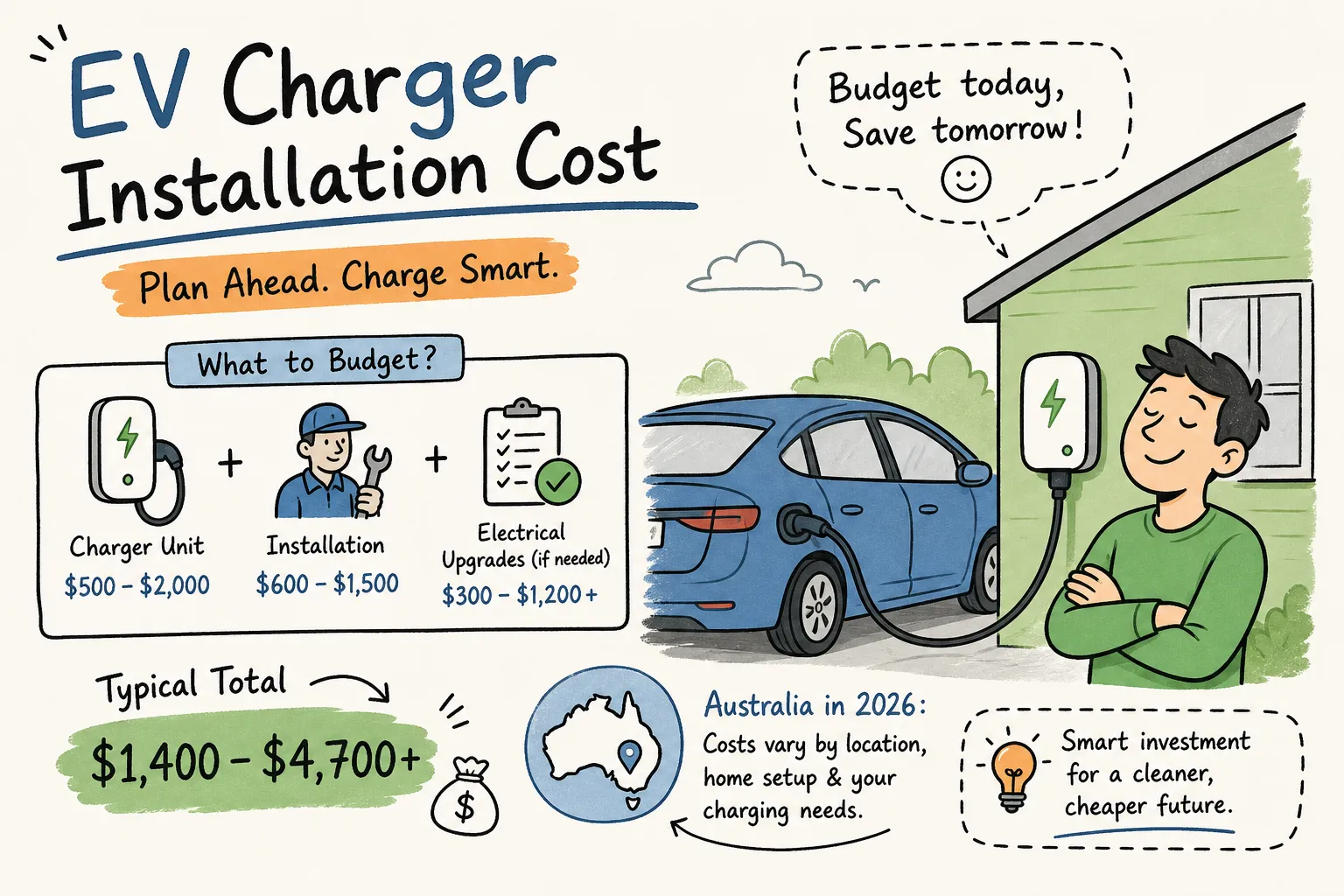
This guide gives you actual numbers. NameTheCost.com publishes independent Australian pricing benchmarks with no installer referral commissions and no sponsored content, that’s the site’s stated methodology, so the figures here reflect what Australians are actually paying in 2026, not what charger manufacturers want you to think you’ll pay. Here’s the headline: most standard home EV charger installations in Australia land between $1,200 and $3,300 all-in, with a national average of around $2,255 including GST as of April 2026. Below you’ll find a breakdown of charger types, cost drivers, city-level pricing, available rebates, and how to read a quote properly.
EV charger installation cost in 2026: what the total installed price looks like
The national average for a complete home EV charger installation sits at approximately $2,255 including GST as of April 2026. Sydney runs slightly higher at $2,309 for a comparable job. A standard install assumes a single-phase charger, a dedicated circuit with a cable run of up to around 20 metres, the necessary protection devices, and a few hours of licensed electrician time. That’s the baseline. A lot of homes fall outside it.
The $1,200 end of the range is realistic only if your switchboard is modern, in reasonable condition, positioned close to the garage, and has spare circuit capacity. The $3,300-plus end appears when any of those conditions aren’t met. Complex installations include older homes with ageing switchboards, long cable runs to a detached garage, or properties needing a service upgrade before a charger can safely be connected. Once major electrical work enters the picture, the number can move well above $3,300. Getting a realistic installed price means knowing which category your home falls into before you call anyone.
Level 1 vs Level 2 chargers: the cost difference that matters
A Level 1 charger uses a standard 10-amp household outlet and adds roughly 10 to 15 kilometres of range per hour. There’s almost no installation cost because it plugs straight in. The practical problem is speed: at around 2.3 kW output, a 60 kWh battery typically takes 25 to 30 hours to charge this way, depending on your vehicle’s onboard charger efficiency. Most EV owners find this arrangement unworkable within a few weeks of daily use.
A Level 2 charger, also called a wallbox or EVSE, runs on a dedicated 240V circuit and delivers between 7 and 22 kW depending on the unit and whether you have single or three-phase power. That translates to a full charge overnight, which is how most EV owners actually expect to live with the car. The home EV charger installation cost breaks into two parts: hardware and labour. The hardware alone for a basic Level 2 wallbox typically costs $600 to $1,500 before installation. Smart chargers with app connectivity and load management sit toward the higher end; three-phase units capable of 11 to 22 kW add more again. When comparing quotes, confirm whether the charger unit is bundled into the price or listed separately. Not all installers include it, and that discrepancy can make two quotes look very different when the scope is actually similar.
EV charger installation cost: what drives the price up
A switchboard upgrade is the single biggest wildcard in any EV charger installation quote. If your current board is older, lacks spare capacity, or doesn’t meet current RCD and RCBO protection requirements, an electrician won’t safely add a high-draw dedicated circuit without upgrading it first. That work typically costs $1,800 to $4,500 on its own, on top of the base installation price. For jobs involving three-phase conversion, or where the household’s combined load requires a broader service upgrade, costs can push into the $3,500 to $6,500 range. None of that appears in a standard quote unless your installer has actually looked at the board.
Switchboard upgrades
An outdated or under-capacity switchboard is the most common reason a straightforward wallbox install becomes a much larger job. If the board needs work, budget separately for it, don’t assume it’s included in a base quote.
Cable runs and trenching
Most base quotes include a cable run of around 20 metres. Exceed that and you’re paying for additional cable, conduit, and labour. If the garage is detached or the cable needs to go underground, trenching is required and priced as a separate access item. Masonry penetrations are also charged additionally in most cases.
Apartment and strata installs
Apartment or common-property installations often require strata approval and additional switchboard work before a charger can be fitted. Asbestos-related work in older homes adds another layer of cost and compliance. A standard installation assumes none of these complications are present. When they are, the base quote becomes a floor, not a ceiling.
How EV charger installation costs vary across Australian cities and states
Sydney sits at the expensive end of the market for most electrical trades, and EV charger installations follow the same pattern. The NSW average of $2,309 for a standard install reflects this. Melbourne sits in a similar band, typically $2,100 to $2,400 for a standard install, depending on charger type and site complexity. Brisbane and Perth are generally cheaper capitals for installation labour, though the gap isn’t dramatic on standard jobs where most of the cost is in the equipment and compliance work rather than hourly rate alone.
Electrician hourly rates by state give some context: NSW averages around $102.50 per hour, VIC around $104, QLD $98, and WA and SA both around $95. Those gaps narrow further on turnkey fixed-price quotes, but they do matter when jobs run long or extras are charged at hourly rates. Regional installs tend to cost more than metro quotes once travel time is factored in. A $200 to $500 premium over a comparable metropolitan job is a reasonable planning assumption, though some electricians charge a per-kilometre call-out fee rather than building travel into a fixed price. NameTheCost.com tracks regional and state-level pricing differences that rarely surface in a standard quote, knowing the going rate before you request quotes puts you in a far stronger negotiating position.
Government rebates and incentives available in 2026
Direct government rebates for home EV charger installation in Australia are limited in 2026 and vary considerably by state. The ACT Sustainable Household Scheme offers 0% interest loans for eligible sustainable home upgrades, including EV chargers, through the Brighte marketplace. Tasmania has offered 0% interest loans for home efficiency upgrades through a state loan programme, confirm current eligibility directly with the Tasmanian government’s energy authority, as scheme terms change. South Australia’s Retailer Energy Productivity Scheme (REPS) offers household EV charger incentives delivered through accredited providers. The Northern Territory had a residential rebate of up to $1,000 that was scheduled to close on 30 June 2026, check the NT government’s website to confirm whether it closed, was extended, or replaced.
There is no current federal rebate specifically for homeowners installing a home EV charger. The federal DRIVEN Charger Rebate Stream applies to automotive dealerships and EV repairers, not households. Some state programmes are also subject to round timing, funding caps, or accredited provider requirements, so eligibility depends on your location, the charger type, and when you apply. Check the relevant state energy authority directly rather than relying on what an installer tells you about available rebates. Installer claims about rebates are often outdated, particularly when funding rounds close without public announcement.
What a proper quote should include and the red flags to watch for
A well-structured EV charger installation quote should clearly itemise each component. Look for the following:
- The charger unit, brand, model, power rating, and whether it’s single or three-phase
- A dedicated circuit with cable type and stated run length
- Circuit protection including an isolation switch and RCD or RCBO
- Installation labour
- Testing and commissioning
- Compliance documentation (an electrical certificate of compliance is required in each state)
- Explicit GST treatment
The quote should also state its assumptions clearly: what cable run length is included, whether the switchboard is assumed to be in good condition and close to the installation point, and what happens if the site doesn’t match those assumptions.
Vague quotes that simply say “install charger” without specifying what’s included are a warning sign worth taking seriously. So is a fixed price with no stated assumptions, a legitimate installer can’t accurately price a job without assessing the site first. Large provisional sums with no justification, no mention of compliance paperwork, and headline figures that exclude GST are all common tactics that make a price look lower than it is.
To compare quotes on equal footing, ask each installer in writing to confirm three things: the maximum included cable run; whether switchboard work is included or excluded; and whether testing, commissioning, and compliance documentation are covered in the price. Three written, itemised quotes from licensed electricians is the minimum worthwhile comparison, not two and a gut feeling.
What to do before you book anyone
The total cost to install an EV charger at home in Australia in 2026 is manageable when you understand what you’re buying. The national average EV charger installation cost is around $2,255 including GST for a standard job. Site conditions, switchboard age, and cable run length can push that figure significantly higher. Knowing your property’s likely complexity before you invite quotes prevents surprises after you’ve committed to someone.
Before accepting any installer’s quote as reasonable, check what Australians in similar situations are actually paying. NameTheCost.com exists specifically to give homeowners an independent, no-spin reference point before they commit to any trade or professional service. That applies to EV charger installs, switchboard upgrades, and any other electrical work on the list. The benchmark is free to use. Not using it and overpaying by several hundred dollars is the outcome worth avoiding.