Contractors Liability Insurance Cost Explained
Many contractors get a renewal notice in the mail or land on an online quote form, see a number, and have no real way to know whether it’s fair. Insurers generally don’t publish a standard pricing formula or definitive price list, and there’s no cross-insurer benchmark you can pull up and check your quote against. Brokers are helpful, but they earn a commission on the policy they place. That’s the gap: no independent reference point, and no way to push back with confidence. Understanding contractors liability insurance cost properly means knowing what drives the numbers before anyone starts quoting at you.
That’s exactly the gap NameTheCost.com was built to fill. It’s an independent Australian pricing resource focused on giving tradies and contractors real benchmark numbers with no advertiser influence on the figures published. This article is part of that resource, and every figure here is drawn from 2026 industry data and insurer benchmarks, not estimates.
What follows covers the actual 2026 premium ranges by trade, the specific factors that move your price up or down, how your cover limit affects what you pay, practical strategies to reduce your annual spend, and how to verify your cover with a certificate of currency. No filler, just the numbers and the logic behind them.
What contractors liability insurance cost looks like by trade (2026)
Contractors liability insurance cost is not a single number. It shifts based on trade, business size, turnover, and risk profile. That said, there are sensible benchmarks, and knowing them means you’re not flying blind when a quote lands in your inbox.
Low-risk to higher-risk trades at a glance
Below are the 2026 typical annual premium ranges for the most common trades across Australia, based on BizCover customer data and broader industry benchmarks. These figures assume standard residential work, $10M cover, and no significant claims history.
- Carpenters: roughly $550, $850 per year
- Electricians and plumbers: around $650, $1,200 per year
- Landscapers: typically $500, $1,200 per year
- Builders: $900, $1,800 per year for smaller residential operations, more for commercial work
- Roofers: consistently among the highest at $1,200, $2,500 per year
Roofers and builders sit at the top because insurers classify them as high-risk trades with significant exposure to property damage and personal injury claims. A roofer working at height on a residential property is priced very differently from a landscaper laying turf on level ground, even if both are sole traders with similar turnover.
Annual vs monthly: does paying in instalments cost more?
Monthly payment options are available from most Australian providers, but they carry an effective interest charge built into the instalment structure. A carpenter paying $700 annually might pay $65, $75 per month if they split payments, adding $80, $200 to the year’s total. Paying upfront in full is almost always cheaper, and the saving is real money, not a rounding error.
How contractors liability insurance cost varies by trade and risk factor
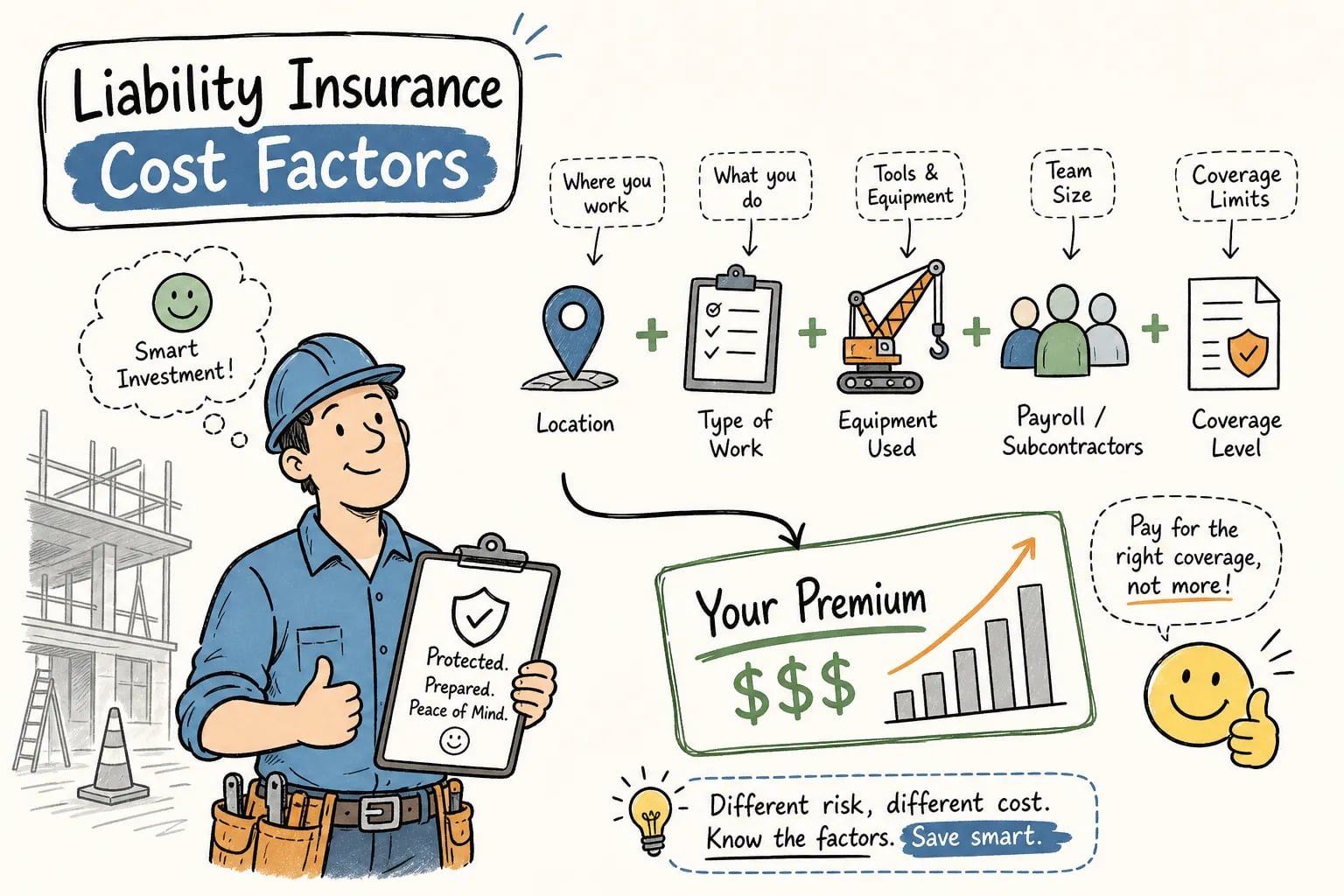
The trade type is just the starting point. Insurers layer several additional factors on top of that base to arrive at your individual price. Understanding these factors is how you challenge a quote that looks too high or explain a renewal increase that caught you off guard.
Claims history and trade classification
Claims history is one of the most powerful pricing factors in the market. One significant claim can push a premium up materially at renewal, and a track record of frequent small claims is treated just as seriously by underwriters. Industry data indicates insurers apply premium loadings of 20, 100% following a claim, and those loadings can persist for three to five years. Trade classification also matters independently of claims: a carpenter doing domestic fit-out is priced differently from one working on high-rise construction sites, even if both quote the same trade description on their application.
Turnover, location, and subcontracting arrangements
Insurers use annual turnover as a proxy for exposure. The more revenue you generate, the more work you do, and the more opportunities there are for something to go wrong. Location is also a factor, with major metropolitan areas often attracting higher premiums than regional markets due to urban site density, litigation environment, and claim frequency. Subcontracting is a particular watch point: bringing in uninsured subbies, or failing to collect certificates of currency from them, increases your liability exposure and can lift your premium at renewal or create problems when a claim is lodged.
How your cover limit changes the price
Many contractors default to the lowest available cover limit without realising the premium difference between options is often smaller than expected. Moving up a tier costs less than most people assume, and for contractors working on commercial sites, it’s often not optional anyway.
Comparing $5M, $10M, and $20M public liability
Based on BizCover customer data and broader 2026 industry benchmarks (as of mid-2026), average monthly premiums break down roughly like this: $5M cover sits around $46 per month; $10M cover sits around $57 per month, a step up of roughly 24%; and $20M cover sits around $91 per month, the biggest jump of the three. In dollar terms, moving from $5M to $10M costs less than $15 per month for many contractors. That’s a worthwhile upgrade for anyone working on commercial sites or for larger principals who set their own minimum requirements.
Picking the right limit for your contracts
The choice of cover limit is often driven by contract requirements, not personal risk assessment. Many commercial clients and head contractors require a minimum of $10M or $20M as a condition of engagement, and they’ll ask to see your certificate of currency before you step on site. Checking your contract terms before selecting a limit saves you from a policy amendment later, which costs time and sometimes money.
Practical ways to reduce your contractors liability insurance cost
Most contractors don’t push back on their premiums. They accept the first quote, pay on time, and renew without question. There are concrete, well-documented ways to pay less without reducing your protection, and none of them require you to take on more risk than you’re comfortable with.
Fast wins: excess, bundling, and payment method
- Higher excess: Increasing your excess from $500 to $1,500 can reduce the premium by 20% or more with some insurers. If you haven’t had a claim in years, carrying more of the first-dollar risk yourself makes financial sense.
- Bundling policies: Combining public liability with tools insurance or income protection through one insurer typically saves 15, 25% compared to buying each policy separately.
- Paying in full by EFT: Paying annually upfront, rather than monthly, saves around 5, 9% with most Australian providers. That saving is immediate and guaranteed.
Longer-term savings through safety records and industry memberships
A clean claims history over three to five years can reduce premiums by 8, 20% at renewal, depending on the insurer and your trade classification. This isn’t passive: it reflects genuine risk management on the tools every day. Some industry bodies, including trade associations with approved insurer group schemes, negotiate discounts of around 10, 15% for members, so it’s worth checking whether your industry association has a preferred insurer arrangement before you go to market independently. Completing relevant safety certifications also supports favourable underwriting in some trade categories, particularly for work at height and confined space operations.
Getting quotes, comparing policies, and verifying your cover
A cheaper premium only counts if the policy actually responds when you need it. Comparing quotes on price alone is how contractors end up with gaps in cover they don’t discover until it’s too late.
What a certificate of currency is and why every client asks for it
A certificate of currency is a one-page document confirming your policy is active. It states who the insured is, the type of cover, the limit of indemnity, and the expiry date. Clients, head contractors, and site managers ask for it because it proves you have current cover before they let you on site. Most insurers and online platforms issue a certificate immediately after the policy is bound; some providers, including Allianz, issue it instantly after purchase, though exact timing varies by provider. Keep a current copy accessible at all times: on your phone, in your email, and in your vehicle. When a client asks for it with 10 minutes’ notice, you need to be able to produce it. Note that the certificate itself carries no additional cost; it is issued as part of your policy.
How to compare quotes without getting caught out
When comparing two quotes, verify that the cover limits are identical, the excess amounts match, and the policy includes the specific work types you perform. A cheaper quote that excludes high-risk activities like roofing, excavation, or hot works is not a saving; it’s a gap in cover that will cost you far more than the premium difference if a claim is made. Read the product disclosure statement for exclusions before accepting any policy. The headline price is not the whole story, and understanding what’s excluded is as important as knowing what’s covered.
The bottom line on contractors liability insurance cost
What you pay for this cover in Australia is not fixed, and it’s not arbitrary either. Contractors liability insurance cost follows a clear logic based on trade risk, business size, claims history, and cover limit. Once you understand that logic, you can benchmark your own premium intelligently and push back when a quote looks out of line.
If you want an independent reference point for what contractors and tradies are actually paying across Australia, NameTheCost.com is built specifically to give Australians unbiased pricing data across trades, professional services, and everyday expenses. You should never walk into a quote conversation without a benchmark to check it against.
Before you renew, get at least three quotes, it’s the single most effective way to sense-check your current premium. While you’re at it, review your excess settings and ask about bundling options. Request your certificate of currency the moment your policy is bound. These aren’t complicated steps. They just require knowing what to look for, and now you do.