Business Insurance Cost in Australia: What to Expect
Understanding your business insurance cost before renewal is one of the simplest ways to avoid overpaying year after year. Too many small business owners accept their renewal without question: a quote arrives, it looks roughly similar to last year, and they pay it. That’s a costly habit. Without knowing what a fair premium actually looks like for your industry and risk profile, you’re negotiating blind against people who price insurance for a living.
The figures in this article come from 2026 Australian market data compiled by NameTheCost.com, an independent pricing resource built specifically to close the information gap between what businesses are quoted and what they should actually be paying. There are no referral commissions and no insurer relationships colouring the numbers. Just realistic ranges, broken down by business type and cover, so you have a concrete benchmark before you sign anything.
Business insurance cost in Australia: what to expect by industry
The honest answer is that it depends heavily on what you’re insuring. But “it depends” is only useful if you know what it depends on. Start with the broadest anchor point: a basic business pack for a typical small Australian business sits somewhere between $1,200 and $10,000 per year in 2026. The spread is large because the businesses are different, not because the pricing is arbitrary.
Here’s how average insurance premiums for businesses break down by industry for a standard business pack:
- Professional services (accountants, consultants, designers): $1,200, $4,500 per year
- Small retail: $2,500, $8,000 per year
- Tradies (painters, plumbers, electricians): $3,000, $8,000 per year
- Hospitality (cafés, restaurants, bars): $2,500, $10,000 per year
Professional services sits lowest because the main cost driver is professional indemnity cover rather than physical property, stock, or heavy foot-traffic risk. A sole-trader accountant carries very different exposure to a café with three staff, 40 covers at lunch, a commercial kitchen, and $80,000 in equipment.
Hospitality packs run highest because they bundle property, contents, stock, theft, glass, money, and business interruption cover into a single policy. Tradies pay more than office-based businesses because liability and portable tools exposure is significantly higher, and if vehicles are involved, the total climbs further.
How public liability fits into the picture
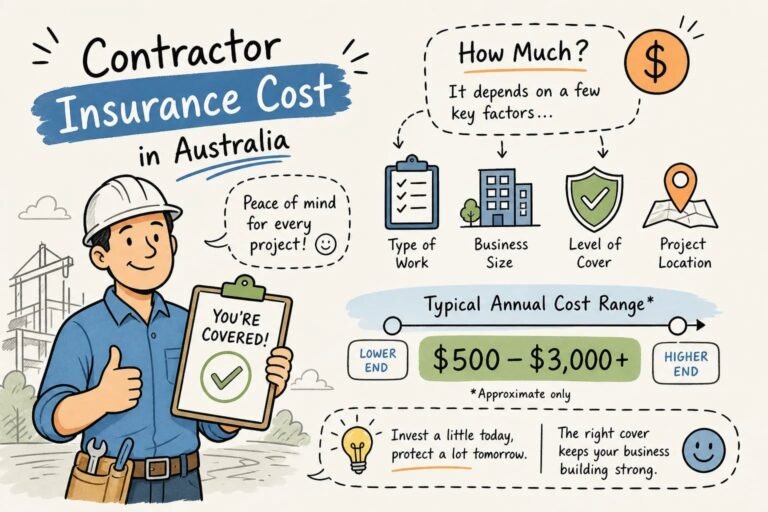
Public liability is often the first cover small businesses price, and many buy it standalone before building out a full pack. The commercial insurance cost varies sharply by risk level. For $5 million cover, the standard entry point in Australia, expect to pay roughly $300, $900 per year if you’re a low-risk consultant or home-based professional. Medium-risk businesses like retailers, cleaners, and mobile services typically pay $600, $1,800 per year. High-risk operations including tradies, construction, and roofing contractors pay $1,200, $3,500 or more for the same $5 million limit.
Stepping up to $10 million cover typically adds 10, 20% to the premium, not double the cost. For most small businesses, the jump is worthwhile given how little it costs relative to the exposure it covers.
The main cover types and what each one costs
“Business insurance” is not a single product. Most small businesses end up buying some combination of public liability, professional indemnity, and business interruption, either bundled into a pack or purchased separately. Knowing what each one costs helps you read a quote intelligently rather than just accepting the bottom-line figure.
Professional indemnity typically runs $700, $2,100 per year for a small business, with sole traders and lower-risk service providers near the bottom of that range. IT consultants and freelance tech workers, for example, typically pay $720, $1,440 per year for standard cover, with a midpoint around $1,000, $1,200 per year for most profiles.
Professional indemnity and business interruption: realistic price ranges
Business interruption cover is rarely sold standalone to small businesses. It’s almost always bundled into a package, which means the relevant anchor is the total pack cost. For a general small business, that package typically runs $1,600, $3,800 per year. When business interruption is included in a retail or hospitality pack, the range climbs to $2,500, $8,000 per year. If you’re trying to price it as a standalone product for reference, a business insuring around $200,000 in gross profit can expect to pay roughly $1,000, $4,000 per year, depending on indemnity period, business type, and claims history.
Bundled business pack vs. standalone cover: what actually makes sense
Bundling typically lowers your overall cost because insurers discount multi-policy clients. For the most common bundles, such as public liability combined with property cover, the discount generally runs 12, 18%. Adding professional indemnity or cyber insurance produces smaller savings, usually 5, 10%. The caution is real though: bundled packs sometimes include cover the business doesn’t actually need, and that inflates the premium. Know which covers are genuinely relevant to your operation before you agree to a package. If you operate entirely from home, for instance, paying for plate glass cover is generally an unnecessary expense.
What actually pushes your business insurance cost up or down
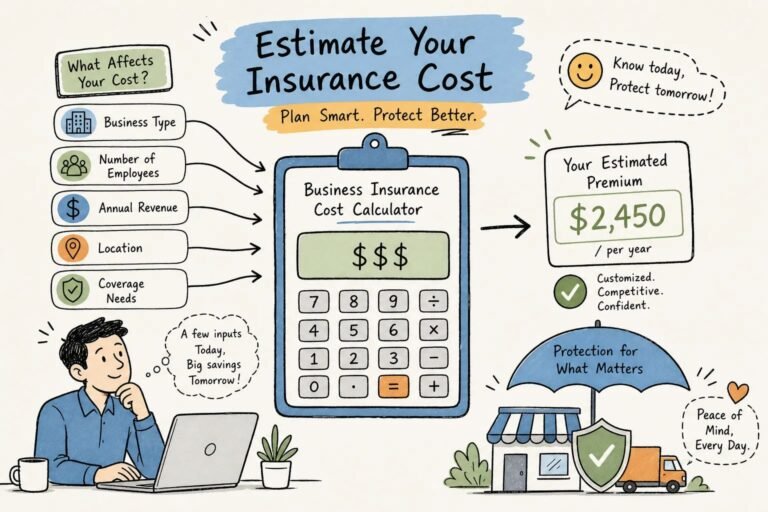
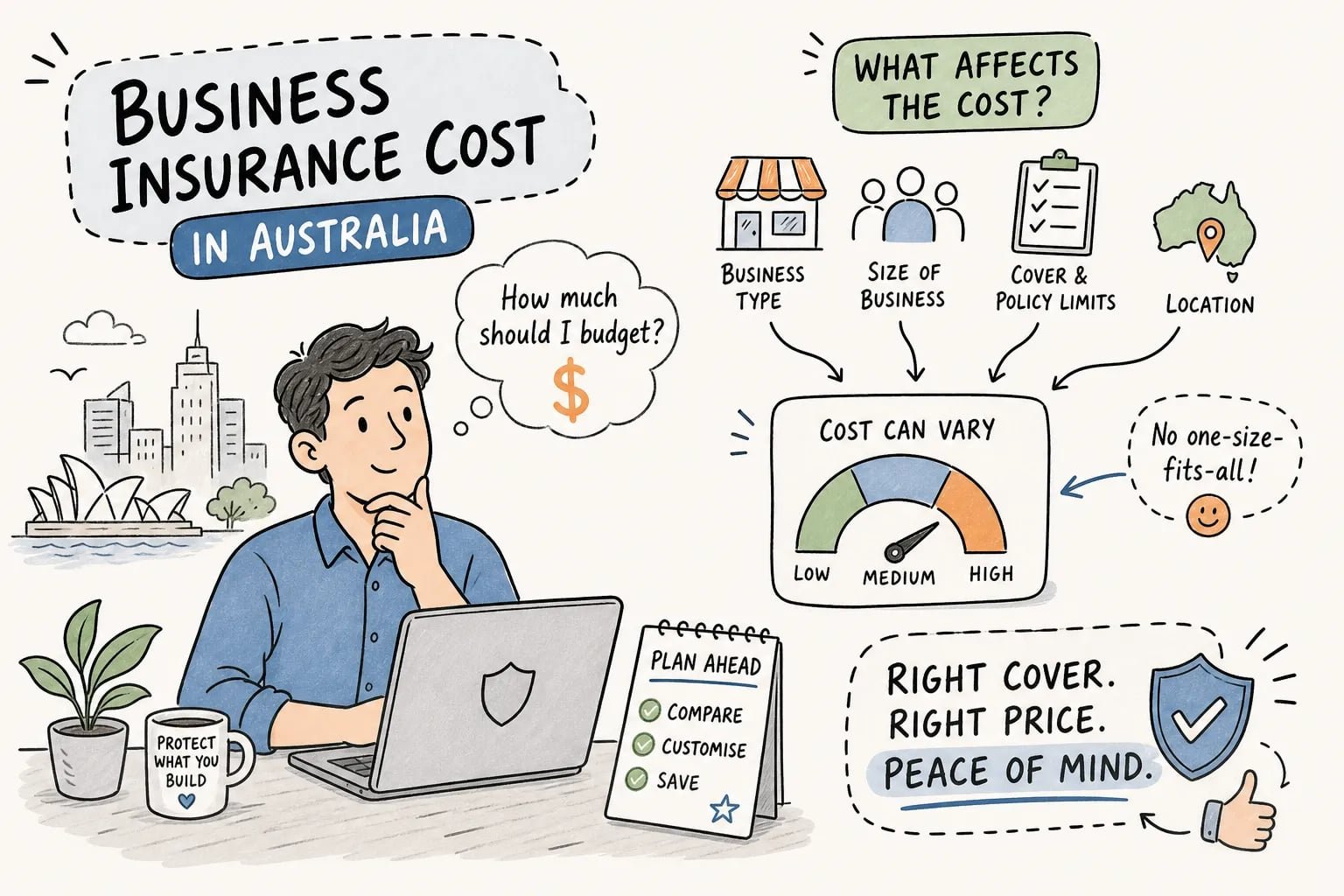
Insurers don’t price from gut feel. They work from actuarial data, and the factors that move your premium the most are well documented. Occupation class code is the single biggest lever because it determines the insurer’s base rate for your risk profile. A construction firm and a consulting firm pay vastly different premiums for identical cover limits, not because one insurer likes builders more than the other, but because the expected loss profile is genuinely different.
The two biggest levers: your industry classification and business size
Turnover and payroll are the second major driver. More revenue means more exposure, which means a higher premium. Insurers use revenue as a proxy for how much activity, how many client interactions, and how many potential liability events your business generates each year. Get these figures right at renewal. An outdated turnover figure, especially one that’s too high, is one of the most common sources of unnecessary premium creep for growing businesses.
Claims history, location, and excess: the adjusters
A clean claims history can reduce your premium by 10, 25%. Multiple claims in recent years can push it 10, 50% higher. Your claims record is essentially your track record, and insurers treat it as predictive.
Location adds another layer: the same business in regional Queensland and inner-city Sydney can carry different premiums due to catastrophe exposure, local legal conditions, and the cost of trades and repairs in that area. Location can shift premiums by roughly 15, 30% in some cases. Raising your excess is the smallest lever of the five, but it still moves the number: moving from a $250 excess to a $2,500 excess typically cuts premiums by 10, 20%. Only do it if your cash flow can genuinely absorb the larger first-loss amount.
How to tell if your quote is actually fair
You’ve received a quote. Without an independent benchmark, you have no way to know if it’s reasonable or inflated. This is exactly the same problem as getting a tradie quote without knowing the going rate. If you don’t know what a bathroom renovation costs in your suburb, you can’t push back on an inflated figure. Business insurance quotes in Australia work the same way.
Why many businesses accept quotes they shouldn’t
The information asymmetry is real and significant. Insurers price from actuarial data built over decades. Business owners price from limited information. That asymmetry is not accidental. Without knowing the realistic premium range for your industry and risk level, you’re negotiating blind at every single renewal. Even a 20% overcharge on a $4,000 annual premium is $800 a year, an extra $800 added to your costs at each renewal for the life of your business.
Using NameTheCost.com to benchmark before you commit
NameTheCost.com exists specifically to close this gap. It’s an independent Australian pricing resource that operates without advertiser bias or referral commissions. The process is straightforward: look up the typical premium range for your business type, compare it against the quote you’ve received, and identify whether you’re within range or significantly above it. If you’re above range, you now have a concrete basis for pushing back or shopping the market further. This is exactly what a smart buyer does before any major purchase: check the going rate first, then negotiate from a position of knowledge.
Practical ways to reduce your premium without cutting corners
The advice to “just shop around” is true but incomplete. Switching insurers every year has diminishing returns, and your claims history follows you regardless. The more reliable approach is to reduce the insurer’s risk assessment of your business, because that’s what actually drives the base rate down over time.
Risk controls that insurers actually price into your renewal
Insurers reward documented risk reduction. The key word is “documented.” Informal safety practices that aren’t recorded don’t help you at renewal time because underwriters can’t credit what they can’t verify. The following measures all signal lower expected losses:
- Formal hazard assessments and written safety procedures
- Staff safety inductions with attendance records
- Cybersecurity controls including multi-factor authentication, backups, and endpoint protection
- Scheduled equipment maintenance logs
Put them on paper, keep the records current, and make them available when you renew or apply for cover.
Policy hygiene: the easiest money most businesses leave on the table
Reviewing your policy before each renewal to remove outdated cover, correct your turnover and payroll figures, and ensure your asset schedules reflect what you actually own is one of the most reliable ways to avoid unnecessary premium creep. An asset schedule that still lists equipment you sold three years ago is costing you money. Correcting your declared turnover if it’s dropped since the last renewal period is equally straightforward. Bundling related covers where they make sense for your operation, and increasing your excess if your cash flow supports it, both contribute to further savings. Start the renewal process well before your policy expires, ideally several weeks out. That window gives you enough time to get alternative quotes, negotiate on the existing policy, and make a considered decision rather than a rushed one.
Bottom line: understanding business insurance cost so you’re not overpaying
The business insurance cost in Australia is knowable. The 2026 ranges in this article give you the benchmark most businesses never have access to: realistic figures, by business type, broken out by cover, grounded in current market data. Your occupation class, business size, and claims history drive most of your premium, and all three are factors you can influence over time.
Before you accept your next quote, check it against the ranges above. If you’re a professional services business paying $5,000 per year for a basic pack, you’re likely well above market. If you’re a café paying $3,500 per year with business interruption included, you’re probably in a reasonable range. NameTheCost.com is the starting point for any business owner who wants independent pricing data to cross-check a quote before committing. Pull your current policy or renewal notice, compare it against these figures, and act on any gap you find. That’s the whole exercise.