
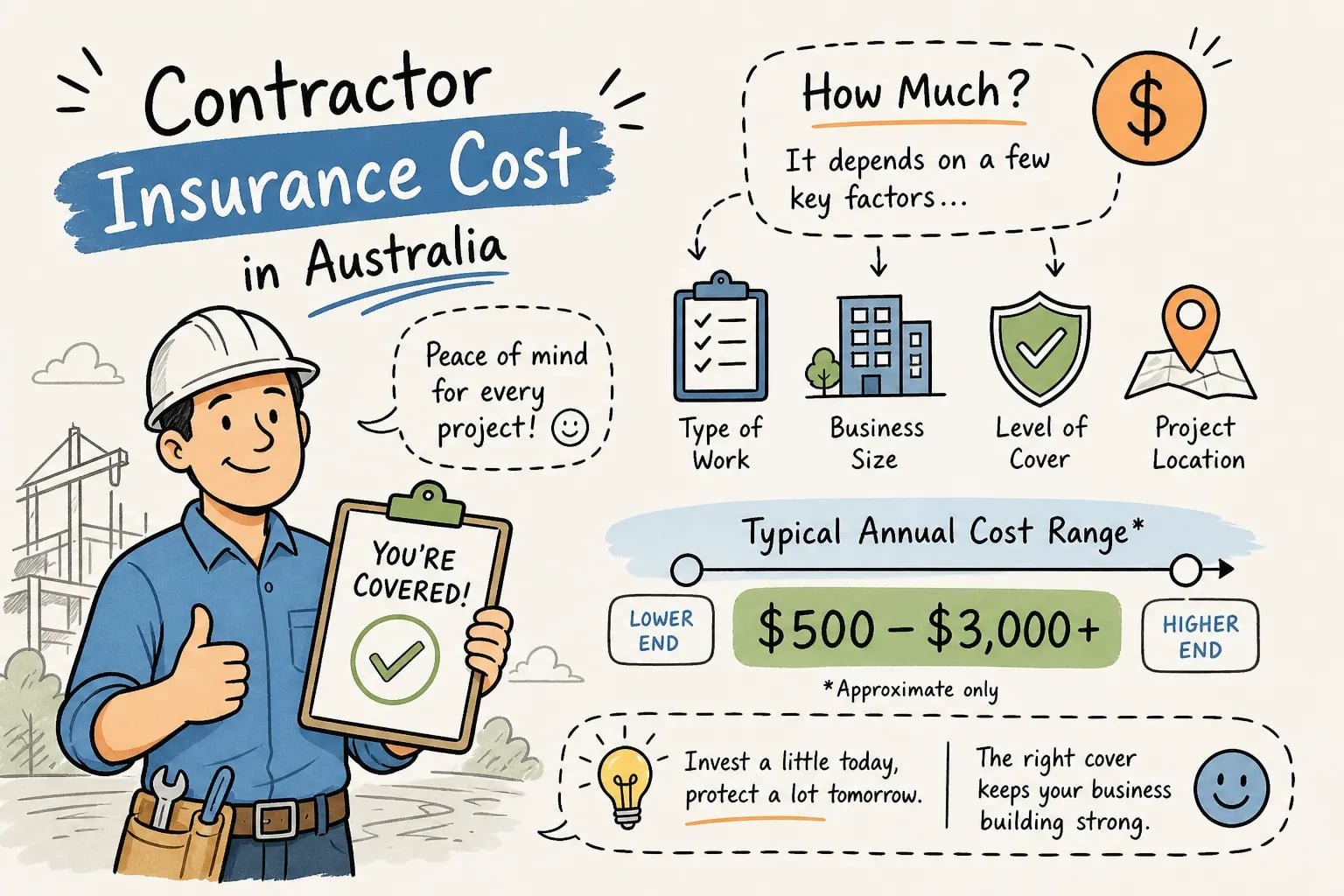
How Much Does Contractor Liability Insurance Cost in Australia
How much does contractor liability insurance cost in Australia? It’s a question that trips up both sides of a trade agreement. Many contractors aren’t sure whether they’re overpaying for their cover, and many clients have no way to tell if the insurance costs folded into a trade quote are real or inflated. Knowing the actual cost of contractor liability insurance in Australia matters whether you’re the one paying the premium or the one approving the invoice. The short answer is that premiums vary more than most people expect, and the benchmarks are worth knowing before you commit to anything.
This article maps the realistic premium ranges for 2026 by cover limit and trade type, explains the factors that push your price up or down, and gives you concrete ways to reduce what you pay. If you’re a client trying to sense-check a contractor quote, there’s a section for you too.
How much does contractor liability insurance cost: premium ranges by cover limit and business size
The numbers first. In 2026, a standard low-to-medium risk contractor in Australia typically pays between $400 and $800 per year for $5 million in public liability cover. That works out to roughly $33 to $67 per month. These aren’t theoretical figures. They reflect what tradies across the country are actually paying for straightforward domestic and commercial work at the most common cover level. The average liability insurance price in Australia for tradies sits within that band, though trade type and business size can push it considerably higher.
One thing that surprises many contractors is how the price scales as you increase the limit. Many assume that doubling the cover doubles the cost, but that’s not how insurers price it.
Cover limit breakdown: $5m, $10m, and $20m compared
Moving from $5 million to $10 million cover typically adds 10 to 25 per cent to your premium, not 100 per cent. For a contractor paying $600 per year at $5 million, the $10 million equivalent is usually somewhere between $660 and $750. Stepping up again to $20 million adds a further 15 to 25 per cent over the $10 million price. The reason is straightforward: insurers know that the probability of a claim reaching $20 million is far lower than one reaching $5 million, so the additional premium reflects a modest increase in tail risk rather than a proportional jump.
In practical terms, that means $20 million cover might cost a standard low-risk contractor $600 to $800 per year when their $5 million cover sits at $400 to $600. The price difference is often smaller than contractors expect, which is worth knowing when a client or principal contractor asks you to carry higher limits.
Sole trader vs small construction business vs larger contractor
Business size shapes the number significantly. A sole trader doing straightforward domestic work sits at the low end of the range, typically $400 to $800 per year. A small construction business with a handful of employees and broader project scope moves into the $1,500 to $5,000 range annually, depending on trade type and turnover. Larger contractors running multiple crews and subcontractors, or taking on commercial and industrial projects, can push well beyond that.
The cover limit you choose matters, but your business structure and scale matter just as much. Two contractors both holding $10 million policies can be paying very different premiums if one is a sole trader doing timber framing and the other is a builder managing six subcontractors on a commercial fit-out.
How much does contractor liability insurance cost by trade type
Generic “small business” insurance estimates are almost useless for tradies. Trade type is one of the primary rating factors insurers use, because it tells them how likely a claim is and how severe it might be. If you’re benchmarking yourself against the wrong trade, your quote will always look confusing.
Trade-by-trade premium comparison
Carpenters and joiners typically sit at the lower end of the tradie liability insurance price spectrum, commonly between $500 and $1,200 per year for $5 million cover. The insurer’s view is that the damage profile of carpentry work is more visible and contained than other trades, which keeps the pricing down. Plumbers often price above carpenters for a similar reason: hidden water damage can cause extensive loss before it’s discovered, and that uncertainty is factored into the premium.
Electricians move into the mid-to-upper range, often $700 to $1,800 per year, because fire, shock, and latent damage exposure are harder to predict and can produce serious losses long after the work is complete. General builders and construction contractors have the widest spread of all, because scope, subcontracting, and project type vary so much that premiums can differ very substantially from one builder to the next.
Why risk classification often matters more than your trade label
The insurer’s risk classification can override the trade label entirely. A domestic electrician may price meaningfully below a commercial electrician. A carpenter doing heritage restoration on older substrates might attract a higher premium than one doing new timber framing on a standard residential build. Insurers typically group trades into three broad bands: low-risk trades around $500 to $1,200 per year, medium-risk trades between $800 and $2,500, and high-risk trades from $1,500 to $5,000 or more. When you receive a quote, ask the insurer or broker which risk band they’ve placed you in and whether that classification accurately reflects your actual work. It’s a simple question that can produce a meaningful saving if the answer reveals a misclassification.
The main factors that push your premium higher
Once you know your baseline by cover limit and trade type, the next question is what moves that number. Some factors are within your control; others are structural. Both are worth understanding.
Turnover, claims history, and location by state
Turnover is often the largest dollar driver because many insurers calculate premiums as a rate per $1,000 of gross receipts or payroll. As your revenue grows, your exposure grows with it, and so does the premium. Claims history is consistently one of the top two rating factors across insurers. A single claim can lift your premium noticeably at renewal. A clean record held over several years can hold it down, and in some cases produce preferred pricing.
State and location add another layer that many contractors underestimate. Australian states have different litigation environments, regulatory costs, and local loss rates. A contractor doing equivalent work in Queensland versus New South Wales may receive a materially different quote from the same insurer. NSW tends to sit at the higher end of the three major states. Victoria is usually close behind. Queensland is broadly comparable but can vary with location, particularly in regions with cyclone or extreme-weather exposure.
Subcontractors, cover limits, and excess amounts
Using subcontractors adds vicarious liability exposure, and uninsured subcontractors are particularly costly. At audit, insurers may treat payments to uninsured subs as additional payroll, triggering back-charges that can be significant. The fix is straightforward: collect and verify current certificates of insurance for every subcontractor before work starts. It’s a simple administrative step that protects you both contractually and at renewal.
On the excess amount, raising your excess reduces your premium but shifts more small-claim risk onto you. Moving from a $500 to a $2,500 excess might reduce your annual premium by 8 to 15 per cent. That’s worthwhile if your claims history is clean and your cash flow can absorb minor incidents without strain. Combined with other measures, adjusting your excess is one of several levers that add up.
Are the insurance costs in your contractor quote realistic?
When a tradie factors liability insurance into their pricing, what should that actually look like? Many clients have no reference point, so they accept the quote or reject it without knowing whether the insurance component reflects reality.
What fair insurance costs look like inside a contractor quote
A sole trader doing domestic tiling or carpentry might carry $400 to $800 per year in public liability insurance. A licensed electrician or plumber might carry $700 to $1,800. A small construction business might sit closer to $2,000 to $5,000. These are real operating costs and contractors reasonably pass them through in their pricing. The concern is when those costs are inflated, doubled, or used as a vague markup line without grounding in actual premiums. Clients who know the benchmarks are better placed to ask sensible questions without being adversarial about it.
Using NameTheCost.com to cross-check contractor pricing
NameTheCost.com is an independent Australian cost and pricing directory built specifically for this kind of cross-check. The data reflects reported contractor costs rather than insurer-published estimates. If you’ve received a contractor quote and want to sense-check whether the business liability insurance cost is realistic for that trade and project type, NameTheCost.com is a practical starting point. It covers the full range of contractor operating costs so you can assess the whole picture, not just one line item.
Five practical ways to reduce your liability premium
Reducing a premium isn’t about finding loopholes. It’s about demonstrating to underwriters that your operation carries lower risk than they assumed when they priced you. There’s a good chance you can improve your position on at least two or three of the following levers.
Safety documentation, claims control, and classification accuracy
Documented safety programmes, toolbox talks, and jobsite audits give underwriters concrete evidence that losses are being actively managed. Insurers price for uncertainty, so less uncertainty means a better rate. Claims management matters just as much: prompt incident reporting, fast medical response, and return-to-work programmes reduce claim severity over time and improve your experience record at renewal.
Classification accuracy is the one that many contractors miss entirely. Annual reviews of your trade classification and payroll splits can uncover errors that have been quietly inflating your premium for years. When an audit finds a misclassification, the savings can be substantial, in some cases 15 to 30 per cent. It costs nothing to ask your broker to review your classification before the next renewal.
Bundling policies, adjusting excess, and paying annually
Placing multiple lines of cover with one insurer, such as combining public liability with tools and equipment insurance, typically attracts a package credit versus buying each policy separately. Choosing a higher excess, where your cash flow supports it, can reduce premiums by 8 to 15 per cent. Paying the full annual premium upfront rather than monthly removes the insurer’s financing margin, which can reduce the total cost by a further 3 to 8 per cent. None of these tactics is dramatic on its own, but combining three or four of them produces a meaningful reduction without changing your actual cover.
How to get an accurate quote for your trade
Generic online quote tools often produce estimates that don’t reflect your actual risk profile. A figure generated in 30 seconds from a postcode and a trade description is a starting point, not a price. Getting a quote that accurately reflects your situation requires a bit of preparation.
Before approaching an insurer or broker, gather your annual turnover or gross receipts, a clear description of your work (domestic, commercial, or industrial), the states you operate in, your subcontracting arrangements and whether your subs carry their own insurance, and your claims history for the past three to five years. The more precise you are, the closer the quote will be to your actual binding price. Vague descriptions push insurers toward conservative pricing, which means you pay for uncertainty that doesn’t reflect your operation.
For most contractors, a specialist trade insurance broker will produce a better outcome than going direct to an insurer. Brokers who work specifically with tradies and construction businesses understand the classification nuances that general insurers miss, and they can place your risk with underwriters who are set up to price it accurately. Most brokers provide free preliminary quotes, confirm whether any fees apply before proceeding. Get at least two or three quotes before making a decision, and compare not just the premium but the excess, sub-limits, and exclusions side by side.
The numbers in plain terms
So, how much does contractor liability insurance cost in Australia? For a low-risk trade, the typical range is $400 to $800 per year for $5 million cover, climbing to $1,500 to $5,000 or more for higher-risk trades and larger businesses. The premium you pay, or the one factored into a contractor quote, should make sense against those benchmarks. If it doesn’t, that’s worth a conversation.
If you’re a contractor, the clearest path to a lower premium is a clean claims record, accurate risk classification, and consolidated cover. If you’re a client evaluating a trade quote, knowing what realistic insurance costs look like for different trades gives you a fair basis for asking the right questions without being unreasonable. For independent Australian cost benchmarks across contractor trades, NameTheCost.com is a practical reference point.