Emergency Vet Fees in Australia: What You’ll Actually Pay
Most pet owners have a number in their head for what emergency vet fees might be. That number is almost always wrong, and almost always too low. The surprise isn’t just the total on the invoice. It’s that the bill itself is structured in a way most people have never encountered before.
Emergency animal hospitals don’t charge one fee. They charge several: a consultation fee, a diagnostics fee, a treatment fee, and a separate hospitalisation fee if your pet stays overnight. Each line item runs independently. If your pet’s crisis happens at 10pm on a Saturday, after-hours loadings commonly increase the consultation charge and can apply to other components of the bill as well. The result is a document that looks nothing like the rough figure you’d mentally prepared for.
Before that moment arrives, having an independent cost benchmark changes everything. Resources like NameTheCost.com publish realistic Australian emergency vet pricing data, so you can set expectations before the crisis, not during it. This article breaks down how emergency vet fees are actually structured in Australia, what common scenarios cost, and what practical steps you can take to manage the bill.
Why emergency vet bills feel so much larger than expected
The billing structure at an emergency animal hospital is categorically different from a standard daytime vet visit. At your regular clinic, you pay one consultation fee and perhaps a small charge for a vaccination or a script. At an emergency hospital, the bill is itemised across multiple distinct categories, and each one has its own pricing logic. A pet owner expecting one number receives a multi-line estimate instead.
The consultation fee covers the examination only. Diagnostics are separate. Treatment is separate. Any medications administered in the clinic are separate. If your pet stays overnight, hospitalisation is a separate charge again. Understanding this upfront doesn’t reduce the cost, but it does mean you can read the estimate clearly and ask the right questions before work begins.
The timing issue compounds everything. Veterinary emergencies frequently occur outside business hours, and many clinics charge higher after-hours or public-holiday rates. This isn’t an arbitrary penalty, clinics cite higher staffing and operating costs at a 24/7 facility as the primary driver. But it does mean the effective consultation fee can be double what a standard daytime visit costs before any diagnostics or treatment are factored in.
Emergency vet fees: what the consultation actually covers
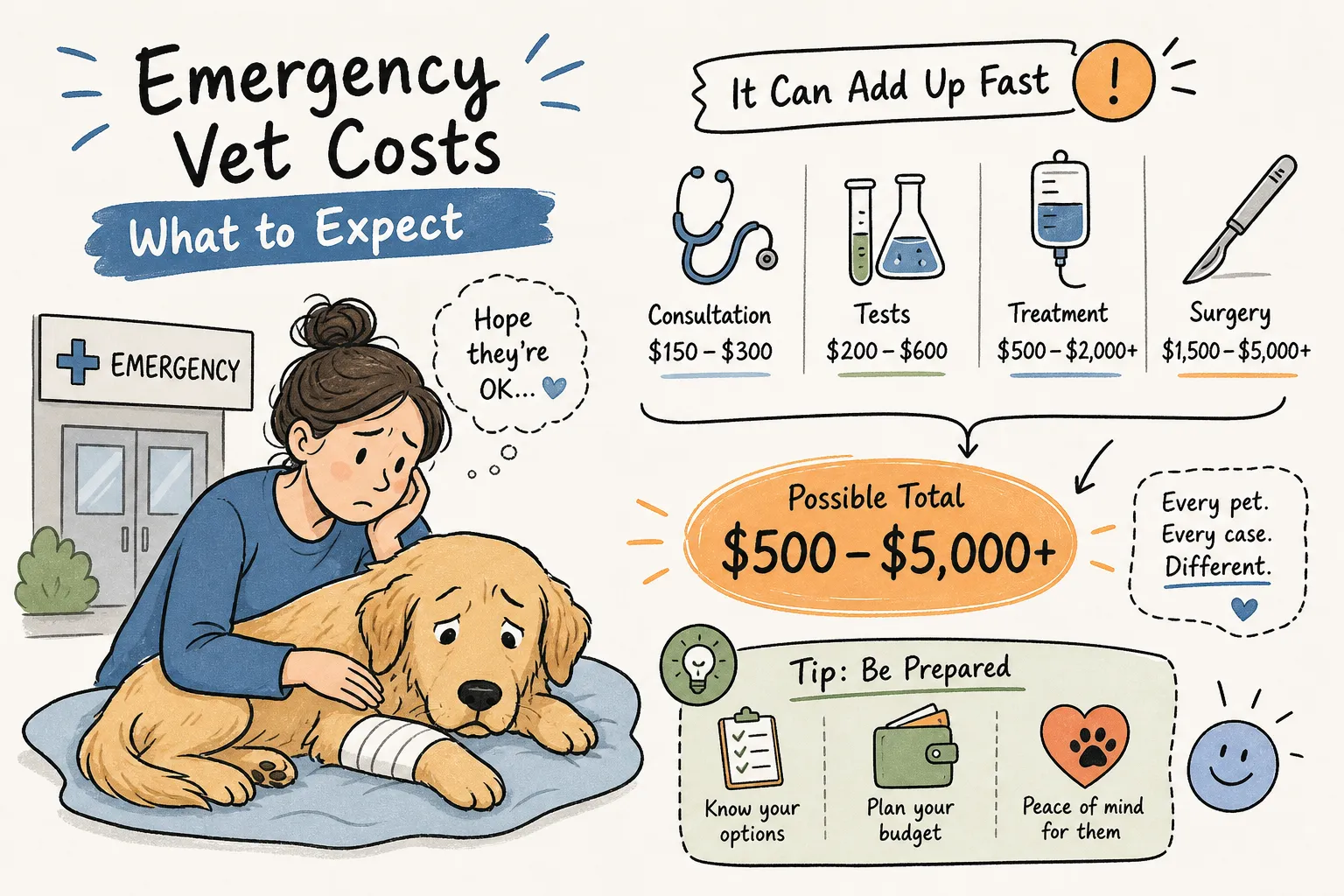
Emergency consultation fees across major Australian cities generally fall between $170 and $450. Sydney sits at the higher end of that range, typically $200 to $400. Melbourne and Perth run $180 to $350. Brisbane is often slightly lower, around $170 to $320. These figures cover one thing: a veterinarian examining your animal and determining what it needs. No X-rays, no blood tests, no treatment. The consultation fee is the price of getting an assessment.
After-hours timing changes that figure substantially. Emergency clinics handle this in two ways: either they apply a flat surcharge on top of the base consultation fee, or they replace the daytime rate with a higher fixed after-hours fee altogether. Weekend presentations typically run 30 to 50 per cent above a standard consultation. Public holiday visits can effectively double the base fee. Some clinics publish a fixed after-hours consultation fee of $235 to $400 rather than calculating a percentage loading.
The practical implication: if your dog eats something dangerous on Christmas Day and you’re in Sydney, expect the consultation alone to land somewhere between $300 and $450, based on published Sydney after-hours rates, before any diagnostic work begins. That’s not the bill. That’s just the cost of the vet walking into the room.
What diagnostics and treatment actually cost
Once the vet has assessed your pet, the next section of the invoice is diagnostics.
Imaging
X-rays at Australian emergency clinics typically cost $150 to $400 depending on the clinic and the complexity of the imaging required. Ultrasound sits in the $250 to $600 range. In most genuine emergencies, imaging isn’t optional, it’s how the vet confirms what’s wrong before deciding on treatment.
Blood tests
Blood panels run $90 to $300 for routine tests, with broader diagnostic workups reaching $400. A basic diagnostic workup covering one X-ray and a blood panel can add $300 to $600 to the bill before any treatment begins.
Medications and interventions
Treatment costs follow a similarly wide range. Intravenous fluids, one of the most common emergency interventions, typically cost $120 to $300 depending on volume and duration. Medications administered in the clinic sit on top of that. If the case requires a specialist, such as a veterinary cardiologist, oncologist, or internal medicine specialist, the referral consultation fee alone runs $200 to $500, with that specialist’s treatment costs additional. Specialist involvement is where an emergency vet bill shifts from a few hundred dollars to several thousand, without the situation necessarily becoming more severe.
Emergency vet fees for surgery and hospitalisation
Minor surgical procedures at Australian emergency clinics start at around $1,000. Complex operations, including foreign body removal, gastrointestinal repairs, and orthopaedic surgery, commonly run $3,000 to $10,000. Anaesthesia adds $500 to $3,000 depending on the duration and complexity of the procedure. The wide range reflects how variable each case is. Emergency surgery doesn’t have a fixed price because the time, equipment, and specialist involvement shift with every patient and every presentation.
Hospitalisation is typically charged in 12-hour blocks rather than by the hour or a flat daily rate. Standard monitoring runs approximately $300 to $500 per 12-hour period. Closer observation with active treatment runs $600 to $1,200 per day. Intensive care or continuous critical monitoring can exceed $1,000 per day, and significantly more for complex cases requiring ventilation, oxygen therapy, or round-the-clock specialist nursing. A pet kept for 48 hours in standard care can add $1,200 to $2,400 to the bill before any procedures are factored in.
What common emergencies actually cost: a realistic price guide
The table below gives indicative total cost estimates for common emergency presentations in Australia, derived from publicly available clinic pricing and independent benchmarks compiled by NameTheCost.com (2026 data). Each range reflects the full visit: consultation, standard diagnostics, and treatment. The two columns separate presentations that don’t require an overnight stay from those that do.
| Scenario | Without hospitalisation | With one night’s stay |
|---|---|---|
| Suspected poisoning (stable) | $400, $900 | $800, $1,800 |
| Broken bone (stabilisation only) | $500, $1,200 | $1,200, $2,500 |
| Foreign body ingestion (monitoring) | $400, $800 | $900, $2,000 |
| Foreign body requiring surgery | $2,500, $6,000 | $4,000, $10,000 |
| Snake bite (antivenin required) | $3,000, $8,000 | $5,000, $12,000 |
| Lacerations / wound repair | $400, $1,500 | $900, $2,500 |
| Respiratory distress (oxygen therapy) | $600, $1,500 | $1,200, $3,500 |
Three factors push any emergency vet bill toward the top of its range: after-hours timing, specialist involvement, and the length of hospitalisation. A snake bite treated during business hours at a general emergency clinic costs considerably less than the same presentation on a Sunday night requiring specialist internal medicine involvement. Knowing these multipliers means you can ask better questions when the vet hands you an estimate at reception.
Managing the emergency vet bill: before, during and after the visit
Most Australian emergency animal hospitals accept card and EFTPOS. Many now offer buy-now-pay-later options including Afterpay, Zip Pay, and Zip Money for smaller-to-mid-range bills. For larger emergency costs, VetPay is a veterinary-specific payment plan available at select clinics, offering fortnightly repayments over six to twenty-four months with an upfront deposit. Some clinics require full payment before discharge, so asking about payment options at the start of the visit, rather than the end, gives you more clarity and considerably less pressure when the invoice arrives.
Pet insurance is worth understanding clearly before you need it. Most policies don’t pay the clinic directly. You pay the bill in full and lodge a reimbursement claim afterwards. Policies vary significantly in their coverage limits, exclusions, and gap payments. The coverage limit on your policy is only useful if it’s calibrated to actual emergency vet costs in your state. A policy with a $3,000 annual limit doesn’t go far if your dog is bitten by a snake in regional Queensland on a public holiday weekend.
Before taking out or renewing a pet insurance policy, cross-check the limits against realistic emergency vet cost benchmarks for your city. NameTheCost.com publishes independent Australian pet care cost guides covering emergency vet pricing across different states, giving you an objective baseline to compare against your policy’s fine print. Setting a dedicated savings buffer is also a practical step. Even $1,500 to $2,000 put aside can cover a conservative range of minor-to-moderate emergency presentations without requiring a payment plan or a credit application at the worst possible moment.
Preparation beats panic
Emergency vet fees in Australia are not a single charge. They’re a layered bill covering consultation, diagnostics, treatment, and hospitalisation, each with its own pricing structure. After-hours surcharges amplify every one of those layers. The range for a genuine emergency runs from a few hundred dollars for a minor presentation to well over $10,000 for complex surgery or intensive care. That range isn’t meant to cause alarm. It’s meant to give you a frame of reference.
Knowing the structure of the bill means you walk into the clinic with clear questions rather than assumptions. You can ask for an itemised estimate, understand what each component covers, and make considered decisions about the level of care you authorise. You can also discuss payment terms before treatment begins rather than scrambling at the end.
Check your pet insurance policy limits against real emergency vet cost benchmarks before the crisis happens. Set a dedicated savings buffer. Use independent pricing guides to stay grounded when a quote is put in front of you. Visit NameTheCost.com for state-specific emergency vet pricing data across Australia, along with broader cost guides covering the full financial picture of pet ownership.