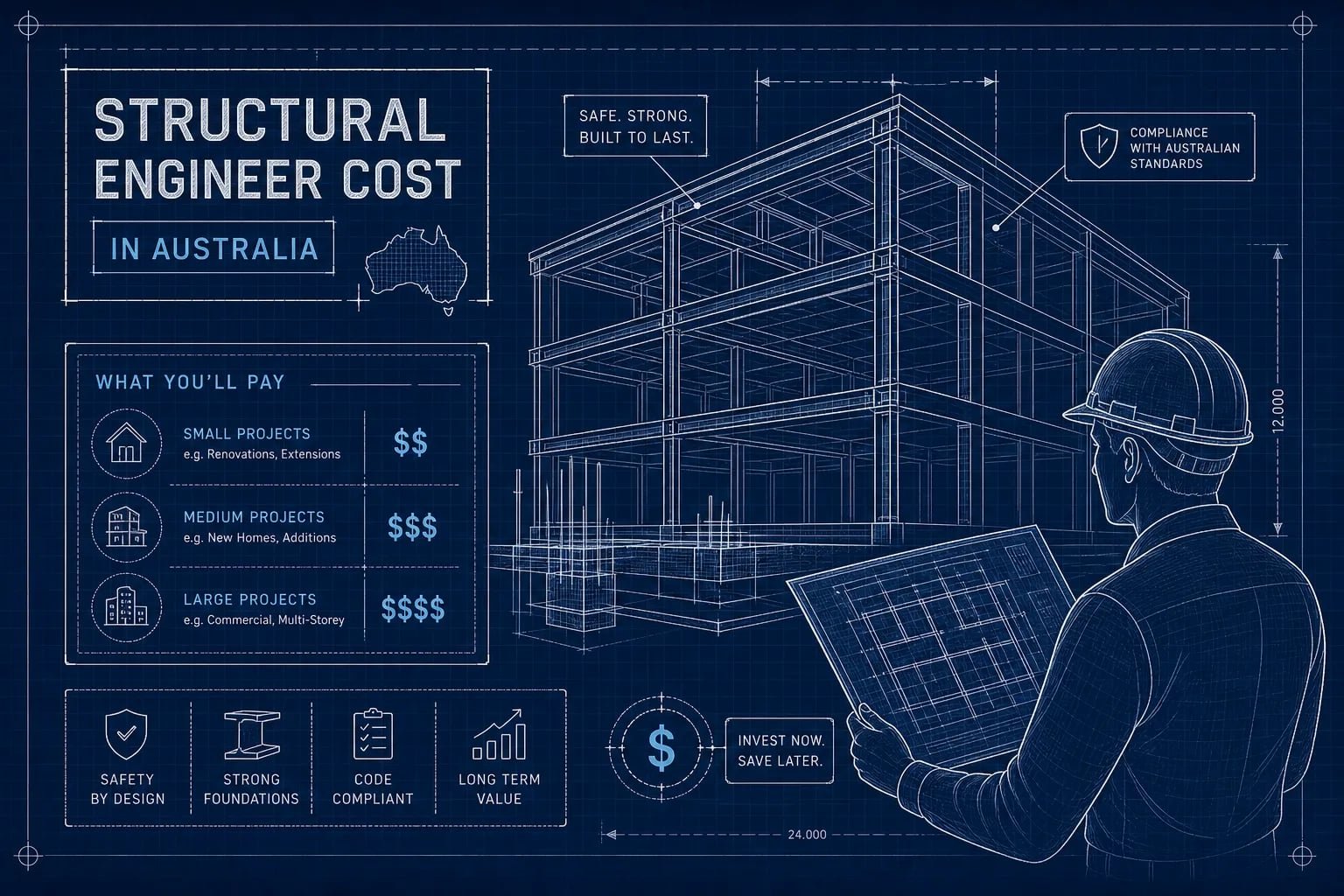
Structural Engineer Cost Australia: What You’ll Actually Pay
Most people have no idea what a fair structural engineer cost looks like before they hire one. They accept the first quote they receive, assume the number is reasonable, and move on, and that information gap is exactly where overpaying happens. Structural engineer fees in Australia vary significantly depending on the service type, the engineer’s experience level, and where your property sits on the map. A site inspection in regional Queensland looks nothing like a full design package for a two-storey extension in Sydney.
This article covers the key numbers: hourly billing rates by experience level, typical fees for the most common services, how residential and commercial pricing differs, what drives quotes higher than average, and how to benchmark a fee before you commit to anything. If you want an independent reference point before you call a single firm, NameTheCost.com is an independent Australian cost and pricing directory covering professional services across the country.
Structural engineer cost: hourly rates vs fixed fees
Hourly billing and what experience level costs you
Structural engineers in Australia bill at different rates depending on their experience level. Junior and graduate engineers typically charge $130 to $170 per hour. Mid-level engineers with several years of experience run $180 to $230 per hour. Senior and CPEng-level engineers handling complex design, certification, or specialist assessments charge $220 to $270 per hour, and some principal-level specialists can charge above $250 per hour for highly technical work.
Hourly billing tends to apply to inspections, advisory work, ad-hoc consultations, and smaller scopes where the deliverable is hard to define upfront. If you’re asking an engineer to look at a crack in your foundation wall and give you an opinion, that’s usually hourly. If you want a formal written report from that visit, expect either an hourly rate with an estimated total or a fixed fee depending on the firm.
When fixed-fee quotes make more sense
Fixed fees suit well-defined scopes. A new dwelling design package, a specific set of engineering drawings, or a standard residential inspection report all lend themselves to a fixed price because the engineer knows what they’re producing. Fixed fees protect you from cost blow-outs on straightforward work. They can work against you when the scope is loosely described, because variations to scope become charged extras regardless of what you assumed was included.
Before accepting a fixed fee, confirm exactly what’s included in writing: the deliverables, the number of site visits, the number of drawing revisions, and whether council documentation is in scope or quoted separately. These questions take five minutes and prevent disputes later.
What structural engineer cost covers, site visits to full design
Site visits, inspections, and written reports
A basic site visit with verbal advice typically starts around $300 to $600 depending on location and engineer experience. A standard residential structural inspection with a written report runs $400 to $900 across most of Australia. Sydney tends to sit at the higher end of that range, with standard crack inspections clustering around $700 and broader residential reports reaching $1,200 or more. Brisbane generally tracks lower, with standard assessments around $550. Melbourne can be notably higher for a full structural report on a dwelling, sometimes $1,200 to $1,800 for standard homes and more for complex or larger properties.
Regional areas are generally cheaper for straightforward work, though remote or hard-to-access sites attract travel costs and logistics charges that can close that gap quickly. Detailed engineering reports covering heritage buildings, complex structural damage, or subsidence can run $800 to $1,800 or more regardless of location.
Full structural design, drawings, and council documentation
Full structural design and documentation for a new house or major extension typically costs $2,000 to $8,000 for standard residential projects. Larger or architecturally complex homes can reach $10,000 to $15,000, and particularly difficult sites or custom structural systems can push that further. A standard fixed-fee package for a new home usually covers:
- structural analysis and load calculations
- footing and slab design
- framing design including beams and bracing
- structural drawings
- a signed certification confirming the design
Council documentation and certification are sometimes scoped separately, even when you assume they’re included. Always confirm whether your quote covers approval-ready documentation or just the engineering design before comparing fees across firms. A quote that excludes council submissions isn’t comparable to one that includes them, even if the headline number looks similar.
Engineer certificates and compliance sign-off
A structural compliance certificate or engineer sign-off for a specific element, such as a beam, a footing, or a balcony, is a distinct service priced separately from design work. Simple sign-off letters typically run $300 to $1,000. Where the certification requires a site inspection, calculations, or supporting documentation, the cost moves into the $500 to $2,500 range or beyond depending on scope and complexity.
The critical question to ask upfront is whether the certification fee includes a site visit or covers only a desktop review of plans already submitted. These are two different levels of service at potentially the same quoted price.
Residential vs commercial: why the price difference is significant
What residential project fees typically look like
For standard residential work, structural engineering fees typically represent around 0.5 to 2 percent of construction cost, with most projects sitting in the 1 to 2 percent range. On a $500,000 build, that commonly translates to roughly $5,000 to $10,000 in total engineering fees across design, documentation, and inspections. Most homeowners deal with fixed-price packages for common scopes: a single-storey extension, a new dwelling, or a retaining wall assessment. The fee is predictable once the scope is clearly defined, and getting that scope in writing before you sign anything is what keeps it that way.
How commercial project pricing differs
Commercial projects are almost always priced on a percentage-of-construction-cost model or against detailed fee proposals, and the complexity premium is real. Multiple occupancies, higher structural loads, fire compliance requirements, and multi-storey configurations all add engineering hours at every project stage. For commercial work, fees of 1.5 to 4 percent of construction cost are common for office, retail, and industrial projects, with complex or multi-storey structures running higher.
Commercial engineering engagements also span more project stages, from preliminary concept through to construction support and project close-out. The total fee commitment is larger and the engagement timeline is longer. Homeowners who compare rates from commercial-focused firms against residential firms are not comparing equivalent services.
The main factors that push your quote higher than average
Complexity, soil conditions, and site access
Project complexity is the single biggest fee driver. Irregular geometry, multi-storey structures, unusual load paths, and custom structural systems add engineering hours regardless of whether the billing is hourly or fixed. Difficult soil conditions, sloped sites, high water tables, and deep footing requirements add investigation time and design complexity. Soil testing alone can add $800 to $2,000 to a project budget before the engineer has drawn a single line.
Remote or hard-to-access sites attract travel costs, logistics premiums, and sometimes overnight allowances. This is rarely flagged upfront unless you ask directly at the quoting stage. If your site is more than an hour from a major centre, raise the question before accepting any fee proposal.
Urgency, heritage overlays, and specialist calculations
Rush turnaround typically adds 10 to 30 percent to a structural engineer’s standard rate. If you need drawings fast for a council submission deadline, you’ll pay for the schedule disruption. Heritage-listed properties or buildings in heritage overlay zones require more detailed analysis and carry higher professional liability, which engineers factor into their fees. The premium varies across firms, but it’s real and worth asking about directly.
Specialist calculations involving seismic loads, unusual wind ratings, or complex structural systems typically attract a premium of around 25 percent or more above standard rates. Some highly technical engagements run higher than that. If your project has any unusual structural characteristics, ask the engineer to be explicit about whether specialist input is priced into their standard fee or quoted separately.
How to benchmark structural engineering costs before you commit
Why an independent reference point matters before you accept a quote
Accepting the first quote without a reference point is one of the most common ways people overpay on structural engineering. Before you sign any engagement letter, knowing what a fair structural engineer cost looks like for your service type and location is the simplest way to protect yourself. A standard residential inspection report in Brisbane should cost very differently from a full design package in inner Sydney, and you should know that before the conversation starts.
NameTheCost.com is built for exactly this situation. It’s an independent Australian cost and pricing directory that publishes professional service fees as a reference point for consumers. If you want a straight read on what structural engineer costs look like for your project type and location before you start calling firms, check it before you make the call.
Getting multiple quotes and comparing them properly
Seek multiple quotes for any structural engineering engagement beyond a simple site inspection, two or three at minimum, where practical. When comparing, check that each quote covers the same scope, the same deliverables, and the same number of site visits. A cheaper quote that excludes council documentation isn’t cheaper if you’re going to need that documentation anyway. The comparison only works when the scopes match.
Ask each engineer to itemise their fee. A transparent firm will have no issue breaking the quote into its component parts. One that resists itemising is worth questioning before you proceed.
Questions to ask before you hire a structural engineer
What to clarify before any work starts
Confirm whether the quoted fee is fixed or hourly, what triggers variations to a fixed fee, and whether GST is included in the number you’ve been given. These three questions alone prevent most budget surprises. Also ask about the engineer’s specific experience with your project type. A firm that handles predominantly commercial work may not be the right fit for a residential heritage renovation, even if their hourly rate looks competitive against the market.
Deliverables, timelines, and what the engagement actually covers
Get the full list of deliverables in writing: site visits, draft and final reports, engineering drawings, council submissions, certifications, and any construction-phase inspection requirements. Verbal commitments about scope disappear quickly when disputes arise. Ask about turnaround times at the point of quoting, and if your timeline is tight, lock in a delivery date in the engagement letter rather than relying on an estimate given verbally before the work begins.
The bottom line on structural engineer cost in Australia
Structural engineer cost in Australia ranges from around $300 for a basic site inspection up to $15,000 or more for full design and documentation on a complex residential project. In 2026, those ranges remain broadly consistent across the major cities, with Sydney and Melbourne typically sitting at the higher end. The spread is significant, what you’ll actually pay depends on scope, location, soil conditions, and the engineer’s experience level.
The biggest risk isn’t the fee itself. It’s committing to a quote without knowing whether it’s reasonable for the scope. Benchmarking structural engineering costs before you engage removes the guesswork and gives you the confidence to push back when something doesn’t look right. Use an independent resource like NameTheCost.com to check fee ranges for your project type and location, get itemised quotes from multiple firms, and confirm in writing exactly what you’re buying before any work begins.