Home Renovation Costs in Australia: What to Expect
The gap between a tradie’s first quote and what a renovation actually costs can be substantial. Materials costs have climbed, skilled labour constraints persist in many markets, and homeowners are frequently caught off guard by what gets uncovered once walls and floors come down. If you’re planning any renovation work in 2026, understanding realistic home renovation costs before you accept a single quote is the best thing you can do to protect your budget.
This guide pulls together real 2026 market data tracked by NameTheCost.com, an independent Australian pricing resource that monitors trade and contractor costs across project types and cities. The benchmarks here cover per-square-metre rates by finish level, typical room costs, location-based cost shifts, budget breakdowns by trade, and hidden cost planning. By the end, you’ll have a practical framework to sense-check any quote you receive.
What home renovation costs per square metre look like in 2026
Per-square-metre rates are the most useful starting point for any renovation budget because they scale with project size and give you an immediate reality check on contractor pricing. The key is understanding that per-sqm costs are not a single number: they vary significantly by finish tier, and knowing which tier your project sits in is essential before you approach any contractor.
The three tiers for 2026 break down as follows. Budget renovations sit at A$2,000, 3,000/m², covering cosmetic or light-refresh work with standard materials and minimal structural change. Mid-range work runs A$3,000, 5,000/m², which gets you solid quality fixtures, moderate scope, and better finishes throughout. Premium renovations start at A$5,000, 7,000+/m², covering custom joinery, luxury materials, and typically more complex structural or design work. Some guides cite a narrower range of A$800, 1,200/m² for purely cosmetic updates, which is worth noting if you’re comparing a light refresh against a full room renovation.
Project complexity is what drives the spread within each tier. A kitchen or bathroom renovation costs more per square metre than a bedroom, because wet areas carry concentrated labour, waterproofing compliance, and materials costs in a small footprint. A whole-house renovation at A$2,500, 4,000/m² across 150 m² typically puts the total between A$375,000 and A$600,000 for mid-range work, a figure many homeowners aren’t prepared for when they start getting quotes.
Room-by-room renovation costs: what each space typically costs
Most readers planning a renovation are focused on one or two rooms rather than a full-home overhaul, so breaking home renovation costs down by space is more useful than any national average. The room you’re renovating has a bigger impact on the per-sqm cost than almost any other variable.
Kitchens and bathrooms: the two most expensive rooms
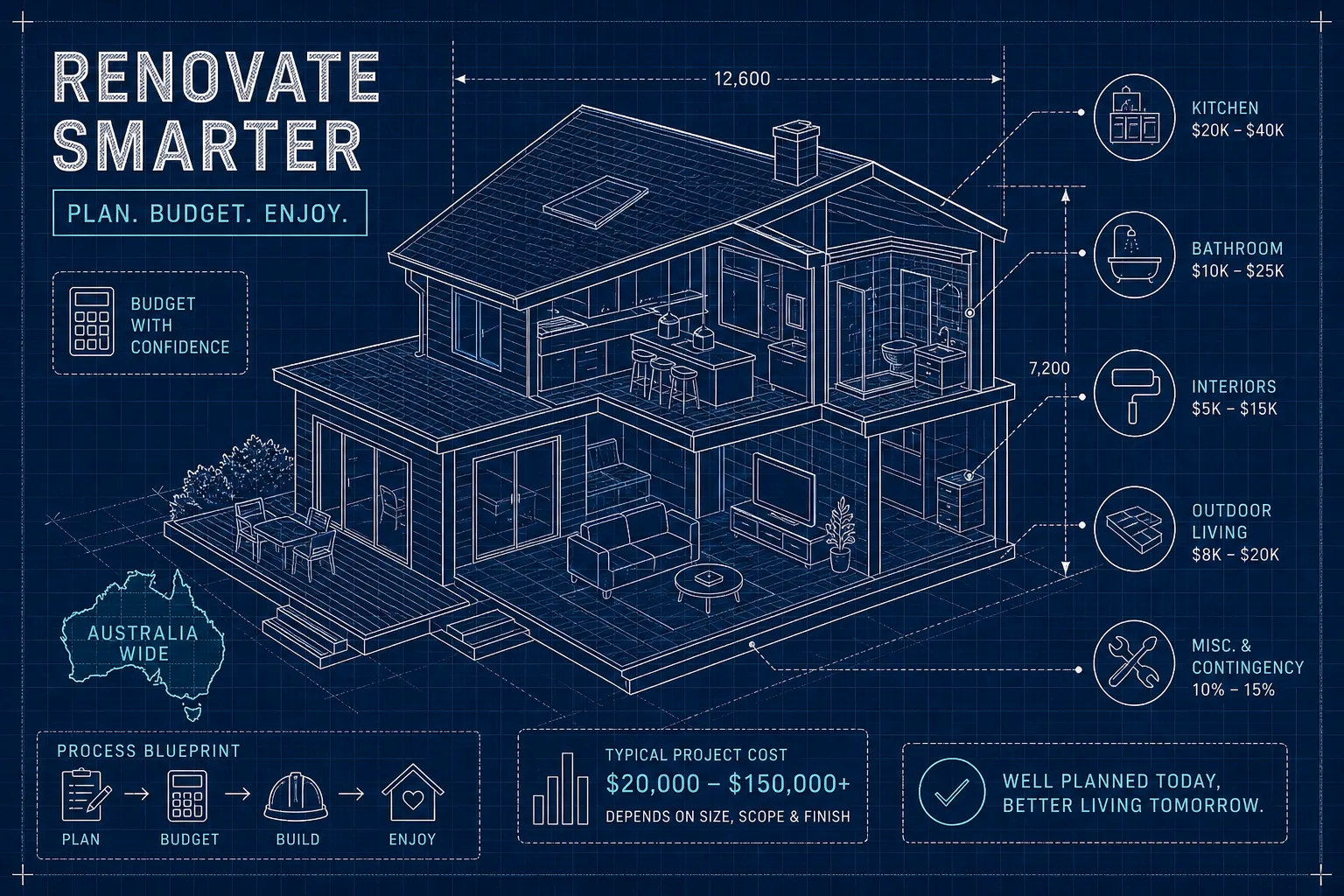
Kitchens are among the most commonly renovated spaces in Australian homes, and the cost range is wide. A budget refresh with flat-pack cabinetry and a straightforward layout sits at A$8,000, 20,000. A mid-range full kitchen renovation, with semi-custom cabinetry, stone benchtops, and mid-tier appliances, typically lands between A$25,000 and A$45,000. Premium custom kitchens start at A$45,000 and move well above A$80,000 once you factor in layout changes, high-end joinery, and appliances.
Bathrooms are expensive despite their size, because waterproofing, tiling, plumbing, and compliance requirements are concentrated in a small footprint. A typical full bathroom renovation in 2026 sits between A$25,000 and A$45,000, with lower-cost cosmetic updates below that range and high-end bathrooms pushing significantly higher. A combined kitchen and bathroom renovation commonly lands between A$50,000 and A$120,000, the most common renovation scenario for homeowners updating a tired property.
Ensuites, open-plan living, and bedrooms
A standard ensuite renovation in 2026 typically runs A$20,000, 35,000, slightly less than a full bathroom in most cases because the footprint is smaller and the scope is usually more defined. Open-plan living and kitchen combinations carry the widest cost range of any project type, commonly A$40,000, 100,000+, because scope varies so dramatically once you factor in flooring, lighting, layout changes, and the kitchen itself.
Bedrooms are the most affordable room to renovate. Cosmetic work, including paint, flooring, and light fittings, typically sits at A$5,000, 15,000. Once you add built-in wardrobes, electrical upgrades, and new flooring throughout, costs push toward A$15,000, 20,000+. Bedrooms represent the clearest opportunity to manage home renovation costs without sacrificing liveability.
How your location shifts the renovation price
Geography is one of the biggest cost levers in any Australian renovation. A mid-range bathroom in Sydney costs noticeably more than the same renovation in Brisbane or a regional town, and applying national averages to a local project without adjusting for location is one of the most common budgeting mistakes homeowners make.
Sydney is consistently the most expensive market, with mid-range per-sqm rates of A$3,000, 5,000+ and whole-house renovation ranges of A$120,000, 450,000+ for full projects. Sydney renovation costs run approximately 15% above the national average for standard scope, and around 20% above for heritage or complex structural work. Melbourne and Canberra sit in the next tier, with some 2026 guides placing Melbourne mid-range rates at A$4,800, 6,800/m² for certain project types, though this partly reflects different project definitions across sources. Brisbane generally runs a fraction below the two southern capitals, with mid-range guides citing A$4,500, 6,000/m² for comparable work.
Regional areas generally benefit from lower labour overheads, with Perth and Adelaide typically running 10, 20% cheaper than Sydney for equivalent scope. The catch is that remote projects introduce logistics and access costs that can close the gap quickly, particularly if specialist trades need to travel to site. If you’re renovating in a regional area, confirm explicitly whether travel and accommodation costs for trades are included in the quote before you compare it against a capital-city price.
What actually drives a renovation quote
Understanding where the money goes in a renovation budget gives you a practical lens for reading any quote you receive. A typical Australian renovation in 2026 breaks down roughly as follows: labour at 35, 50% of total budget, materials and finishes at 20, 25%, and specialist trades such as plumbing, electrical, tiling, and waterproofing at 20, 30%.
On a A$100,000 renovation, that means labour alone is typically A$35,000, 50,000, with trades adding another A$20,000, 30,000. Labour is almost always the largest single line item, particularly in wet-area and structural renovations. Any quote with an unusually low labour component is worth interrogating. The work doesn’t disappear from the scope, it either gets absorbed somewhere else in the pricing or signals that the contractor is planning to cut corners.
Permits, engineering, and compliance typically account for 5, 10% of the total budget, but that share rises when a project involves structural changes, extensions, or council scrutiny. In dollar terms, permits and certifier costs commonly add A$1,500, 20,000 depending on project scope and location. These costs rarely appear prominently in initial quotes, which means homeowners who don’t ask about them specifically often discover them late in the process.
Hidden costs and the right contingency to set aside
Most renovation budget blowouts are not caused by scope changes that homeowners choose. They’re caused by what gets discovered once walls and floors are opened up. Planning for it upfront is simply good budgeting.
The major hidden cost categories with 2026 ranges are:
- Asbestos removal: A$5,000, 30,000, with older homes carrying the highest risk
- Structural repairs (termite damage, foundation issues, undersized framing): A$10,000, 50,000
- Electrical upgrades and switchboard replacement: A$3,000, 20,000
- Plumbing relocation or replacement: A$3,000, 15,000+
- Waste removal and skip bins: A$3,000, 12,000
- Temporary accommodation during major works: A$500, 1,500 per week
- Scope creep in kitchens and bathrooms: A$2,000, 5,000 on average
The contingency guidance that comes up consistently across 2026 renovation data is tiered by project type. Budget 10, 15% for cosmetic or single-room renovations, 15, 20% for full-home projects, and 20, 25% for older or heritage homes where hidden issues are most likely. Contingency is not optional padding: it is a structural part of any renovation budget. Older homes almost always sit in the higher tier, and underestimating this is the single most consistent cause of projects running out of funds before completion.
How to sense-check a quote before you commit
Getting an accurate quote starts with how clearly you brief the job. A written scope of works, your preferred finish tier, a realistic timeline, any known structural concerns, and a clear statement of what is included versus excluded will all produce a more accurate response from any contractor. Vague briefs produce vague quotes, and comparing a vague quote against a detailed one is not a meaningful comparison.
For any renovation above A$20,000, getting at least three quotes is commonly recommended practice in Australia. Reviewing them side by side with a consistent scope forces contractors to price the same job, which makes outliers on the high or low end immediately visible. A quote that comes in significantly below others deserves as much scrutiny as one that comes in significantly above.
Before you accept any quote, benchmark it against independent pricing data. NameTheCost.com provides cost guides across trades, project types, and cities, so you can verify whether A$45,000 for a bathroom is reasonable in your suburb before you sign anything. According to the site, its guides are built on real market data rather than sponsored content or referral commissions. Use the benchmarks as a cross-check, not a replacement for professional quotes, and you’ll go into any negotiation with a clear view of what fair market pricing looks like.
Putting the numbers together
The key figures from this guide are worth keeping in one place. Per-sqm rates sit at A$2,000, 3,000 for budget, A$3,000, 5,000 for mid-range, and A$5,000, 7,000+ for premium finishes. Kitchens typically run A$25,000, 45,000 for mid-range work, bathrooms sit in the same band at A$25,000, 45,000, and a full-home renovation across 150 m² can easily land between A$375,000 and A$600,000. Sydney carries the highest price premium of any Australian city, running roughly 15, 20% above the national average depending on project type.
The contingency rule is non-negotiable: 10, 15% for simple projects, 15, 20% for full-home renovations, and 20, 25% for older homes. Hidden costs including asbestos removal, structural repairs, and electrical upgrades have derailed more Australian renovations than any contractor mistake. Planning for them upfront is what separates a renovation that finishes cleanly from one that runs out of budget at the worst possible moment.
Before you commit to any renovation contract, check current home renovation costs for your suburb at NameTheCost.com. Independent pricing data across Australian trades and project types gives you the benchmark you need to negotiate with confidence and avoid overpaying for work that should cost far less.
Frequently asked questions about home renovation costs in Australia
How much do home renovation costs typically run for a full house?
A full-home renovation in Australia typically costs between A$375,000 and A$600,000 for a 150 m² property at mid-range finish level, based on 2026 market data. Per-sqm rates range from A$2,000, 3,000 for budget work up to A$5,000, 7,000+ for premium finishes. Your final figure will depend heavily on city, project complexity, and the condition of the existing structure.
What is the most expensive room to renovate?
Kitchens and bathrooms consistently carry the highest renovation costs per square metre. A mid-range kitchen renovation typically runs A$25,000, 45,000, and a full bathroom sits in the same range. Their concentrated plumbing, waterproofing, tiling, and compliance requirements drive costs far above simpler spaces like bedrooms.
How much contingency should I budget for a renovation?
The standard guidance is 10, 15% for cosmetic or single-room renovations, 15, 20% for full-home projects, and 20, 25% for older or heritage homes. Contingency covers structural surprises, asbestos removal, and scope changes once works begin, categories that affect a significant proportion of Australian renovations.
Do home renovation costs vary much between cities?
Yes, significantly. Sydney is the most expensive market, running approximately 15, 20% above the national average. Melbourne and Canberra follow closely. Brisbane sits slightly below the southern capitals, while Perth and Adelaide typically run 10, 20% cheaper than Sydney for equivalent scope. Regional areas can be cheaper on labour but may attract travel costs for specialist trades.