How Much Does Bathroom Waterproofing Cost in Australia
You’ve got a quote from a tiler. It includes “waterproofing” somewhere in the middle, probably as a single line item, and you have no idea whether that number is fair or whether it covers what it legally needs to cover. Many homeowners find themselves in exactly this position when a bathroom renovation gets underway. Bathroom waterproofing is commonly under-specified and underpriced, because most homeowners are focused on the tiles, the fixtures, and the look of the room. The membrane behind the tiles gets almost no attention. That’s a problem.
Before you sign off on anything, you need to understand what a compliant job actually involves, what products it requires, and what it should cost in your state. This article breaks all of that down. NameTheCost.com publishes state-by-state cost guides based on real local pricing, worth cross-referencing before you accept any number a tradie puts in front of you.
What the law actually requires for wet-area waterproofing
Two documents govern domestic bathroom waterproofing in Australia: NCC 2022 (specifically the Housing Provisions, Part 10.2) and AS 3740:2021, the Australian Standard for waterproofing of domestic wet areas. These apply to Class 1, 2, and 4 buildings, which covers the vast majority of houses and residential units. These aren’t suggestions or best-practice guides. They are the minimum legal requirements.
The wet areas covered under this framework include bathrooms, showers, laundries, and sanitary compartments. Kitchens are excluded. Within a shower recess specifically, the requirements are:
- the entire shower floor must be waterproofed
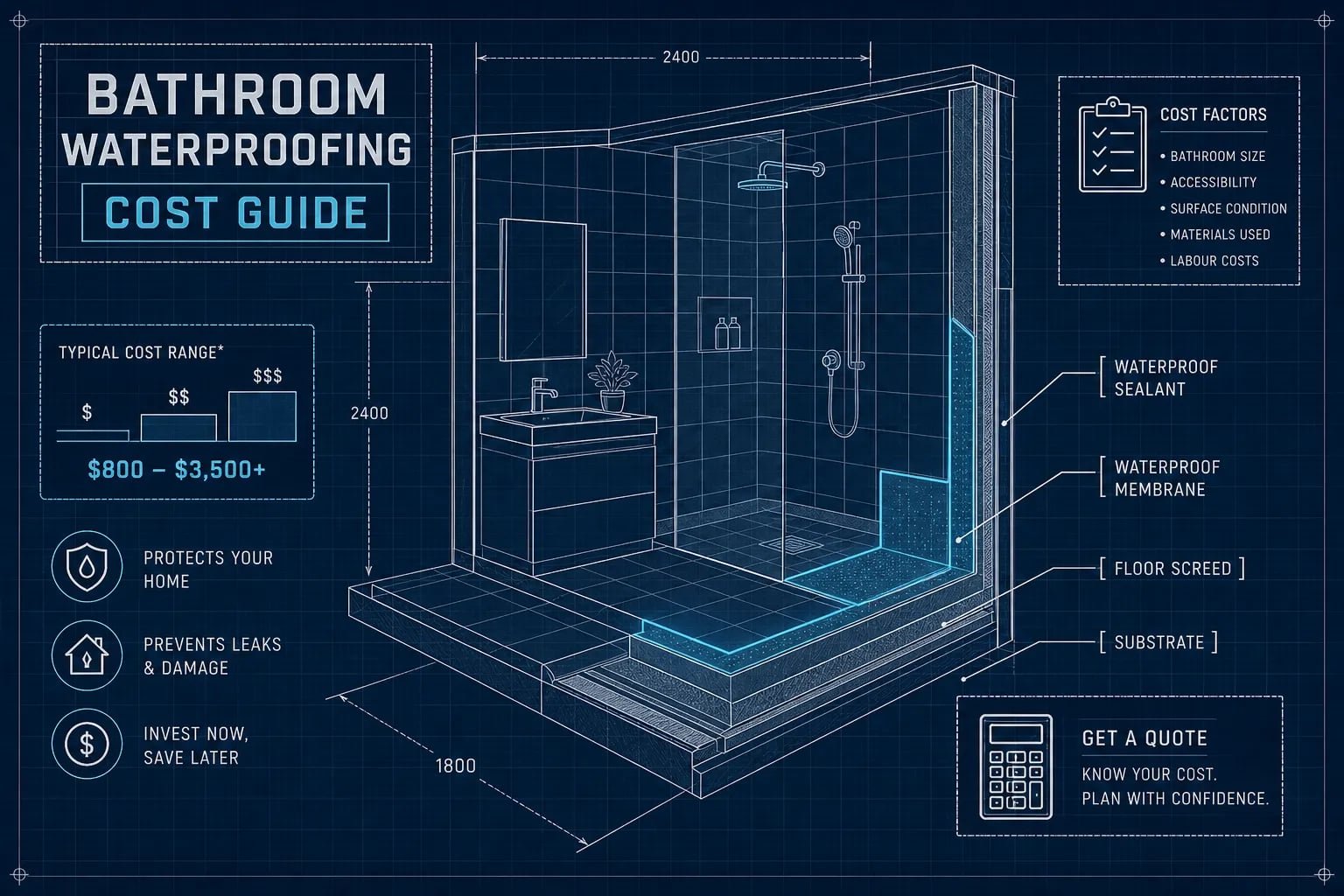
- walls must be waterproofed to at least 1,800 mm above the floor substrate
- all wall-to-wall and wall-to-floor junctions must have waterproofing extending at least 40 mm either side
- every pipe penetration and waste outlet must be fully sealed
Here’s the thing most homeowners don’t know: tiles and grout are not the waterproofing layer. The membrane applied to the substrate before tiling is the barrier. Grout is porous. Tiles crack. The membrane is what keeps water out of your walls and subfloor. If it’s missing, undersized, or applied incorrectly, the tiles on top mean nothing.
Connecting compliance to cost is straightforward. A bathroom waterproofing job that meets AS 3740:2021 requires greater product coverage, thorough detailing at junctions, and more labour time than a quick single-coat brush-over. If a quote looks unusually cheap, one or more of those requirements has likely been dropped. When leaks appear later, the financial and legal exposure can fall heavily on the homeowner, so it pays to check contracts, warranties, and installer insurance before committing.
Bathroom waterproofing: membrane types and what they mean for your invoice
Liquid membranes are the standard choice for under-tile applications in domestic bathrooms across Australia. Products like ARDEX WPM 155, Mapei Mapelastic Smart, and Crommelin Shower Waterproofing Membrane all sit in this category. They are brushed or rolled on in multiple coats, form a seamless coating around complex shapes, and handle tight spaces well. For materials alone, liquid membrane systems typically cost $15 to $40 per m².
Sheet membranes are rarely used in domestic bathroom floors. They appear more often in higher-risk applications like podium slabs or below-grade areas where consistent membrane thickness matters more than flexibility around complex geometry. If you see them listed in a domestic bathroom quote, ask why.
Bond-breaking tapes, reinforcing fabric, preformed corner units, and primers are different: these should appear on a compliant quote. They are not extras and they are not padding. Tapes, preformed corners, and reinforcing fabric are applied at junctions and internal angles, which are the most failure-prone points in any shower recess. Primers go on porous or dusty substrates to ensure the membrane bonds correctly. If none of these line items appear, the quote is describing an incomplete job.
What licensed waterproofers charge by state in 2026
Professional bathroom waterproofing in Australia costs between $40 and $100 per m² installed. For a standard bathroom, the waterproofing component alone typically lands between $500 and $1,000. Larger ensuites or more complex layouts can push that to $1,500 or beyond, before any tiling or other trades are factored in.
State pricing varies meaningfully. Sydney sits at the upper end, commonly $50 to $100 per m², driven by higher trade labour costs across NSW generally. Brisbane has been quoted at $60 to $120 per m² depending on membrane type and project complexity. Melbourne and Adelaide are broadly mid-range. Perth can carry a premium due to tradie availability, particularly for specialist waterproofing work; Darwin’s market is more variable and worth getting at least three local quotes before drawing any conclusions. Licensed waterproofer labour rates across the major capitals run between $45 and $110 per hour in 2026, well above the award minimum, because commercial rates include licensing, travel, and overhead.
Regional pricing doesn’t follow a simple pattern. In some regional areas, fewer licensed waterproofers mean less competition and higher rates. In others, lower overheads bring costs down. The safest approach is to collect at least three quotes in your area and measure them against an independent reference. NameTheCost.com publishes state-by-state waterproofing cost data based on real Australian pricing, which gives you a genuine benchmark before you accept any quote.
One practical requirement: a professional quote should itemise waterproofing separately from tiling labour. If your tiler bundles everything into a single job price without separating out the waterproofing scope, you have no way of knowing what you’re paying for compliance. Ask for the membrane brand, the number of coats, and the coverage area in square metres. Those three pieces of information tell you immediately whether the scope matches what’s legally required.
What a compliant shower waterproofing line item looks like
A properly itemised waterproofing scope in a quote might read something like this:
- Membrane: ARDEX WPM 155 liquid membrane, 6.2 m² shower recess and floor
- Application: Two coats to AS 3740:2021 wet-film thickness requirements
- Tapes and corners: Bond-breaking tape to all wall-to-floor and wall-to-wall junctions; preformed corner units at internal angles
- Flood test: 24-hour water test prior to tiling, included
- Certificate: Waterproofing compliance certificate issued at completion
If your quote doesn’t show this level of detail, ask for it in writing. A tradie who can’t or won’t itemise the scope is one you should be cautious about engaging.
What drives the cost up on your specific job
Bathroom size is the obvious driver, but complexity matters just as much. A small 4 m² bathroom with a single shower recess is a fundamentally different job from a large ensuite with a double shower, a freestanding bath, and a separate wet room. Internal angles, shower niches, hobs, and multiple pipe penetrations all require additional detailing time at every junction.
Substrate issues
Existing damage and substrate problems are where renovation budgets blow out. If the substrate has cracks, moisture ingress, or old waterproofing that needs stripping before the new membrane goes on, the job becomes a rectification project. Rectification can cost significantly more than a standard installation; in some cases the removal and repair cost exceeds the original bathroom waterproofing price entirely. A contingency of around 10 to 15 per cent is a reasonable buffer to set aside for any renovation involving tile removal, treat it as a planning guide rather than a fixed rule, since substrate conditions vary considerably. Substrate surprises are not the exception. They are the norm.
Complex layouts
New builds typically offer clean substrates, clear access, and few unknowns. Renovations almost always reveal something once tiles come off. A double shower with a hob, multiple niches, and a floor waste in a corner involves far more junction detailing than an open, rectangular recess. Each additional element adds labour time and material cost. Price your contingency before you start, not after.
DIY vs hiring a licensed waterproofer
The maths on DIY looks attractive on the surface. Materials cost $15 to $40 per m², which is substantially less than the $40 to $100 per m² professional rate. But that comparison doesn’t include primer, tapes, preformed corner units, detailing at penetrations, or the cost of rework if the membrane fails an inspection.
Licensing and certification requirements for wet-area work vary by state and territory. In NSW, for example, residential waterproofing work tied to a building approval requires a licensed tradesperson to sign off. The requirements in other jurisdictions differ, so check the rules that apply in your state before deciding to self-manage. Beyond the paperwork, a waterproofing certificate provides genuine protection: if a leak causes damage and you need to make an insurance claim, the certificate is your evidence that the work was done to standard. A DIY job typically cannot produce that documentation.
Shower waterproofing also requires a flood test. Ponding the shower with water for 24 to 72 hours before tiling is the standard check that the membrane is continuous and watertight. A licensed professional includes this as part of the process. A DIY job that skips it creates a risk that may not surface for months or years. By then, the waterproofing warranty has likely lapsed, tiles are bedded in, and the repair bill starts at $3,000. Full bathroom strip-outs and redo jobs run $3,000 to $8,000 or more, and if water has reached wall framing or subfloor, costs can exceed $15,000.
How to read a waterproofing quote before you sign
A compliant bathroom waterproofing quote should specify the membrane brand and product name, the number of coats and target wet-film thickness, the areas to be waterproofed in square metres, and confirmation that the work will meet AS 3740:2021. It should state whether a flood test is included and whether a waterproofing certificate will be issued at completion. If any of those elements are absent, ask for them in writing before committing.
Red flags on a quote are specific. Be cautious of any quote that doesn’t name the membrane product, bundles waterproofing into a tiling rate without separating it out, or proposes to waterproof and tile over it on the same day. Proper curing takes time, and rushing it compromises the membrane. A quote dramatically below the state average almost always means something is missing. That something is usually compliance.
Ask the tradie which membrane system they’re using and whether it carries a warranty. Ask whether the quote includes membrane tape, preformed corner units, and junction detailing throughout. Ask how long they allow between the final coat and tiling. Then ask directly: “Will you issue a waterproofing certificate at completion?” The answers to those questions tell you more about the quality of the job than the price does.
What the numbers add up to
The cost range covered above, $40 to $100 per m² installed, with most standard bathrooms landing under $1,000 for the bathroom waterproofing stage, reflects compliant work done to NCC 2022 and AS 3740:2021 standards. That means specific zones, correct membrane thickness, thorough junction detailing, and certification. The cheapest quote rarely delivers all of those things.
Knowing the real benchmark for your state means you walk into any quote conversation with confidence. You can ask the right questions, spot the gaps, and compare what you’re being offered against what compliance actually demands. Before you accept any waterproofing quote, cross-check it against NameTheCost.com’s independent pricing data for your state. It’s the kind of reference that takes five minutes and can save you from a very expensive mistake.
Waterproofing done right is invisible forever. Waterproofing done wrong shows up at the worst possible time, usually after the tiles are down, the bathroom is in use, and the rectification cost is several times what the compliant job would have been. Get it right the first time.