Car Wrapping Price Australia: Full Cost Breakdown 2026
Car wrapping price in Australia varies considerably depending on film choice, vehicle size, and labour, and knowing the real market range before you commit is the difference between a fair deal and an expensive lesson. Australians are using vinyl wraps for colour changes, paint protection on new vehicles, and commercial fleet branding at a rate that’s made it a mainstream trade service. Yet price transparency from installers remains patchy at best. Quotes often arrive as a single number with no breakdown of materials, labour, or prep work, leaving buyers with no clear sense of whether what they’ve been offered is reasonable.
That’s exactly the gap that resources like NameTheCost.com are built to fill. Before you commit to any trade or service quote in Australia, whether it’s a kitchen renovation or a vinyl wrap, knowing the real market range puts you in a far stronger position. This guide pulls together 2026 price ranges for car wrapping across Australia, the main cost drivers, the film quality question, and the city-by-city differences that most wrap articles gloss over entirely.
Car wrapping price Australia: what it actually costs in 2026
Here’s where the market sits right now across the main wrap categories.
Full car wrap price ranges
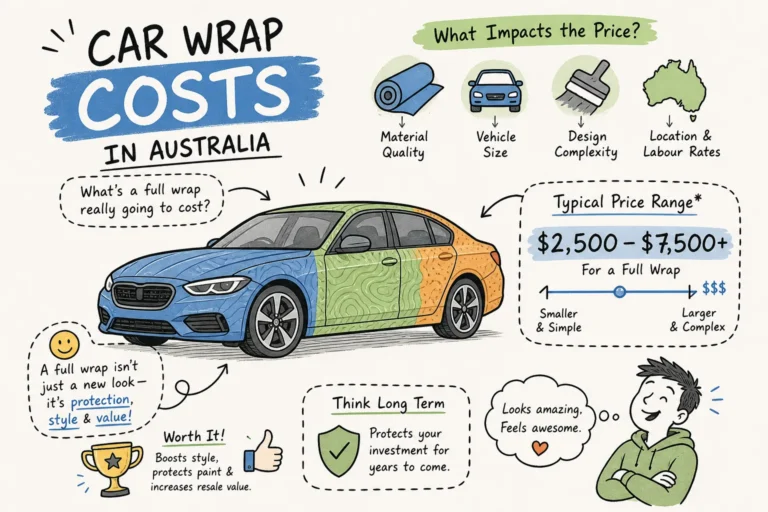
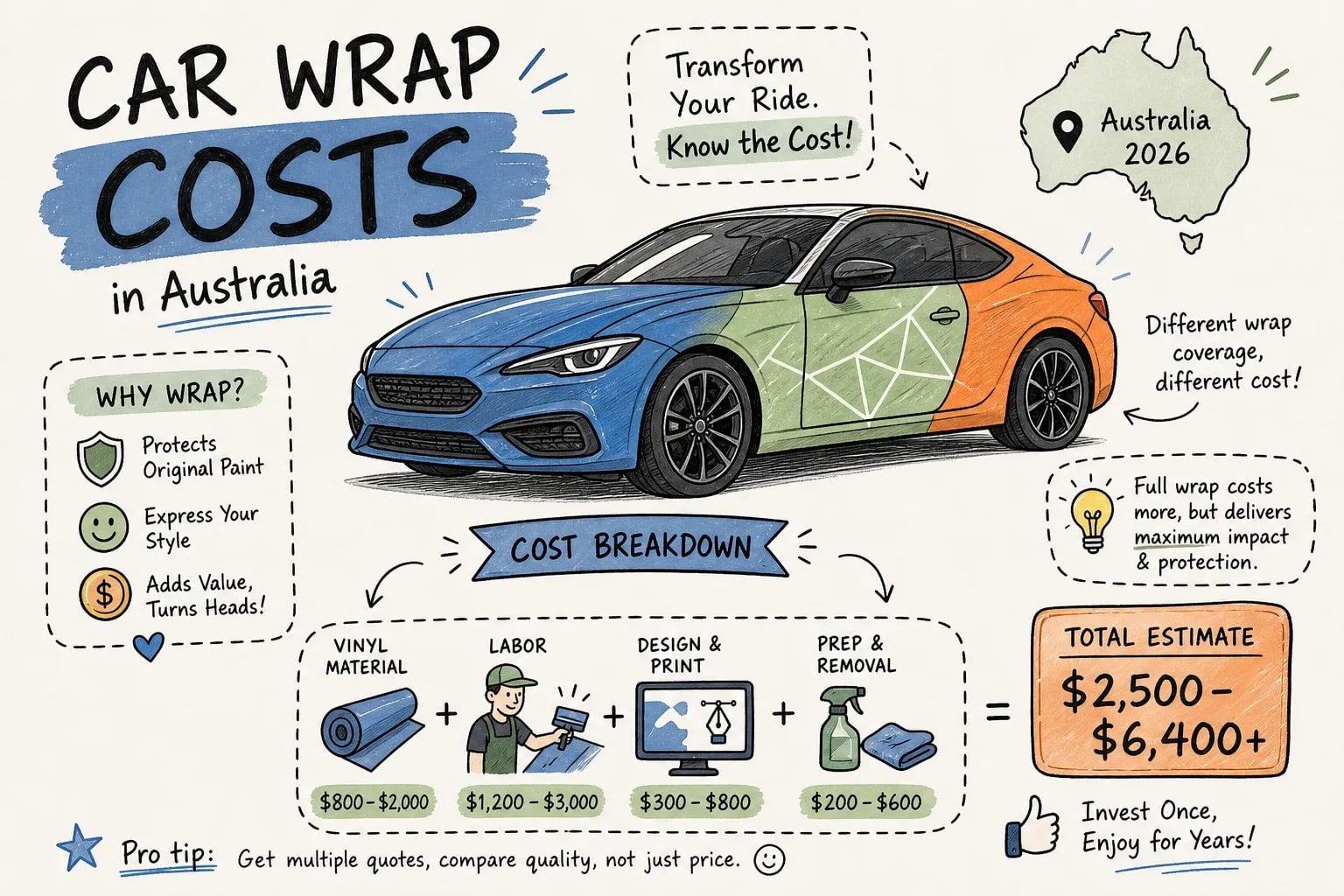
A full wrap on a standard vehicle (think a sedan or a mid-size hatch) typically runs between $3,000 and $6,000, with the national market range extending to $7,000 or beyond for premium finishes or larger vehicles. Chrome, brushed metal, and colour-shift films push the number toward the upper end and beyond. Even for the same model, quotes can vary by $1,000 or more between installers because the scope of what’s included differs: some quotes bundle paint prep, others don’t; some use premium cast film, others use whatever’s in stock.
Partial wraps, bonnet wraps, and accent graphics
Partial wraps typically run $500 to $2,500 depending on coverage and complexity, and they’re the go-to choice for commercial messaging or branding on business vehicles. Bonnet and roof panel wraps generally sit around $300 to $600 each, though pricing varies by shop and vehicle condition, and they’re popular for contrast colour looks where the owner wants a two-tone finish without a full repaint. Accent graphics and stripes start around $200 for simple designs and can reach $1,500 or more for elaborate custom work.
Colour-change wraps and specialty finishes
A colour-change wrap is a full wrap by definition, but it commands a premium when the chosen finish is anything other than standard gloss. Satin, matte, brushed aluminium, and colour-shift finishes all carry a material cost premium on top of the base installation price. Budget accordingly: a colour-change job in a specialty finish on a standard sedan will sit toward the upper end of the full wrap range, and often beyond it.
How vehicle size and type affect the car wrapping price
The rule is straightforward. More surface area means more film and more installation time, and each adds directly to the invoice. A larger vehicle can add $500 to $1,500 in material cost alone, before labour is factored in.
From small hatch to full-size SUV
A small hatch like a Toyota Corolla typically sits in the $1,500 to $3,500 range for a full wrap. A mid-size SUV like a RAV4 moves that up to roughly $3,000 to $5,500. A full-size SUV like a LandCruiser lands between $4,000 and $6,500. These brackets reflect both the additional film required and the extra installation hours needed to work around larger panel areas, more complex trim, and a greater number of curved surfaces.
Utes and commercial vehicle wrapping costs
Utes such as the Toyota HiLux or Ford Ranger typically fall in the $3,500 to $5,800 range for a full wrap, though the cab and tray configuration affects installation complexity and can push that higher. Commercial vehicle branding is priced differently again. Signage wraps, fleet graphics, and full commercial body wraps involve design and print production as separate line items that sit on top of the base installation cost. If you’re wrapping a work vehicle for branding purposes, get those design fees itemised before you agree to anything.
Film choice makes a bigger difference than most people realise
This is where buyers get misled the most. The brand name on the film matters far less than whether it’s a cast or calendered product, a distinction that affects longevity, conformability, and ultimately whether you’re getting value for money.
3M car wrap price and Avery Dennison vs budget calendered vinyl
Cast films, including 3M’s 2080 and 1080 series and Avery Dennison’s comparable premium lines, are manufactured differently from budget calendered vinyl. Cast films are formed over a mould, which gives them consistent thickness, better conformability around complex curves, and a much longer service life. Premium cast films from 3M and Avery Dennison perform similarly in real-world use and typically sit in the same shop-installed pricing tier. Budget calendered vinyl is cheaper per metre but is not suitable for a full wrap: it doesn’t conform well to complex shapes, and it fails faster. The saving is false economy on a full wrap job.
Real-world lifespan expectations
Premium cast films last 5 to 7 years in real-world conditions with proper care, and manufacturer warranties extend to up to 8 years on vertical surfaces. Budget calendered films commonly fade, shrink, or peel within 2 to 5 years, with budget grades often failing closer to the 2 to 3 year mark. If you’re spending $4,000 on a full wrap, the cost-per-year case for using a premium film is obvious. Ask your installer specifically which product they’re using and whether it’s cast or calendered before you sign off on anything.
What’s actually driving the labour costs
Most people focus on the material price. Labour and prep work represent a large share of any wrap quote, and they’re where the real variation between installers shows up.
Paint correction and panel prep add-ons
Paint correction before wrapping typically adds $400 to $1,500 or more depending on the stage required. A single-stage correction generally runs $400 to $650; a two-stage correction runs $600 to $1,000; heavily damaged panels can push the prep cost higher still. These figures vary by shop and vehicle condition, so always ask for this to be itemised. Paint prep isn’t optional if you want the wrap to adhere properly and last its full lifespan. A shop that skips paint prep isn’t saving you money; it’s shortening the life of the wrap and potentially damaging your paint when the film is removed.
Design complexity and installation time
Installer labour rates in Australia typically run $75 to $150 per hour, with $100 per hour a common working rate. A straightforward colour-change on a smooth-panelled sedan takes considerably less time than a vehicle with deep character lines, recessed door handles, complex bumper detailing, and mirrors that require careful film management. Any shape that makes installation harder adds time, and time adds cost. This is why two vehicles of similar size can carry meaningfully different installation quotes.
Does your city change what you pay?
Most wrap price guides quote a national range and leave it there. In Australia, where labour market conditions and overhead costs vary significantly between capital cities, location makes a real difference.
Sydney and Melbourne vs the rest
Sydney is generally the most expensive market for trade and service work in Australia. Business overheads are greater, and skilled labour tends to command a premium, a pattern that reflects the city’s broader cost structure rather than anything specific to wrapping. Melbourne generally follows, with prices running somewhat lower across most trade services. As a rough guide based on overall trade cost differences between the two cities, a full wrap quoted at $5,000 in Sydney may come in at $4,500 to $4,700 from a comparable Melbourne installer, though individual shop pricing will vary, and it’s worth getting quotes in your own city rather than relying on these as fixed differentials.
Brisbane, Perth, and Adelaide
Brisbane and Perth sit in a mid-range band for trade services, generally below Melbourne pricing. Adelaide is typically the most affordable of the five capitals for wrap installation and trade work generally. Regional areas outside the capitals can also offer lower pricing, but installer availability and quality vary more, and it’s harder to assess a shop’s track record without local referrals. The practical takeaway: if you’re in Sydney and considering a significant wrap job, it’s worth knowing that a comparable install in Brisbane or Adelaide may cost meaningfully less.
Getting a quote you can actually trust
What to clarify before you book
Before you accept any wrap quote, ask these questions directly:
- Is the material cost itemised separately from labour?
- Which film brand and grade is included, and is it cast or calendered?
- Does the quote include paint correction if the paint condition requires it?
- What’s the warranty on the installation, separate from the film manufacturer’s warranty?
- How is edge finishing handled, tucked under panels or cut at the edge?
A professional installer will answer all of these without hesitation. Vague responses to any of them are a signal worth taking seriously before you hand over a deposit.
Benchmarking your quote independently
When checking any wrap quote against the broader market, an independent pricing resource gives you a reliable reference point before you commit. NameTheCost.com covers real Australian pricing across trades and services, including cost guides designed to give consumers a clear benchmark. It’s the same logic you’d apply to a building quote or a legal fee: know the market first, then decide.
Car wrapping price Australia: the bottom line for 2026
Car wrapping price in Australia in 2026 ranges from a few hundred dollars for accent work to $7,000 or more for a full premium wrap on a large vehicle. The final price is driven by vehicle size, film quality, paint preparation, installation complexity, and where in Australia the work is being done. None of those variables are hidden once you know to ask about them.
The cheapest quote is not automatically the best value. A cut-price installer who skips paint prep or wraps your car in budget calendered vinyl will cost more in the long run through premature failure or paint damage on removal. Do the homework before you book: ask the right questions, get the line items broken down, and use an independent resource to verify that the car wrapping price Australia installers have quoted you reflects the real market. Walk into that conversation informed, and you’ll be in a far stronger position to make a decision that holds up.