Contractor Insurance Costs in Australia: What Tradies Pay
General contractor insurance cost is a line item that lives quietly inside every contractor’s quote. Clients rarely see it called out separately, and it often doesn’t appear on the invoice with a label, but it’s there, typically built into the hourly rate or the project price a tradie puts in front of you. Whether you’re a contractor working out what you need to carry, or a homeowner staring at a quote that feels steep, understanding what construction insurance actually costs in Australia is worth the time it takes to read this.
The numbers below are real. Not vague brackets. Not “it depends” shrugs. Actual premium ranges, rate logic, and the factors that move costs up or down for Australian tradies in 2026. If you’ve ever wanted a benchmark before calling a broker or accepting a quote, this is it. NameTheCost.com exists precisely for moments like this: giving Australians independent, no-spin pricing data so they can assess what they’re being told before they sign anything.
The three cover types every Australian contractor needs to understand
Public liability: the non-negotiable
Public liability insurance covers third-party property damage or bodily injury caused by your work or your team on-site. If a subcontractor drops something on a client’s vehicle, or a customer trips over equipment left in a walkway, this is the cover that responds. For most builders, subbies, and general contractors, it’s not optional. Commercial sites require it before you set foot on them, and residential building contracts often mandate it before work begins. It’s the floor of any contractor’s insurance programme, not an optional extra.
Professional indemnity: who actually needs it
Professional indemnity (PI) insurance is not for every tradie. It applies when a contractor designs, specifies, advises, or makes decisions that a client relies on financially. Design-and-construct operators, project managers, building certifiers, and structural engineers sit in this category. A carpenter framing walls on someone else’s design, or a tiler following a plan handed to them, generally doesn’t need PI cover. Getting clear on whether your work involves professional judgement that others rely on is the fastest way to avoid paying for cover that doesn’t fit your actual scope.
Tools and equipment insurance: the one tradies often skip
Tools insurance is a standalone policy, not a component of public liability, and that’s where tradies get caught out. On-site theft is a well-recognised risk across Australia. A van break-in can wipe out thousands of dollars in hand tools, power tools, and specialist gear overnight. The physical kit that makes the work possible is not covered under a public liability policy. It needs its own cover, and skipping it is a false economy that tends to surface at the worst possible time.
General contractor insurance cost, what these covers actually run in Australia
Public liability premium ranges for general contractors
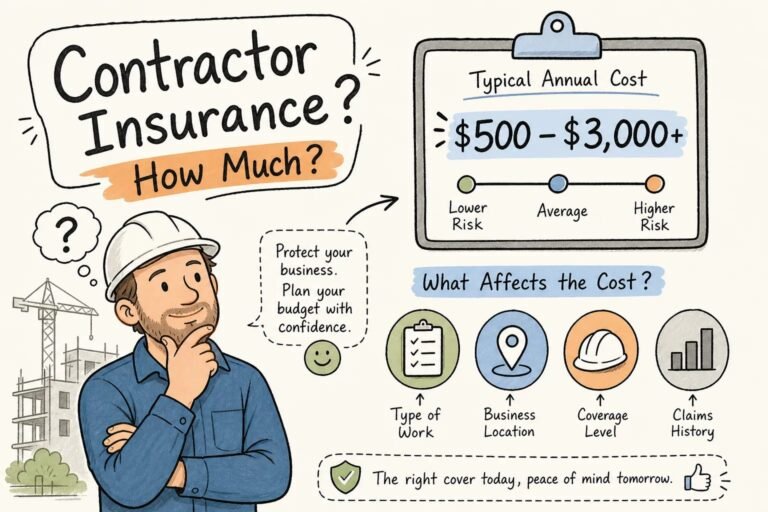
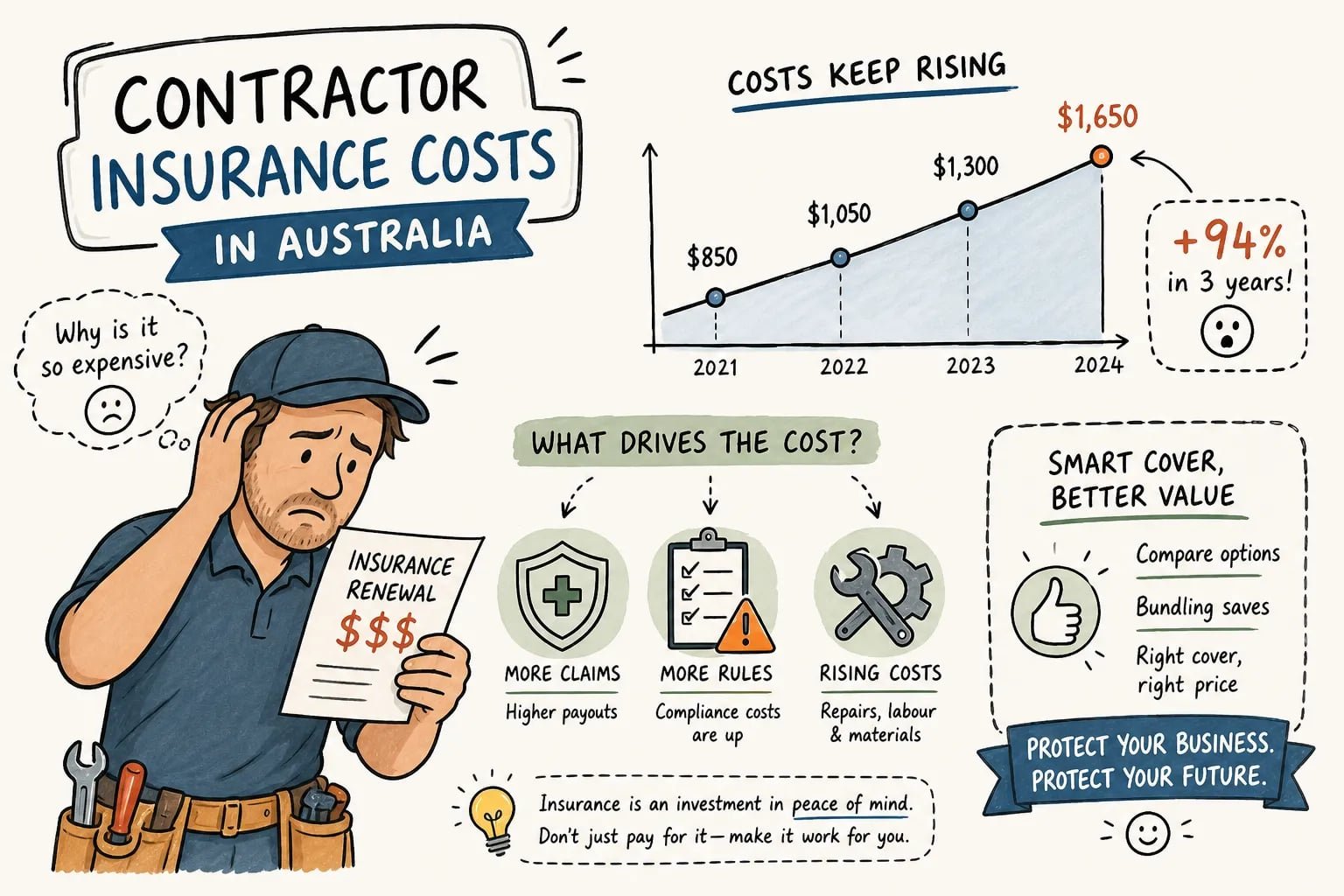
For a general contractor in Australia, public liability insurance typically runs between $1,200 and $3,500 per year, with most medium-risk operators landing somewhere between $1,200 and $2,500 annually. If you need a single working number for planning or quoting purposes, $2,000 per year is a fair midpoint. That sits well above the broader small-business average of $400 to $1,500, because construction work carries materially higher on-site risk than a consulting firm or a retail operation. Higher risk means a higher base rate, that’s not an insurer quirk, it’s loss data.
On cover limits, the jump from $5 million to $10 million public liability typically adds only 10% to 25% to the premium. The step from $10 million to $20 million adds roughly another 15% to 40%. For most contractors, moving to a $10 million or $20 million limit is often cost-effective relative to what it buys you, particularly on commercial or government sites where those limits are contractually required.
Contract works insurance: priced by project value
Contract works insurance (also called construction works or erection all-risks cover) is priced as a percentage of the contract value, typically 0.15% to 0.5% depending on project type, duration, and risk profile. For a $250,000 residential build, expect to pay roughly $300 to $700 for a standard policy. A $1,000,000 project typically falls between $1,500 and $5,000, though larger or higher-risk jobs can push toward $10,000 on some market quotes. The logic is straightforward: the bigger the project, the bigger the insured value, and the premium scales with it.
General contractor insurance cost: tools and professional indemnity budgets
Tools and equipment insurance for a typical tradie with a standard kit runs roughly $300 to $800 per year, with $500 a year sitting comfortably in the middle of the range observed across the market for sole traders and small operations. For contractors with specialist or high-value equipment, that number can exceed $1,000 annually. PI premiums for design-and-construct contractors are tied closely to annual turnover, with premiums commonly estimated at 0.3% to 0.8% of revenue. At $1 million turnover, that points toward $3,000 to $8,000 per year. At $5 million turnover, the range moves to $15,000 or more. The only way to get a number that actually fits your scope is to speak with a specialist broker who understands construction work.
The factors that move your premium up or down
Claims history and trade type: the two biggest levers
Claims history is the single strongest controllable factor in a contractor’s premium. When your file shows losses, the insurer reprices accordingly, on some contractor classes, one or two paid claims can push renewal pricing up by 50% or more, consistent with underwriting guidance across the construction sector. That’s not a threat, it’s the underwriting reality. Trade type sets the base rate before any other factor is applied. Roofing, demolition, excavation, and heavy construction attract materially higher base rates than painting, tiling, or cabinet-making. Loss frequency data backs up that difference; it’s not arbitrary categorisation.
Turnover, location, and project scale
Higher annual revenue means more exposure: more workers on more sites completing more jobs. Insurers treat turnover as a proxy for total risk volume, and premiums scale upward as revenue grows.
Location creates genuine rate differences across Australia because state-by-state regulatory environments and litigation climates affect how often and how severely claims resolve. Project scale affects the cover limits required, and higher limits cost more, though as noted above, the step-up between common limit bands is often more modest than contractors expect.
Why insurance always shows up in a contractor’s quote
How insurance loading works in a tradie’s pricing
Contractors don’t absorb insurance costs out of margin. They can’t afford to, and they shouldn’t have to. These are real, fixed business overheads and they get built into the hourly rate or the project price as a loading. To illustrate the scale: a tradie carrying $2,000 in public liability, $500 in tools cover, and contract works cover on a mid-size project (at a rate of around 0.2% to 0.3% of contract value) is already looking at well over $3,000 in annual insurance overhead before a single tool is unpacked. That loading isn’t padding. It’s cost recovery. A contractor who doesn’t load their insurance into their pricing is one who’ll either cut corners or go under.
How homeowners can assess what’s legitimate
When a quote seems high and you suspect the overhead loading doesn’t match the actual cost, you need a benchmark, not a guess. NameTheCost.com gives Australians access to independent pricing benchmarks across trades and services, including the genuine cost of contractor overheads, so you can assess whether what you’re being charged reflects actual business cost or inflated margin. That’s not about being suspicious of every tradie. It’s about having a reference point that lets you ask an intelligent question rather than either accepting a price blindly or rejecting a fair one.
How to bring your tradie insurance premium down without cutting cover
Review your cover limits and policy structure annually
Most tradies set their insurance once and let it roll over without review. Premiums drift upward at renewal without any coverage change. An annual review against your actual turnover, project mix, and contractual requirements can surface areas where you’re over-insured or paying for limits you don’t need. Bundling public liability, tools, and contract works with one insurer often delivers a package discount somewhere in the 5% to 25% range, though this varies by insurer and policy terms, it’s worth comparing the bundled price against separate policies before committing.
Invest in safety systems and maintain a clean claims record
Safety programmes reduce incident frequency, and incident frequency is what insurers price off. A documented safety plan, regular toolbox talks, and site induction records signal a lower-risk operation to underwriters. The cleanest long-term strategy for holding premiums down is giving your insurer fewer reasons to raise them at renewal. A clean record over three to five years does show up in pricing, particularly with brokers who advocate for their clients during the renewal process.
Work with a specialist construction insurance broker
General comparison platforms price generic policies. A broker who specialises in construction understands the actual risk profile of different trades, knows which insurers are competitive in your state, and can structure a policy that neither over-exposes you nor under-covers you. Broker fees are frequently reported to be offset by the premium saving achieved through specialist market access and negotiation, though outcomes vary depending on your trade, location, and policy complexity. For anything beyond a basic public liability policy, get a specialist broker on the phone.
What this means for you
General contractor insurance cost in Australia follows predictable logic once you understand the moving parts. Public liability runs $1,200 to $3,500 per year for most general contractors. Contract works scales by project value at roughly 0.15% to 0.5% of the contract. PI for design-and-construct operators ties to turnover at around 0.3% to 0.8% annually. Tools cover adds $300 to $800 for most tradies. None of these numbers are identical across two contractors, because trade type, claims history, turnover, location, and project scope all shape the final premium.
For tradies, the next step is a specialist broker quote, an annual policy review, and honest loading of those costs into every price you put forward. For homeowners, it’s having access to independent benchmarks before you query or accept a quote. The numbers in this article give you both. Use them.