General Liability Insurance Cost for Contractors Explained
If you’re asking how much does general liability insurance cost for a contractor in Australia, you’ve come to the right place. Most tradies have no idea what their peers pay for public liability insurance, and most homeowners never think to ask for a certificate of currency before the job starts. Both situations cause real financial pain when something goes wrong on site. This guide gives you actual premium ranges by trade, the factors that move your premium up or down, and a clear framework for benchmarking any quote you receive.
Whether you’re a contractor comparing your renewal notice to the market, or a homeowner trying to understand whether a tradie is properly covered, the numbers here give you a grounded starting point. NameTheCost.com exists to give Australians an independent, no-bias reference before they hire, sign, or spend anything. Contractor insurance costs sit squarely in that territory.
What public liability insurance actually covers for contractors
Public liability insurance covers third-party claims for personal injury or property damage that occur as a result of a contractor’s work or presence on site. A plumber leaves a tool on a stair, a homeowner trips and breaks a wrist: the plumber’s insurer handles the claim. In Australia, “general liability” and “public liability” refer to the same product class, so don’t let different terminology confuse you when reading policy documents or comparing quotes. This guide uses both terms interchangeably, as Australian insurers and contractors do in practice.
What it does not cover is equally important to understand before any dollar figure is discussed. Public liability is not professional indemnity cover, which responds to advice-based errors. It doesn’t cover tools and equipment stolen from a van or damaged on site. It won’t replace your income if you’re injured and can’t work. A contractor who holds only public liability is not covered for all risk scenarios, and any quote comparison needs to account for which risks are actually insured and which are not.
How much does general liability insurance cost for a contractor, premiums by trade
Here are indicative 2026 annual premium ranges for common Australian trades at $5 million public liability cover, based on publicly available insurer and broker data collected through mid-2026. These are planning figures, not locked quotes. Two tradies in the same trade can land in very different spots depending on their turnover, location, and claims history.
- Electricians: $650 to $1,200 per year, with a reported median around $875 to $884 annually for small operators
- Plumbers: $650 to $1,200 per year, with higher-risk or larger operations moving toward $2,200 or more
- Carpenters: $500 to $1,200 per year, with entry-level sole traders sitting toward the lower end of that band
- General builders and building contractors: $800 to $1,500 or more, reflecting larger sites, higher turnover, and greater public exposure
A sole-trader electrician with $50,000 in annual turnover sits at the lower end of the electrician band. A small builder running $300,000 in annual work sits noticeably higher, often approaching or exceeding $1,200 per year before any claims history is factored in. The range is wide because the inputs are personal.
Cover limits change the number significantly. The three common tiers in the Australian market are $5 million, $10 million, and $20 million. Moving from $5 million to $10 million typically adds $150 to $400 per year depending on trade and risk profile. The jump from $10 million to $20 million costs more again but usually not proportionally, the increment is often smaller than the first step. For most residential sole traders, $5 million is the minimum sensible floor. Commercial and government contracts frequently mandate $10 million or $20 million as a condition of engagement, so check your contract requirements before you lock in cover.
The factors that move your premium up or down
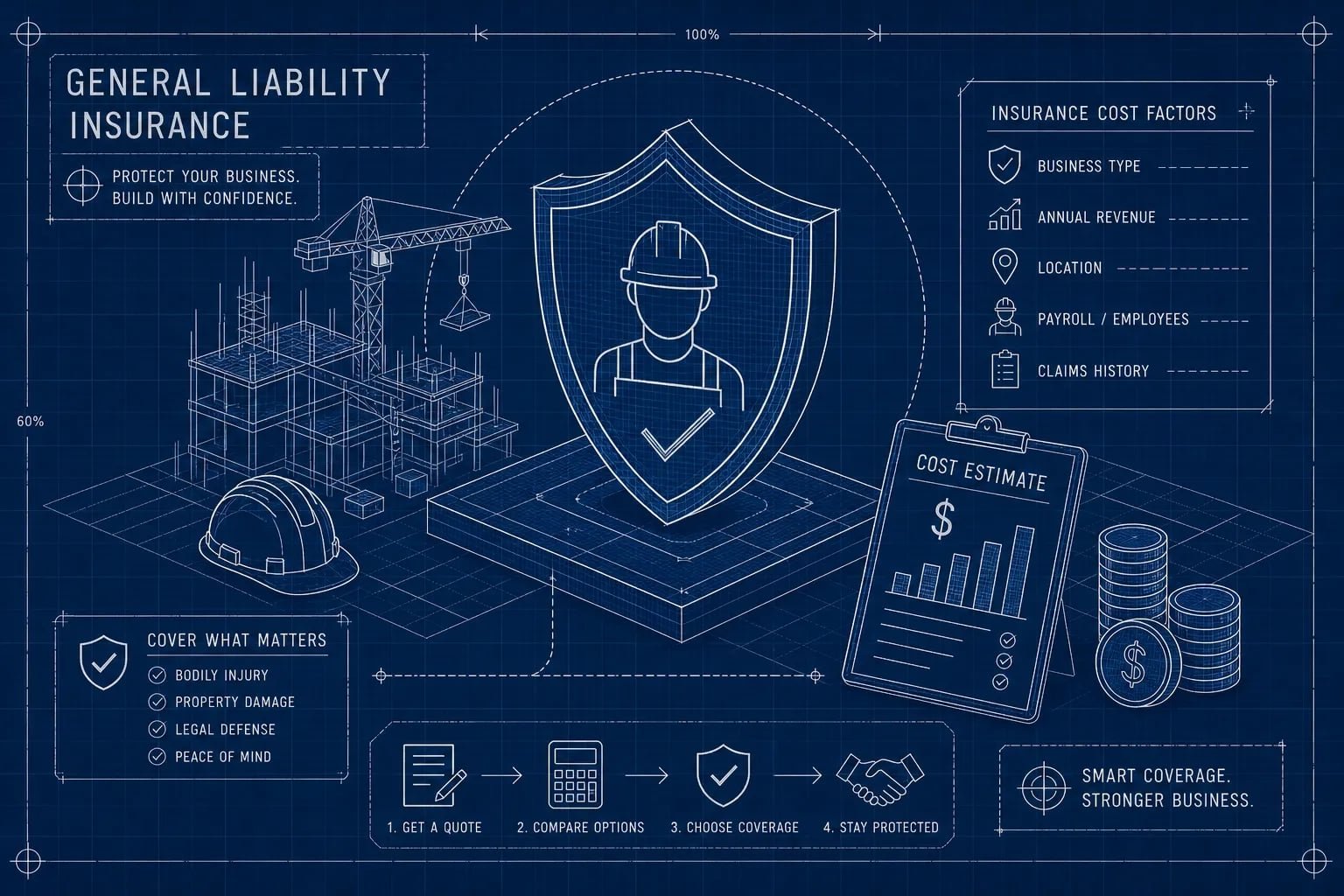
Insurers use trade or class code as the starting point for the base rate. A roofer and a tiler may both call themselves tradespeople, but the insurer sees materially different risk profiles from the outset. That base rate is then scaled by turnover and employee headcount, roughly proportional to business size, though not in a rigid 1:1 ratio. A contractor who doubles their annual revenue should expect their premium to increase, but the increase is rarely a straight doubling.
Location is a heavier pricing lever than most contractors realise. State-based litigation climates, accident rates, and local building standards all feed into the calculation. A contractor doing complex commercial work in a high-density urban area pays more than a sole trader doing residential maintenance in a regional centre. This is not a small gap; in some scenarios the difference between locations is more meaningful than the difference between trades.
Claims history is the most personal modifier of all. A clean loss run keeps premiums competitive and gives you negotiating room at renewal. One or two significant claims in recent years can trigger a meaningful surcharge that lingers for several renewal cycles. Insurers view past claims as the clearest signal of future risk, so protecting that record matters as much as shopping around for better pricing.
How to bring your annual premium down without sacrificing coverage
Raising the policy excess is typically the strongest single lever available to contractors. Moving from a standard $200 to $500 excess up to $1,000 commonly saves 15% to 30% on the annual premium, and some contractors report reductions of up to 40% in specific scenarios. The trade-off is straightforward: a higher excess means a larger out-of-pocket cost when a claim occurs. This approach works well for contractors with solid cash flow and a clean claims history who are comfortable self-insuring for smaller incidents.
Bundling policies under a single business pack is the second major lever. Combining public liability with tools cover, business interruption, or other products typically yields 10% to 25% off the combined premium. Some industry associations and trade bodies negotiate group rates that offer a further 5% to 15% reduction for members. Both options are worth running against a standalone, separately-shopped policy. The bundled total needs to be genuinely cheaper, not just discounted from an inflated base rate. That distinction matters more than it sounds.
One caution worth stating plainly: do not reduce cover limits purely to cut the premium. The incremental cost of moving from $5 million to $10 million cover is modest relative to the exposure gap it closes, particularly for contractors doing any commercial work. Save money on the excess and administrative structure, not on the ceiling that protects you when a serious claim lands.
Why homeowners need to verify contractor insurance before work starts
Before any tradie sets foot on your property, ask for a current certificate of currency. Not a verbal assurance. Not a website mention of being “fully insured.” The actual document. A certificate of currency confirms the policy is active, names the insurer, and shows the cover limit. Check the expiry date against the planned job dates. Check the cover amount is appropriate for the scope of work. If a contractor quotes $20 million cover verbally, the certificate should confirm it.
If an uninsured contractor causes injury or property damage on your property, you may be left to pursue the contractor directly through the courts or rely on your own home and contents policy, which often does not respond to third-party trade liability events. The financial exposure can be significant, and the recovery process is slow. Uninsured contractors operate across all trades in Australia, particularly in informal or cash-in-hand arrangements. Asking for the certificate upfront costs you nothing and can save you a significant amount of grief later.
In NSW, the absence of required home building compensation insurance creates further complications: homeowners may lose access to scheme protections that normally cover certain losses if a contractor dies, disappears, or becomes insolvent. The legal consequences vary by state, but the principle is consistent, verification before work starts is far easier than recovery after something goes wrong.
Getting a competitive quote and knowing if it’s a fair price
The best approach is to work with a specialist insurance broker who handles trades and contracting, and to obtain at least two to three quotes from different underwriters. Compare not just the premium number but the policy wording, particularly the exclusions, the excess structure, and how the policy responds to subcontractor work. A cheaper policy with a critical exclusion may not respond when the claim that matters finally arrives.
Before you accept any quote at renewal, or before you engage a contractor whose pricing seems unusually high or low, use NameTheCost.com as your independent benchmark. It’s not a comparison site chasing referral commissions. It’s a straightforward cost guide built to help Australians understand what things realistically cost before money changes hands. Contractor insurance costs, tradie pricing structures, and the full lifecycle of what goes into a job quote are all covered without advertiser bias or spin.
If you’re a contractor, NameTheCost.com gives you the reference point to push back on a renewal that looks inflated, or to explain to a client why your quote includes an insurance cost that others might be quietly omitting. If you’re a homeowner, it helps you ask the right questions before work begins rather than the harder questions after something goes wrong.
How much does general liability insurance cost for a contractor, frequently asked questions
How much does general liability insurance cost for a contractor in Australia?
Most Australian contractors pay between $500 and $1,500 per year for $5 million public liability cover, though the figure varies significantly by trade, turnover, location, and claims history. Electricians and plumbers typically sit in the $650 to $1,200 range as sole traders, while builders with larger operations can exceed $1,500 annually.
Is general liability insurance the same as public liability insurance in Australia?
Yes. In Australia, “general liability” and “public liability” refer to the same product class. The terms are used interchangeably across insurers, brokers, and policy documents. When comparing contractor insurance quotes, treat both terms as equivalent.
What cover limit should a contractor carry?
For most residential sole traders, $5 million is the minimum sensible starting point. Many commercial and government contracts require $10 million or $20 million as a condition of engagement. Check your contract terms before selecting a limit, the cost difference between tiers is modest relative to the exposure gap.
How can a contractor reduce their public liability premium?
The most effective levers are raising your policy excess (which can cut premiums by 15% to 30%), bundling policies into a business pack, and joining an industry association that negotiates group rates. Do not reduce cover limits purely to lower the premium, the incremental cost of higher cover is small compared to the risk it offsets.
Should homeowners ask for proof of insurance before a tradie starts work?
Always. Ask for a current certificate of currency that names the insurer, confirms the policy is active, and shows the cover limit. Verbal assurances are not sufficient. If an uninsured contractor causes damage or injury on your property, your own home and contents policy may not respond, and recovery through the courts is slow and costly.
The bottom line
Understanding how much general liability insurance costs for a contractor gives both tradies and homeowners a practical advantage. Contractors can benchmark their renewals, adjust their excess intelligently, and avoid overpaying for cover they’re not using to its full potential. Homeowners can spot whether coverage has been factored into a job price and insist on proof before anyone picks up a tool.
The figures in this guide are a starting point. The real work is getting actual quotes, reading the policy documents, and not assuming coverage exists because someone said it does. Use NameTheCost.com to check where any quote sits relative to what the Australian market genuinely charges. That check costs nothing and takes minutes. Doing it after something goes wrong on site costs considerably more.