Cordells Cost Guide Explained: What Australians Need to Know
Many Australians first encounter the name “Cordell” somewhere unexpected: buried in a home insurance renewal notice, mentioned casually in a builder’s quote, or referenced in a contract variation clause. If you’ve ever wondered what that name actually refers to, you’re not alone. The term gets thrown around as though it describes a single publication sitting on a shelf, when in reality it covers a suite of distinct products with different purposes and different audiences.
This plain-language Cordells cost guide is written for everyday Australians, not for quantity surveyors or insurance actuaries. It explains what each Cordell product does, what the current data tells you about construction cost movements, where you’re likely to encounter these tools in real life, and whether you actually need to pay for access. For readers who want a free, independent benchmark on construction and renovation pricing in Australia, NameTheCost.com covers realistic building costs without requiring a paid industry subscription. Here’s how the whole Cordell ecosystem fits together.
Cordells cost guide: what the suite actually includes
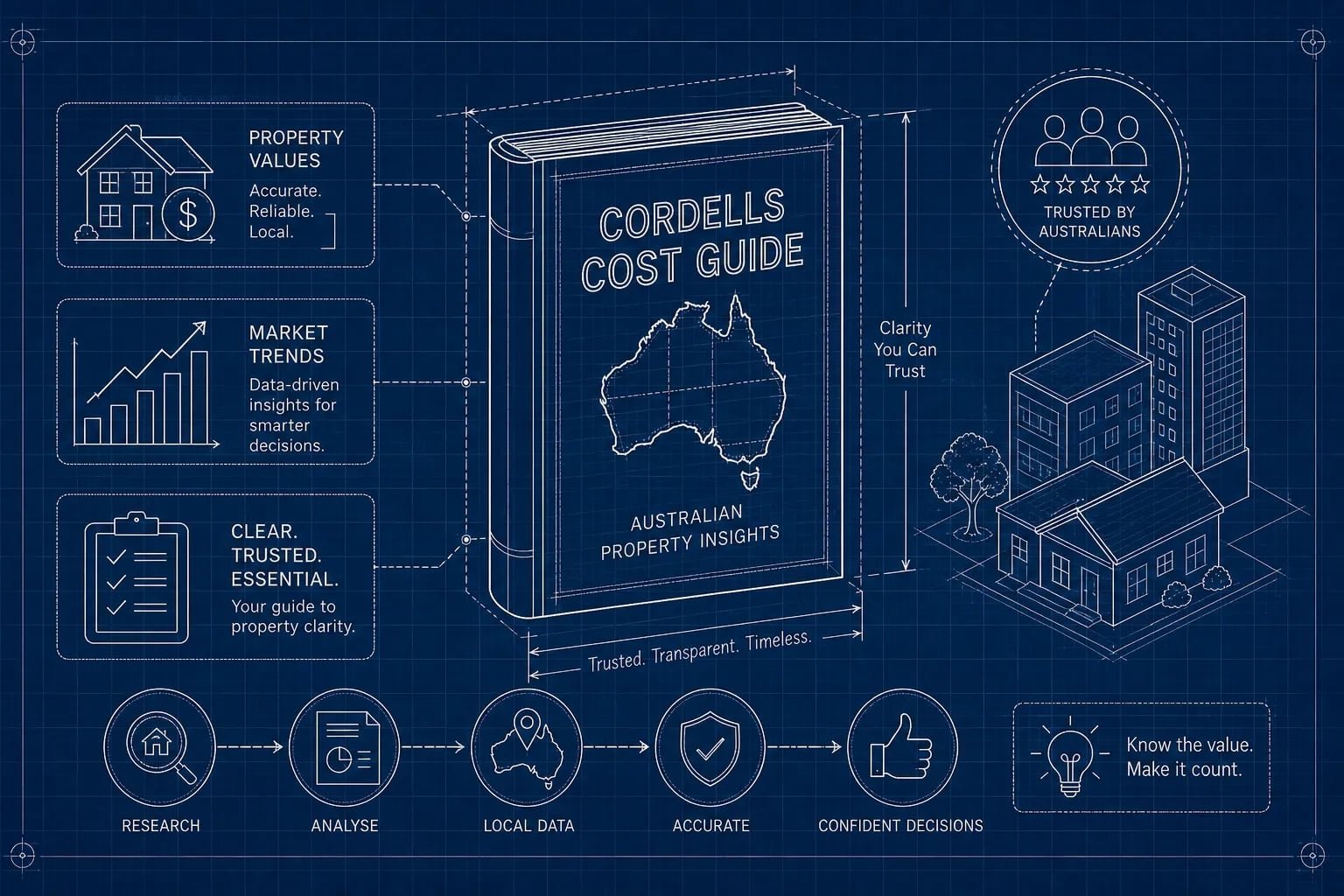
What most people call the “Cordells cost guide” is really three distinct offerings from Cotality, the company formerly known as CoreLogic’s construction data division in Australia. Cotality rebranded globally in 2025, but the Cordell products continued under the same name. Understanding the difference between these three offerings is the starting point for making sense of any reference you see in industry documents or insurance paperwork.
The Cordell Construction Cost Index (CCCI)
The CCCI is not a quoting tool and it won’t tell you what your renovation should cost. It is a quarterly measure of how much residential construction costs have changed, expressed as a percentage movement. It captures shifts in labour rates, materials costs, and other inputs across Australian states. Economists, insurers, and market analysts use it to track building cost inflation over time, not to price a specific job.
Cordell Estimator: the cloud-based pricing tool
Cordell Estimator is the actual software platform used to generate cost estimates. It draws on a database of thousands of construction components, covering materials, labour, plant hire, and subcontract rates, updated regularly to reflect current market conditions. Builders, insurance assessors, project managers, and quantity surveyors use it to produce line-item cost breakdowns for renovations, insurance rebuilds, and new residential or commercial construction.
The building costings database underneath it all
When tender documents or contracts reference “Cordell price books,” they are almost always referring to the item-level cost database that sits behind Estimator, not a standalone printed volume. Unlike Rawlinsons, which publishes physical volumes you can buy directly, Cordell’s pricing data is embedded in its digital platform rather than sold as a separate printed reference. Knowing this prevents confusion when you see the term used loosely in industry paperwork.
How the CCCI works and what the 2026 figures tell you
Reading the CCCI correctly requires understanding that it is an index, not a rate card. A quarterly movement of +1.0% doesn’t tell you what it costs to build per square metre. It tells you that costs rose 1.0% compared to the previous quarter, and those movements compound over time in ways that directly affect insurance recalculations and builder margin revisions.
The latest CCCI results for Australia in 2026
Australia recorded +1.0% growth in Q2 2026 and +2.8% annual growth to June 2026, following a softer Q1 2026 result of just +0.2%. The Q2 figures broke down by state as follows: NSW came in at +1.1%, with QLD, SA, and WA each at +1.0%, and VIC slightly behind at +0.9%. The Q4 2025 quarterly figure of +1.0% provides useful context: this was the strongest single-quarter result for all of 2025, suggesting the construction cost environment has remained active into 2026.
To put the annual figure in practical terms: a rebuild that cost $400,000 at the same point last year now benchmarks closer to $411,200 using the 2.8% annual movement. That is not a number to ignore when your home insurance sum-insured hasn’t been reviewed in two years.
What drives the index movement
The CCCI responds to movements in materials costs (including PVC and PEX piping, structural steel, and timber), crane and plant hire rates, and labour costs across Australian states. This is why the index doesn’t move in a straight line. A spike in one input category, such as a regional labour shortage or a disruption to imported materials, can push a single quarter higher before settling back down. Understanding the inputs helps you read the index more critically rather than treating each quarterly result in isolation.
Where Cordell shows up in your insurance and building quotes
This is the section most everyday Australians actually need. Many people who encounter Cordell data do so without realising it, because their insurer uses a Cordell-powered tool to set or recalculate the sum-insured on their home insurance policy.
Insurers: how Cordell Estimator sets your rebuild figure
Australian insurers use Cordell Estimator to estimate the cost of rebuilding a home from the ground up, incorporating current regional labour and material rates. The figure your insurer shows as the “estimated rebuild cost” in your policy is often generated through a Cordell-powered calculator. If that figure is based on incorrect inputs about your home’s size, construction type, or features, or if it hasn’t been recalculated to reflect recent CCCI movements, the result is underinsurance. It’s worth asking your insurer directly how recently that figure was recalculated and what inputs were used to generate it.
Builders: how Cordell rates appear in renovation quotes
Trade contractors, project managers, and quantity surveyors use Cordell Estimator to generate line-item cost breakdowns for renovation and construction work. When a builder references “Cordell rates” in a quote or variation, they are drawing on the Estimator’s regional pricing database. Knowing this gives you a more informed basis for questioning a quote: you can ask which version of the data was used, when it was last updated, and whether the regional rates applied match your specific location.
Contracts: how the CCCI appears in escalation clauses
Contracts with price escalation clauses sometimes reference indices such as the CCCI to adjust pricing mid-project, a practice used across the residential and commercial construction industry. If your renovation contract runs for six months or more, a quarterly CCCI movement of +1.0% translates directly into real dollar increases on your final bill. Budget for this upfront rather than treating the initial quote as a fixed number.
Cordells cost guide vs Rawlinsons: which tool fits your situation
Both Cordell and Rawlinsons are authoritative Australian cost references, but they are built differently and serve different purposes. The decision between them comes down to the type of project, the level of detail required, and whether you need a live digital tool or a structured reference publication.
Rawlinsons publishes two separate volumes: the Handbook and the Cost Guide. These provide detailed elemental cost breakdowns, trade-level pricing, labour constants, plant rates, and escalation forecasts across all Australian states. The Handbook is explicitly targeted at projects above approximately A$1.5 million. For formal estimating, bill of quantities work, and tender documentation, Rawlinsons is a well-regarded published reference in the industry.
Cordell Estimator’s strength is its digital workflow and update frequency. Where Rawlinsons is an annual publication with periodic supplements, Cordell Estimator refreshes its pricing data on a regular cycle, making it well suited to fast-moving materials markets and insurance workflows where currency of data matters. For most renovation budgeting and insurance assessment work, that ongoing update cycle is a practical advantage.
For formal QS work, large commercial projects, or tender documentation, Rawlinsons tends to be the industry standard. For insurance assessments, renovation budgeting, and quick project pricing, Cordell Estimator’s digital format is more practical. Most everyday Australians genuinely need neither: a realistic pricing benchmark from an independent source is sufficient for planning and quote comparison.
What access to Cordell Estimator actually costs in 2026
For readers considering whether a subscription makes sense, the pricing is structured around a tiered access model with a single-user base plan and add-ons for additional users or broader data coverage.
The Estimator Lite plan
The entry-level plan is Estimator Lite at A$220 per month, billed on a 12-month minimum commitment, which works out to A$2,640 including GST for the year (based on current published pricing, verify with Cotality before committing, as subscription rates are subject to change). This covers one user, one geographic area of data access, and residential-only costing data. Phone-based training is included. For a single renovation project or a one-off insurance review, that is a significant outlay for a tool designed around ongoing professional use rather than occasional consumer access.
Additional users and enterprise configurations
Additional users can be added to the Lite plan at A$38.50 per user per month. For national data access or commercial construction datasets, Cotality requires a direct quote rather than publishing a fixed price. Enterprise and multi-user deployments are priced on request, so if you are comparing costs for a team-wide subscription, you will need to contact Cotality directly for a figure.
Is a subscription worth it for a one-off project?
For most homeowners and renovators, a Cordell Estimator subscription is not cost-effective. The tool is designed for professionals who price work regularly across multiple projects. For a one-off budget check or insurance review, the smarter move is to use independent pricing resources or ask your insurer to walk through the Cordell-generated rebuild figure with you directly. Some insurers offer this during a policy review, so it is worth asking before your next renewal.
Free ways to cross-check construction pricing without a subscription
You don’t need a paid industry subscription to get a realistic picture of what building and renovation work costs in Australia. Several free resources give you enough context to ask informed questions, compare quotes, and identify pricing that doesn’t add up.
NameTheCost.com is an Australian cost and pricing directory built for consumers rather than industry professionals. It covers renovation cost breakdowns, trade pricing, and building cost benchmarks, including indicative building cost rates per square metre, across Australia, presented in plain language without industry jargon. If you want to cross-check what a builder or insurer is quoting before committing, it offers a grounded starting point without requiring a Cordell subscription or a Rawlinsons purchase.
Beyond that, some state-based building and planning authorities publish indicative building cost rates that are publicly accessible, worth checking with your relevant state body for current figures. The Australian Bureau of Statistics tracks construction cost data through its producer price indexes, which are available free of charge. Some insurers also provide their own online rebuild cost calculators powered by Cordell data, which lets you access a Cordell-based estimate at no direct cost during the policy quoting process.
If you are a builder, estimator, project manager, or insurance assessor who prices work multiple times per month, a Cordell Estimator subscription pays for itself quickly.
For occasional use or consumer budgeting, the combination of free independent resources, insurer tools, and comparative quotes from multiple tradespeople will serve you better than a professional-grade subscription billed annually.
Putting it all together
As this Cordells cost guide has shown, the Cordell construction cost suite is not a single product. The CCCI tracks quarterly market movement, Cordell Estimator enables detailed project and insurance pricing, and an underlying costings database supports both. Many Australians encounter this data through their insurer or builder without realising it, which means understanding what each product does puts you in a stronger position when reviewing a quote or an insurance policy.
The 2026 CCCI figures, with annual growth sitting at 2.8% to June, are a concrete reminder that construction costs continue to move upward. If your home insurance sum-insured hasn’t been reviewed recently, or if you’re planning a renovation and relying on quotes from a single builder, those numbers matter. A subscription to Cordell Estimator makes sense for professionals; for everyone else, independent resources and a few sharp questions will take you further than a $2,640 annual software commitment.
For a free starting point on Australian renovation and construction pricing, NameTheCost.com is built for exactly this purpose. There is no subscription required, no advertiser influence shaping the data, and no jargon standing between you and the numbers that matter for your project or policy.