Best Franchises to Buy in Australia in 2026
If you’re searching for the best franchise to buy in Australia in 2026, the first thing you need is an independent cost benchmark, not a sales brochure. Australian franchising is not a niche play. The sector is projected to generate $179.5 billion in revenue in 2026, making it one of the largest business-format industries in the country, and growth is still running in the right categories. But franchise brochures are designed to sell rather than inform. The investment figure on page one rarely includes fit-out contingencies, working capital, staff onboarding, or the slow grind of the first six months. NameTheCost.com is built to help with exactly that, transparent Australian pricing data on what businesses and services actually cost to set up and run, with no commercial bias shaping the figures.
This guide cuts through the marketing layer to compare real entry costs, fee structures, and ROI potential across the franchise categories worth your attention in 2026. By the end, you will have a framework to shortlist options that match your capital, your risk tolerance, and a sector with genuine demand.
Why the franchise landscape has shifted entering 2026
That $179.5 billion headline number flatters some categories while masking real weakness in others. Health and wellness, home services, child services, and senior care are outperforming. Legacy food retail and discretionary lifestyle concepts are under sustained pressure from online substitution and softening consumer spending. The smartest move at the shortlisting stage is to anchor your search to sectors where demand is structural rather than trend-driven.
From 1 July 2026, Payday Super requires superannuation contributions to be paid alongside wages rather than quarterly. For franchise operators managing casual and part-time staff, this removes the quarterly cash-flow buffer that many businesses quietly relied upon. Super must now reach employees’ funds within seven business days of each payday, meaning cash leaves the business far more frequently. Combined with persistent staffing shortages flagged across the 2026 franchise outlook, labour management is now a core operational competency, not a back-office function. Factor both cost and capability into your category choice before you go any further.
There is one more shift worth noting. AI-based search and digital discovery are reshaping how consumers find service providers. Franchise systems with stronger omnichannel execution are gaining a measurable lead-generation advantage over those with poor digital infrastructure. Consider two brands at similar investment levels: a network with 500 outlets and weak local SEO may underperform a smaller system with strong digital visibility. Brand size alone is no longer a reliable proxy for franchise performance.
Best franchise to buy in Australia: premium investments in food and fitness
McDonald’s remains Australia’s undisputed franchise revenue leader with over 1,073 outlets, but the entry bar is steep. Total investment ranges from $1.2 million to $2.6 million, and McDonald’s expects candidates to have at least $1.5 million in unencumbered funds before engaging seriously. The royalty structure sits at 5% of gross sales, with approximately 4% added for marketing. Based on a typical $1.8 million entry cost and reported EBITDA margins, the payback period is estimated at around 8.5 years, a long horizon by any measure, and one that assumes a strong location and consistent trading conditions throughout.
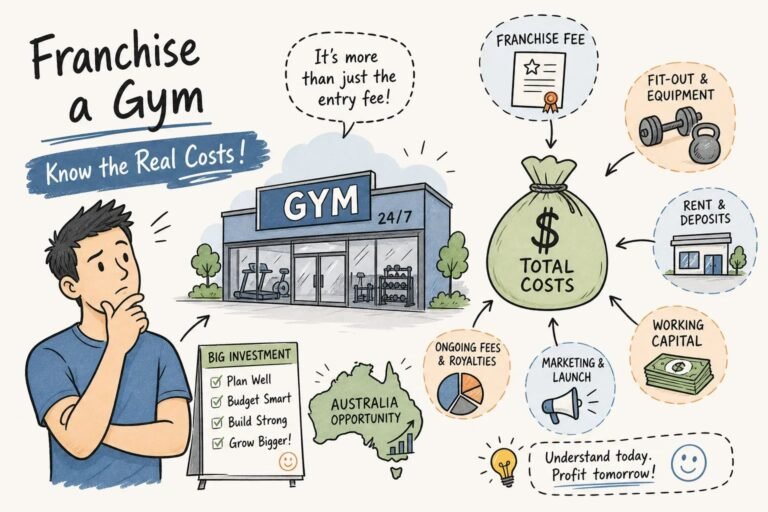
Anytime Fitness and Boost Juice represent a credible middle tier for investors who want brand recognition without the capital intensity of a major food chain. Anytime Fitness carries a one-time franchise fee of $42,500 and a flat monthly royalty of approximately $699, with total startup investment ranging from $350,000 to $975,000 depending on site and fit-out. Estimated margins sit at 20 to 35%, making it one of the stronger performers in the fitness category. Boost Juice runs estimated margins of 15 to 22%, broadly comparable to McDonald’s but with a lower entry cost and reduced reliance on large retail footprints.
At the premium end of the market, payback periods of six to ten years are realistic for strong locations, assuming consistent trading, a range derived from publicly available figures for established brands such as McDonald’s and Anytime Fitness. No franchisor’s disclosure document will model a worst-case scenario for you. Site selection and staff retention are chief among the variables that compress or extend that timeline, along with the intensity of local competition. The gap between the optimistic projection and the realistic range is exactly where independent cost verification earns its keep.
Low-cost franchises worth serious consideration in 2026
Jim’s Mowing and the broader Jim’s Group network report estimated margins of 35 to 50%, among the highest of any franchise category surveyed for this guide. Entry costs range from roughly $20,000 to $35,000. Fox Mowing takes a different fee structure altogether, charging $125 per week flat with no royalty percentage. That suits operators who want predictable fixed costs rather than revenue-linked obligations that scale up as the business grows. At this investment level, the risk profile is fundamentally different from a food franchise requiring a million-dollar shopfront.
Education and professional services represent an underrated tier among profitable franchise opportunities in Australia. First Class Accounts, a bookkeeping franchise, starts from approximately $9,900. Kumon ranges from $4,000 to $30,000 depending on location and setup. These are not glamorous categories, but tutoring and bookkeeping are needs-based rather than discretionary, which gives them defensive demand characteristics. Young Engineers carries a 10% royalty but targets the growing STEM education market. Lower entry points in this tier mean faster payback potential and a smaller financing requirement from the outset.
Not all low-cost franchises offer the same value, though. Elm Cleaning starts at $28,500 plus GST and carries a 10% royalty plus a 2% marketing levy. On modest revenue, those ongoing fees absorb a meaningful share of earnings. Vending@Work starts from $5,000 with no ongoing fees if you own the machine, but revenue is entirely location-dependent. The entry cost is only one number. What actually matters is the ratio of ongoing fees to realistic turnover at your target site or territory, and that calculation requires you to work with your own numbers, not the franchisor’s.
How to verify what a franchise truly costs before you commit
The Franchise Code of Conduct requires franchisors to provide a disclosure document, but that document does not model your specific operating costs, estimate your working capital needs in the first 12 months, or account for fit-out variations between sites. First-time buyers of franchises for sale in Australia consistently underestimate the gap between the headline investment figure and the total cash required to reach breakeven trading. That gap typically includes equipment top-ups, lease bonds, training travel, local marketing setup, and three to six months of operating losses.
The cost categories most buyers miss entirely are working capital for months one to six, lease incentive repayment clauses, legal fees for agreement review, accountant fees for due diligence, and state-specific registration costs. Add 15 to 20% to any franchisor’s stated investment range as a planning buffer. For a $300,000 franchise, that means having at least $345,000 to $360,000 available before you sign anything.
Before accepting any cost figure from a franchisor’s materials, run the same numbers through an independent source with no commercial relationship to the deal. NameTheCost.com is built for this purpose: it provides Australian pricing data across business startup costs, service fees, and operational expenses, without advertiser influence shaping the figures. When you shortlist a franchise, use NameTheCost.com to benchmark the cost categories you can independently verify, fit-out trades, equipment, professional fees, and insurance. It will not tell you whether a specific franchise is a good investment, but it will tell you whether the numbers you have been quoted are plausible in the Australian market.
Financing your franchise in 2026: what lenders actually want
Australian banks and specialist franchise lenders typically expect a cash contribution of 20 to 50% of the total investment. For established, high-profile franchise systems, the lower end of that range is achievable. For newer or less-documented systems, expect lenders to want closer to 50%. Lenders want that deposit to come from genuine savings rather than personal borrowing, and having a franchisor that sits on an accredited or preferred lending panel significantly streamlines the approval process.
A standard bank franchise loan in 2026 typically funds 50 to 70% of the total cost, runs over five to ten years, and is priced at roughly 7.5% to 9.5% per annum for secured deals. Non-bank business lenders may fund a higher proportion but at 9 to 14% per annum. Equipment finance is a separate and usually cheaper facility for tangible assets such as vehicles, machinery, and kitchen fit-out. There is no Australian Government loan programme specifically for franchise acquisition. Federal business support is activity-based rather than purchase-based, so do not plan your capital stack around government assistance that does not exist in this space.
When your application lands on a lender’s desk, expect to provide business bank statements, profit and loss statements, cash flow forecasts, BAS statements, personal tax returns, proof of your equity contribution, and the franchise agreement itself. For a new franchise site with no trading history, lenders lean heavily on your experience, your business plan, and the strength of the franchise system’s track record. Preparing these documents before you approach a lender, rather than scrambling for them afterwards, signals the operational discipline lenders weight heavily in their assessment.
From shortlist to signed agreement: the due diligence steps that protect you
Request a complete list of existing and former franchisees in the network, then contact at least five of them directly. Ask specifically about the gap between projected and actual earnings in the first two years. Follow up on the franchisor’s responsiveness to operational issues. Then ask the question that cuts through everything else: knowing what they know now, would they buy the franchise again? These conversations will tell you more about a franchise system than any disclosure document.
Review the disclosure document with a franchise-specialist lawyer, not a general commercial solicitor. Legal fees for this work are often in the range of $2,000 to $4,000 depending on complexity, and it is one of the highest-return expenditures in the entire process. A specialist will identify problematic clauses around territory exclusivity, lease assignment rights, renewal terms, and exit provisions that a general practitioner might miss.
To find the best franchise to buy in Australia in 2026, narrow your final shortlist using three filters: entry cost within your confirmed finance capacity, a sector with structural demand, and a margin structure where ongoing fees leave a realistic net return after debt service. Benchmark every cost figure independently through NameTheCost.com, arrange pre-approval finance before you negotiate, and only engage the franchisor formally once you have validated the numbers from an outside source. The franchise rankings in Australia shift year to year, but the buyers who consistently find good opportunities are the ones who read the numbers carefully before they commit.