Insurance for a Retail Store: What It Really Costs in Australia
Many retail store owners receive their first insurance quote and do one of two things: accept it without question or shop around blindly, with no real sense of whether any quote is actually fair. Both approaches cost money. The cost of insurance for a retail store in Australia follows a clear logic, and once you understand that logic, a quote stops being a mystery and starts being a negotiation. This article puts real numbers on the table, drawn from Australian market data, so you can benchmark what you’re being charged before you sign anything.
The figures here cover what a small to medium retail store typically pays across the three core covers, what makes two stores on the same street pay completely different premiums, and where you have genuine leverage to reduce costs. Each cover contributes differently to your total retail store insurance cost, and knowing the breakdown is what separates a well-structured policy from an overpriced one. Before committing to any business insurance policy, it’s worth checking independent Australian cost data at NameTheCost.com, which publishes unbiased benchmarks across business, trade, and professional services so you can verify whether a quote sits within a reasonable range for your specific situation.
By the end of this article, you’ll know whether your quote is reasonable, what’s actually driving the price, and exactly how to bring it down.
How much does insurance for a retail store cost in Australia?
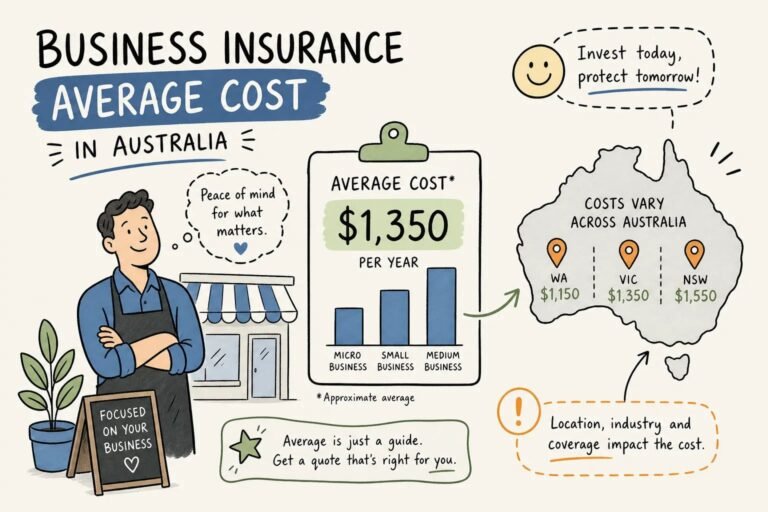
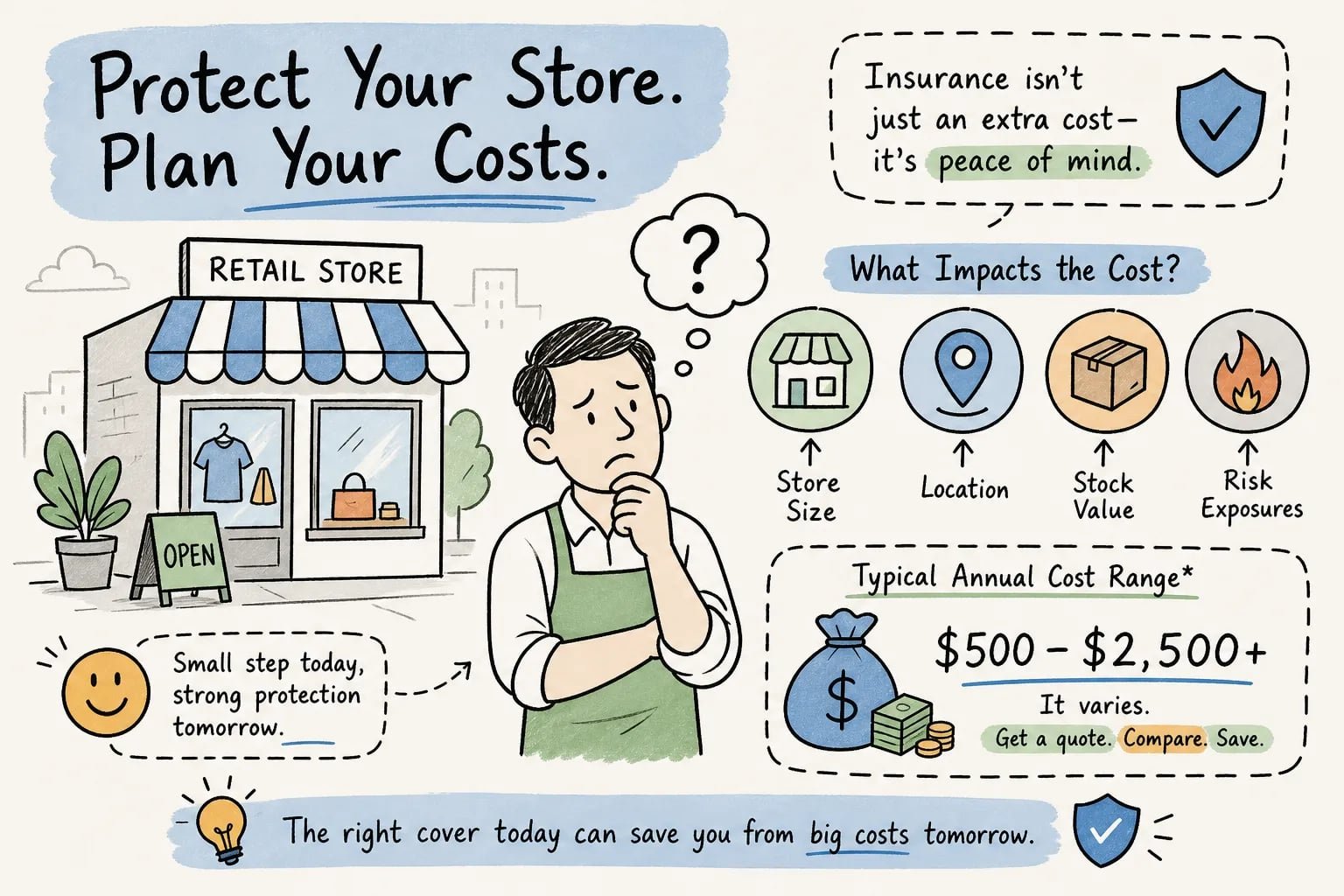
The headline number most often cited comes from BizCover’s retail customer data, which puts the average monthly premium for an Australian retail business insurance package at around A$83 to A$103 per month, or roughly A$996 to A$1,236 per year. That’s an average across all retail, which means your actual retail store insurance cost depends on turnover, location, stock value, and the covers you select. The turnover-band breakdown gives a more useful starting point.
Average annual premiums by store size
Micro retailers with annual turnover under A$150,000 typically pay between A$480 and A$960 per year (A$40 to A$80 per month) for a basic business insurance package. Small retailers turning over A$150,000 to A$1 million generally land in the A$840 to A$1,680 range annually. Stores with turnover between A$1 million and A$5 million usually pay A$1,400 to A$3,100 per year. These figures reflect bundled commercial packages rather than standalone covers.
What a basic retail pack includes at these prices
The figures above typically bundle public liability, contents and stock cover, and basic business interruption into a single commercial package. A standalone public liability policy without additional covers will come in cheaper. A full shopkeepers pack that properly insures fit-out, seasonal stock, and adequate liability limits pushes toward A$100 to A$250 per month once those variables are factored in. Based on current market ranges, expecting to pay under A$500 per year for genuinely comprehensive retail cover is, in most cases, unrealistic.
The three core covers and what each one adds to your retail store insurance cost
Understanding the internal cost structure of a retail insurance policy tells you exactly where your money goes and where there’s room to move. Each of the three covers below contributes differently to your total premium, and each carries its own levers for cost control.
Public liability: your baseline cost
Public liability cover is routinely required by retail leases and generally essential for any retail premises. It covers injury or property damage claims made by customers on your premises, and without it, a single slip-and-fall incident can be financially catastrophic. For a small retail store, A$5 million in public liability cover typically costs between A$500 and A$1,500 per year on its own, depending on foot traffic, store format, and location. Higher customer volumes and more interactive retail environments push the figure toward the upper end, because the insurer’s exposure to a claim is simply greater.
Most retail leases and shopping centre agreements require at least A$10 million in public liability cover. Moving from A$5 million to A$10 million typically adds around 10% to 20% to the public liability section of your premium, which is often a modest increase worth making to satisfy lease conditions and reduce personal exposure.
Stock and contents cover: where the variables kick in
Contents and stock cover is where premium calculations become more variable. Insuring A$20,000 in stock is inexpensive; insuring A$200,000 in high-value electronics or seasonal inventory carries a meaningfully different price. The premium scales with the declared value of your stock, the merchandise category (theft attractiveness is a genuine underwriting factor), and whether you include theft cover as a separate endorsement. Retailers who underinsure their stock to save on premium often discover the problem at the worst possible time: a claim that pays out less than your loss.
Business interruption: the cover most retailers undervalue
Business interruption insurance covers lost revenue if your store can’t trade due to fire, flood, or another insured event. It is also the cover most small retailers either skip entirely or buy at an indemnity period that’s too short to be useful. Adding basic business interruption to a retail pack typically adds A$200 to A$600 per year, depending on declared turnover and the chosen indemnity period. Twelve months is the standard period; anything shorter leaves a real gap if the disruption extends through a rebuild or major fit-out replacement.
What drives your retail store insurance cost up or down
Several rating factors determine how a quote moves and where you have genuine leverage when negotiating or reviewing renewal pricing. Understanding each one means you’re not just accepting a number, you’re in a position to challenge it.
Location: the single biggest variable most retailers ignore
Where your store sits geographically affects your premium more than most people expect. An insurer pricing a retail store in coastal Queensland applies a fundamentally different risk model than one pricing the same store in suburban Melbourne, because cyclone, flood, and storm exposure creates materially different claims likelihoods. To illustrate the scale of this gap: a commercial property insured for around A$1 million might cost approximately A$4,000 per year in Victoria but exceed A$20,000 per year in a Cairns cyclone zone, based on figures from northern Australian reinsurance pricing analyses. Urban high-crime postcodes also attract higher theft and public liability loadings compared to lower-risk suburban or regional locations.
Claims history, store age, and security measures
An insurer reviews your prior claims history before pricing your policy. Two or more claims in the last five years can increase your premium by 20% to 50% or result in specific exclusions being applied. Security measures work in the opposite direction: monitored alarms, deadlocks, and CCTV systems are active risk reducers that most insurers price more favourably, particularly for theft and malicious damage cover. Store age and construction type (brick versus lightweight construction) also factor into the property component of a retail pack.
How your retail niche changes the quote
Not all retail is priced the same. The category you operate in signals specific risk profiles to underwriters, and the same turnover figure can produce very different annual premiums depending on what you sell.
Boutique clothing, convenience, and electronics: three different risk pictures
A boutique clothing store is typically assessed on stock value, theft risk, and customer foot traffic, placing it in a moderate-risk retail category with annual comprehensive packages often landing in the A$1,200 to A$5,000 range depending on stock and location. A convenience store attracts higher premiums across most covers because longer trading hours, higher visitor turnover, cash handling, and food or alcohol exposure all increase both public liability and theft risk significantly. An electronics retailer sits at the expensive end for stock cover, because high-value, easily resaleable inventory is more attractive to thieves and generates larger business interruption losses when stolen or damaged. The same A$300,000 in annual turnover can produce three meaningfully different small retail store insurance premiums depending on which of these categories applies.
Why industry classification matters when getting a quote
Insurers assign retail businesses to industry classifications, and these classifications carry embedded risk weightings that directly affect your premium. Misclassifying your business, even unintentionally, can result in a policy that doesn’t respond correctly at claim time. When getting a quote, be precise about what you sell, how many customers visit daily, and whether you offer any ancillary services (such as repairs or installations) that expand your liability exposure beyond straightforward retail.
How to compare retail insurance quotes without getting it wrong
Price comparison only works when you’re comparing the same thing. Most retailers compare headline premiums and miss the details that determine whether a policy is actually worth buying. The section below covers the specific checks that separate a genuinely competitive quote from one that looks cheap on paper but underdelivers when it matters.
What to look at beyond the headline premium
The annual premium is the starting point, not the finish line. Check the excess on each section of the policy, particularly the theft section, because a A$1,000 excess on a A$1,500 theft claim effectively means you’re uninsured for that event. Most retail policies carry a standard property and theft excess of A$500 to A$1,000, with higher-risk stores sometimes facing A$1,500 to A$2,500. Review whether stock cover operates on a replacement cost basis or an indemnity (depreciated) basis, because this distinction alone can significantly affect a payout. Confirm that the public liability limit satisfies any lease requirements, which commonly specify A$10 million or more.
Using independent benchmarks before you buy
Before accepting a quote, benchmark it against independent Australian data. NameTheCost.com publishes unbiased cost guides for Australian businesses so you can check whether the premium you’ve been offered sits within a reasonable range for your store type and turnover. Getting three quotes from different insurers gives you a market spread; benchmarking those quotes against independent data tells you whether the spread itself is reasonable, or whether you’ve been quoted at the high end of the market without a strong reason for it.
Practical ways to reduce your retail insurance premium
Most retailers have more control over their premium than they realise. None of the following moves require sacrificing genuine protection, they’re about structuring your policy and risk profile so you’re not paying a loading you don’t need to carry.
Higher excess, bundled covers, and annual payment
Electing a higher excess lowers your base premium, but only make this trade-off if you can genuinely cover that excess amount out of cash flow without stress. Bundling public liability, contents, and business interruption into a single commercial pack is almost always cheaper than buying each cover separately. Paying annually rather than monthly reduces the total cost by roughly 5% to 10%, because monthly payment instalments often include a financing charge that insurers don’t always make obvious in the quote documents.
Risk reduction measures that directly influence pricing
Installing a monitored security system, upgrading locks, and adding CCTV are all risk mitigation steps that most insurers acknowledge with a premium reduction or, at minimum, prevent adverse loadings at renewal. Keeping accurate stock records and conducting regular stocktakes also strengthens your position at claim time and signals to underwriters that you manage your inventory seriously. Review your sum insured annually; overinsuring stock you no longer carry is a straightforward cost you can eliminate without reducing your actual protection.
The bottom line on retail store insurance costs in Australia
The cost of insurance for a retail store in Australia varies more than any single quote suggests. A micro-retailer in a low-risk Melbourne suburb and an electronics store in a Brisbane flood zone are priced completely differently, even if their turnover figures look similar on paper. The honest benchmark range, A$480 to A$3,100 per year depending on size and cover, gives you a solid reference point. What drives your actual retail store insurance cost is a combination of location, stock value, retail category, claims history, and the specific covers you choose to include.
Get at least three quotes and read each policy’s excess and cover basis carefully. Then benchmark what you receive against independent Australian cost data before you sign. A fair premium exists for your store, it takes a few hours of focused comparison to find it, and those hours are worth it.