Commercial Cleaning Cost Australia: What Businesses Pay in 2026
Without an independent benchmark for commercial cleaning cost, most business owners are negotiating blind. Many sign a contract with no reference point to judge whether the quoted rate is fair, which tends to create one of two problems: you overpay because the supplier knows you’re working without a comparison, or you take the cheapest quote available, engage a non-compliant operator, and spend more later managing the fallout. Both outcomes are avoidable with the right numbers in hand.
This guide gives you those numbers. Hourly rates by city, cost estimates by office size, the components of a fair quote, and the red flags that signal a supplier cutting corners on compliance. NameTheCost.com is an independent Australian pricing resource that benchmarks operational costs for businesses across the country, commercial cleaning included. The figures here reflect the market in 2026.
By the time you finish reading, you’ll know what a realistic cleaning budget looks like for your site and how to assess any quote that lands in your inbox.
What commercial cleaning actually costs per hour across Australia
The national benchmark for standard commercial cleaning sits at $35, $65 per hour. That range covers the majority of recurring office cleaning contracts across the major cities, with Sydney consistently at the top and Adelaide and Perth typically sitting lower. Sydney CBD work regularly pushes the upper boundary further, with quotes commonly reaching $45, $80 per hour in dense commercial precincts.
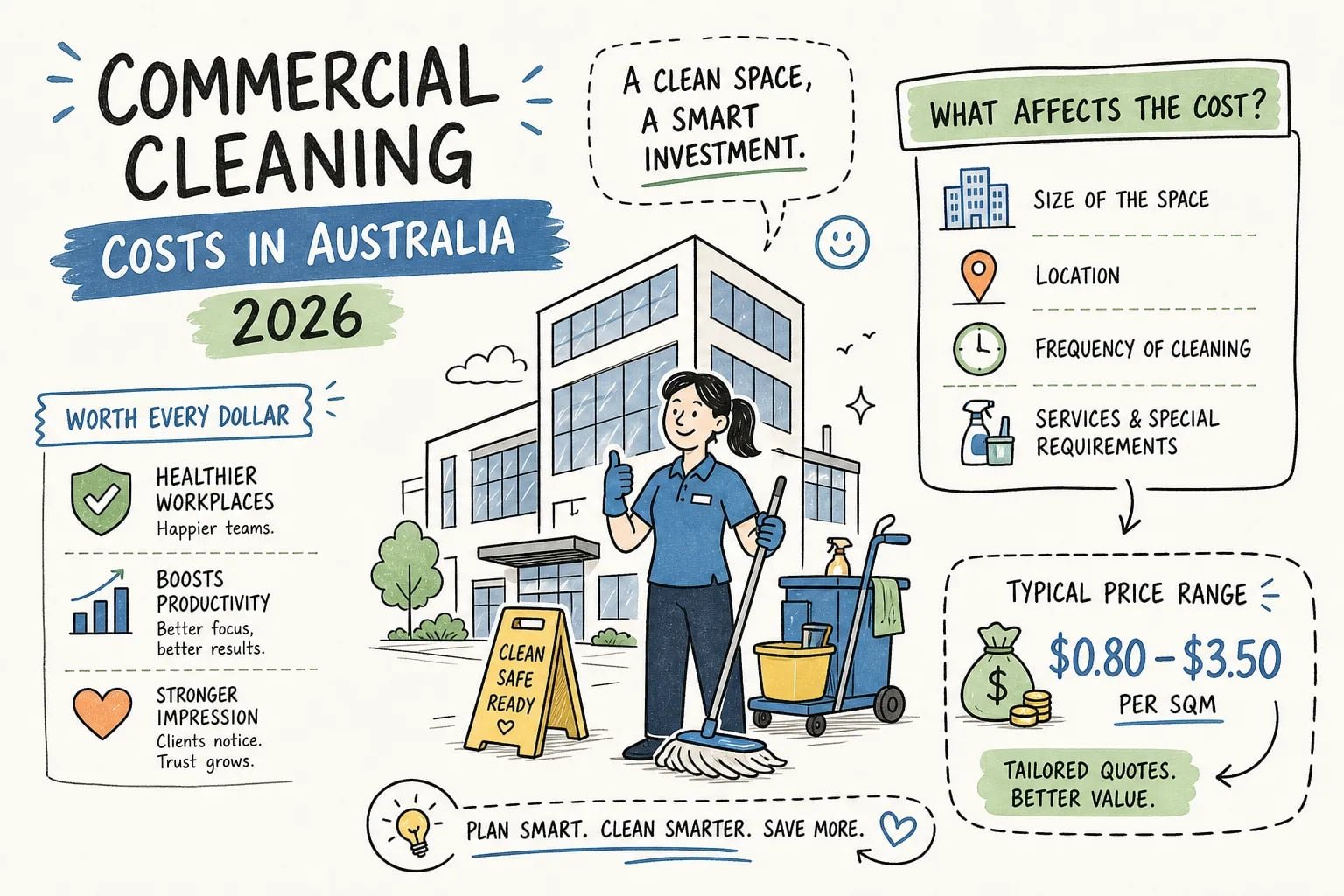
For contract work priced per square metre, standard recurring cleans are generally quoted at $2, $4 per sqm. Deep-clean or premium service moves into the $5, $7.50 per sqm range. The two pricing models often coexist: suppliers use hourly rates for smaller or ad hoc jobs and shift to per-sqm pricing for larger ongoing contracts where they can plan labour efficiently.
City-by-city commercial cleaning rate breakdown
The table below shows typical market bands by city. These are ranges drawn from contract and ad hoc rates across sole operators, service companies, and premium providers. Treat them as benchmarks rather than exact averages, because source methodologies vary significantly.
| City | Typical hourly rate | Standard cleaning cost per sqm (recurring) |
|---|---|---|
| Sydney (general) | $40, $70/hr | $2, $6/sqm |
| Sydney CBD | $45, $80/hr | Up to $8+/sqm for deep or compliance work |
| Melbourne | $35, $70/hr | $2, $4/sqm |
| Brisbane | $35, $65/hr | $2, $4/sqm |
| Perth | $30, $65/hr | $2, $4/sqm |
| Adelaide | $30, $65/hr | $2, $4/sqm |
Why Sydney costs more than Perth
Sydney’s higher rates reflect operating costs, not simply higher wages. CBD demand density, commercial rent pressure on supplier premises, and cost-of-living pressure on labour all push supplier overheads above what providers in less congested markets carry. The Cleaning Services Award (MA000022) sets the wage floor nationally, but suppliers in high-demand urban centres factor in materially higher overheads to stay viable. Perth and Adelaide don’t carry the same cost pressure in most service areas, so commercial cleaning rates in those markets sit lower as a result.
Commercial cleaning cost by office size
Most commercial cleaning suppliers calculate their quote using a combination of hourly rate and site size. As floor area increases, the effective cleaning cost per sqm tends to drop slightly, because fixed costs like travel, setup, and supervision get spread across more area. Understanding this helps you evaluate whether a quote is proportionate for your site.
Small office (100 sqm): what a realistic quote looks like
A standard weekly clean of a 100 sqm office typically takes around 2, 3 hours, based on standard contractor time estimates for this size. At the national rate band of $40, $65 per hour, you’re looking at $80, $195 per session, or roughly $320, $780 per month for weekly service. At this size, most suppliers quote on an hourly basis rather than per sqm. The scope usually covers floors, bins, bathrooms, kitchen surfaces, and touchpoints.
Medium office (500 sqm): where volume pricing starts
A 500 sqm office typically requires an estimated 4, 6 hours per clean. At the same rate band, that’s $160, $390 per session, or $640, $1,560 per month at weekly frequency. At this scale, suppliers commonly offer contract cleaning rates that bring the effective per-session office cleaning cost down. A recurring contract becomes noticeably more cost-effective than ad hoc bookings once you’re cleaning weekly or fortnightly, and at this size the difference is worth quantifying before you sign.
Large office (2,000 sqm): contract terms dominate
At 2,000 sqm, most providers move to fixed-term contracts with set service schedules, often involving multiple cleaners running nightly or daily shifts. Monthly cleaning budgets at this scale commonly range from $3,000 to $8,000, depending on frequency, city, and scope. Deep cleans and specialist services such as carpet steam cleaning and high-level dusting are typically quoted separately, even when a base contract is in place.
Contract cleans vs one-off bookings: the price gap is real
Recurring contracts are priced lower per visit than one-off bookings. When a supplier can forecast their labour and route across regular visits, they price that certainty into the rate. One-off cleans carry more uncertainty, more setup cost, and no guarantee of repeat work, so the premium is built in from the start.
What a recurring contract typically includes
Standard contracts in Australia are most commonly structured at weekly, fortnightly, or monthly frequency, with a 12-month term being the most typical starting point. Shorter trial periods of 3, 6 months exist, and longer terms of 24, 36 months are also offered for established sites.
Most contracts include a 30-day notice period for month-to-month arrangements, while fixed-term agreements often require 60, 90 days’ notice for non-renewal. Price-variation clauses, which allow the supplier to adjust rates with written notice, are a standard feature worth reading carefully before signing.
When a one-off or deep clean is worth the premium
One-off bookings make practical sense in specific situations: post-construction handover, end-of-lease cleaning, or a seasonal deep clean layered on top of an existing contract. Deep cleaning sits at $5, $7.50 per sqm or $75, $100 per hour at the higher end of the market. Some providers apply a minimum booking value for one-off work, confirm the minimum directly with the supplier before requesting a quote, as this figure varies by operator.
What’s included in the price (and what quietly gets charged extra)
A significant amount of bill shock in commercial cleaning comes from assumptions about scope. A quote that looks comprehensive often excludes several high-frequency costs that only appear on the invoice after work begins, particularly consumables, external windows, and periodic deep cleans. Knowing what to check upfront removes most of that risk.
Standard inclusions most quotes cover
For recurring office contracts, the baseline scope typically covers hard floors, vacuuming, bins, bathroom cleaning, kitchen bench and sink, internal glass, touchpoints such as door handles and light switches, and basic surface wipe-downs. This is the floor, not the ceiling. Any quote that doesn’t specify these areas in writing is already a problem.
Common exclusions that add cost later
Carpet steam cleaning is almost always quoted separately, typically at $3, $7.50 per sqm for commercial office spaces. External windows are a specialist service with their own pricing tier, commonly $4, $8 per sqm for standard commercial work. High-level cleaning requiring access equipment, biohazard or mould remediation, and consumable restocking (bin liners, soap, toilet paper) are also commonly excluded from base contracts. Always confirm whether the quoted office cleaning cost is GST-inclusive or GST-exclusive before you sign anything.
What’s actually driving the price on any given quote
The hourly rate on a cleaning quote is not just a cleaner’s wage, it stacks several cost layers. Understanding those layers helps you evaluate whether a quote is competitive or just cheap for the wrong reasons.
Labour: award wages, penalties, and after-hours loading
The Cleaning Services Award (MA000022) sets the legal wage floor. At Level 1, the ordinary hourly rate is $27.08, with casual loading bringing that to $33.85 per hour. After-hours and weekend work attracts penalty rates that push the effective hourly labour cost well above the base: Saturday rates sit at $40.62 per hour and Sunday rates at $54.16 per hour at Level 1. On-costs including superannuation, workers compensation, payroll tax, and leave provisions typically add 25, 40% above the base wage before any overhead or margin is applied.
Insurance, supplies, and overhead
Public liability insurance, commonly required by clients and property managers at $10, $20 million coverage, and WorkCover are standard inputs for any compliant provider, and both are folded into the charge-out rate. Equipment and chemical supply is another variable: some contracts include these, others don’t. A quote that looks unusually cheap is usually reflecting fewer hours on-site, underpaid labour, or non-compliant insurance arrangements, not genuine operational efficiency.
How to compare quotes without getting burned
Once you have the benchmarks, you need a practical way to evaluate what suppliers send back. Most businesses lose ground here by comparing totals without comparing scope, then signing on price alone.
Five things every quote must state clearly
Before accepting any commercial cleaning proposal, check that it covers all five of these elements:
- Scope of work: specific tasks and areas included, not generic language like “general office clean”
- Service frequency and timing: days, times, and access arrangements stated clearly
- Pricing structure: hourly, per sqm, or flat fee, and what triggers additional charges
- GST status: whether the quoted price is inclusive or exclusive of GST
- Insurance confirmation: public liability and WorkCover details in writing, not just a verbal assurance
Red flags that signal a quote is too cheap to trust
A quote with no written scope, no insurance mention, an unusually low hourly rate with no explanation, or no clarity on what triggers additional charges is signalling one of two things: non-compliance somewhere in the labour or insurance stack, or a service scope so thin it won’t meet your actual needs. Either way, it costs more to unwind than to avoid. Use the market ranges from this article and the independent benchmarks at NameTheCost.com as your reference point when assessing whether a commercial cleaning cost sits inside realistic territory for your city and site size.
Getting this right before you sign
Commercial cleaning pricing is not complicated once you have a benchmark. The national standard for recurring office cleaning in 2026 is $35, $65 per hour for compliant providers, with Sydney at the upper end and Perth and Adelaide typically sitting lower. Office size, service frequency, city, and the difference between contract and ad hoc work all move the number, but they move it predictably once you understand the inputs.
Businesses that overpay typically do so because they walked into the conversation with no reference point. Most that underpay do so because the cheapest quote looked identical on paper to the fair ones. A well-scoped, fully itemised quote from a compliant provider, benchmarked against real Australian market data, is the standard worth holding out for. NameTheCost.com exists to give you that data before you commit to anything.
Get at least three quotes. Apply the five-point checklist from this article to each one. Compare them scope against scope, not just total against total, use these benchmarks to judge any commercial cleaning cost quoted to you and avoid the surprises that catch most businesses out.