Franchising a Gym in Australia: The Real Costs Explained
Franchising a gym is often sold as a lifestyle. The flexibility, the growing fitness industry, the recurring revenue model, gym franchise marketing is very good at making the opportunity look straightforward. What it’s less forthcoming about is the full financial picture before you sign anything. The honest number for a major brand like Anytime Fitness sits between $397,000 and $973,000 all-in before you open the doors to your first member, based on the brand’s own Australian franchise disclosure documentation. That’s not a scare figure; that’s what their paperwork states.
Before any Australian commits to a franchise agreement, getting a neutral benchmark matters. A franchisor’s development team is not a disinterested party, their job is to sell you on the opportunity. Independent benchmarking services can give you something real to measure a sales conversation against. NameTheCost.com is one such resource: a straightforward, unbiased cost directory covering Australian business categories, including the kind of commercial fit-out and operational figures gym franchisors typically present in their best possible light. This guide covers what franchising a gym actually costs, what you get for it, and what to verify before you write a single cheque.
Franchising a gym: what you pay before you open the doors
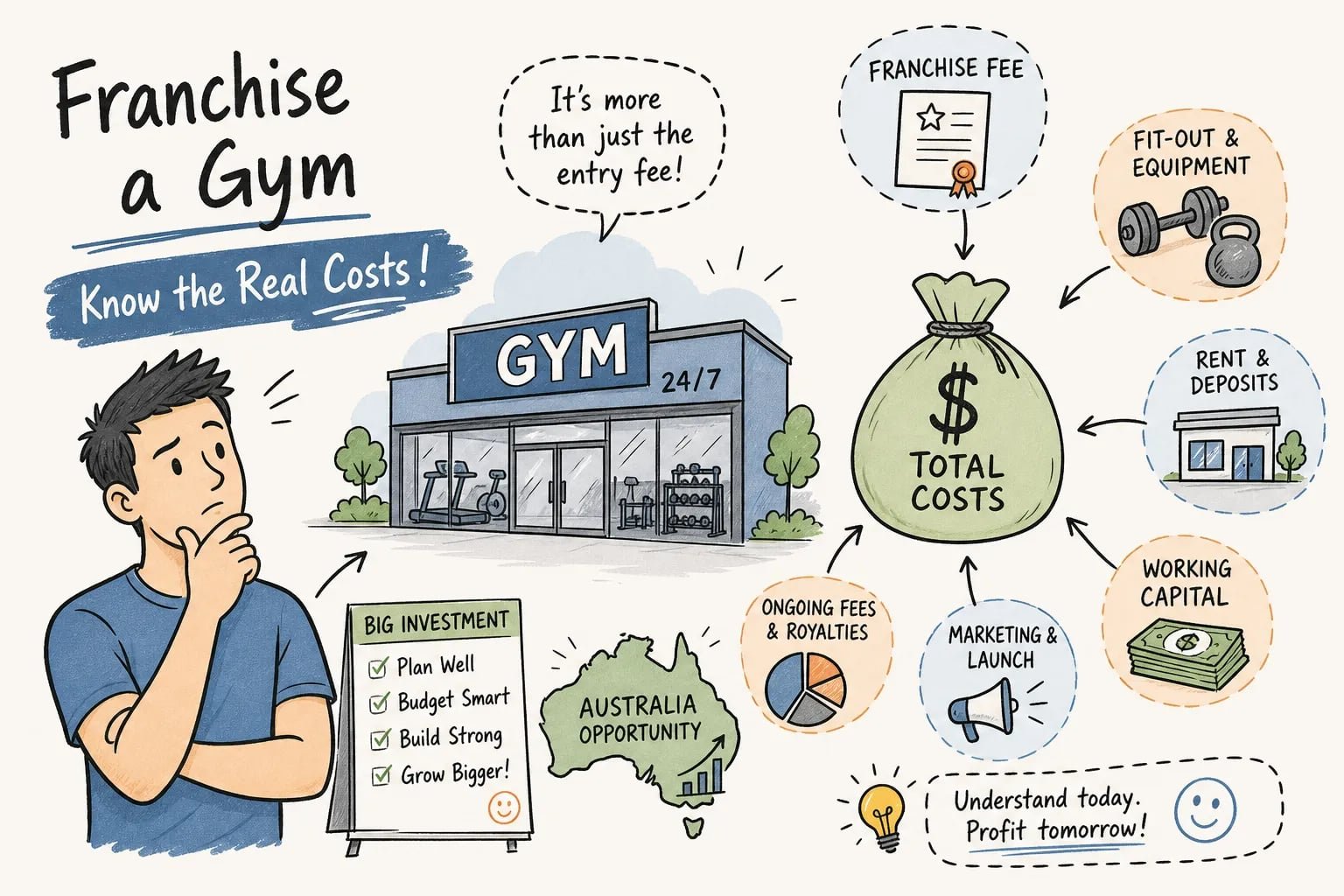
There are three distinct layers to upfront investment, and franchisors often blur them together in their marketing materials. The franchise fee, the fit-out, and the equipment are separate line items with very different implications. Understanding each one clearly is the first job of any serious prospective franchisee.
The franchise fee is just the entry ticket
Franchise fees vary more than the headline figures suggest. Anytime Fitness charges $42,500. Snap Fitness sits in the $25,000 to $30,000 range, while Plus Fitness comes in at $25,000. F45 Training is at the higher end at $60,000. These figures come from each brand’s franchise disclosure materials, which are worth reading in full rather than relying on summary comparisons. This fee buys you a brand licence, territory rights, and access to the franchisor’s initial support system. It does not build a gym. It is a sunk cost: non-refundable, and typically the first of many cheques you write on the road to opening.
Fit-out and equipment costs do most of the heavy lifting
Commercial gym fit-out in Australia in 2026 runs roughly $1,800 to $3,500 per square metre in Sydney, $1,800 to $3,200 in Melbourne, $1,700 to $3,000 in Brisbane, and $1,500 to $2,500 in regional areas. These figures cover build and fitout costs including flooring, HVAC, change rooms, and compliance work, but do not include equipment. On a 400-square-metre facility, you’re looking at $720,000 to $1.4 million in Sydney before a single piece of equipment is purchased. Packages for a mid-size facility add another $80,000 to $250,000, and because most franchisors require you to source through approved vendors, your ability to negotiate on price is limited.
Plan for several months of working capital for operating expenses before you’ve enrolled enough members to cover costs. Industry advisers commonly recommend reserves covering the first six to eighteen months of operations, with many suggesting you hold enough capital to survive at least the first twelve months. The lower end of any investment range published by a franchisor reflects best-case conditions. For most metro locations in Australia, planning for the mid-to-upper end is the more defensible position.
Why the “total investment” figure varies so widely
Franchisors publish broad ranges in their disclosure documents because the actual figure depends heavily on location, the condition of the tenancy, council compliance requirements, and the franchisor’s mandatory specification standards. A 24/7 gym in regional Queensland and a boutique studio in Sydney’s inner suburbs are not the same business financially, even if they carry the same brand. The published range is not a guarantee; it’s a corridor. Always plan for the upper half.
The ongoing fees that quietly compress your margins
The entry cost gets most of the attention, but the ongoing fee structure is what shapes your business economics for years. These costs never stop, and they are owed to the franchisor regardless of whether your membership base is growing or contracting.
Fixed monthly fees vs percentage royalties
Anytime Fitness charges a fixed monthly fee in the range of $699 to $820 rather than a traditional percentage royalty. Snap Fitness uses a flat monthly contribution model, typically around $300 to $500 per month in marketing levies alone. F45 Training takes a different approach: 2% of gross sales or $200 per month, whichever is higher, plus a separate fixed marketing fund contribution of $2,500 per month. These figures are drawn from franchise disclosure materials and may change between disclosure versions, so verify current structures directly. Each model has different implications depending on where you are in your growth curve. A fixed fee is predictable but punishing in early months when membership is still building. A percentage structure takes more when you’re profitable but gives you some breathing room at the start.
Marketing levies, technology charges, and the costs most people underestimate
Marketing levies across Australian gym franchise networks run between 1% and 4% of revenue, or a fixed monthly equivalent. These contributions fund national campaigns that may or may not be effective in your specific trade area. Technology platform fees, CRM licences, scheduling software, and member management systems are often charged separately or bundled into fixed amounts; compare franchisor pricing to current market quotes when evaluating total cost. Your power bill, your staff wages, your insurance, and your ongoing equipment maintenance all sit entirely with you. The franchisor’s brand does not subsidise your operating costs.
What the franchisor actually provides in return
The support package is real. It’s worth understanding clearly rather than dismissing or over-valuing it based on a sales conversation.
Training, site selection, and the pre-opening support package
Most major gym franchisors provide structured initial training covering operations, sales methodology, staffing, and financial management. For a first-time business owner, this has genuine value. Site selection assistance, lease review, and trade area analysis are commonly included in the pre-opening package, and these services can save a franchisee from committing to a poor-location lease. Signing a bad lease is one of the most expensive mistakes in commercial fitness; the help here is worth taking seriously.
Ongoing operational support: useful or superficial?
Post-opening, franchisees typically receive access to operations manuals, KPI frameworks, business coaching sessions, and marketing campaign assets. Technology support, lead-generation tools, and national marketing campaigns are standard. Quality varies considerably between systems, and the only reliable way to assess it is to speak with existing franchisees who were not hand-selected by the franchisor’s development team. Find them yourself rather than accepting a curated referral list. Ask directly about response times, practical usefulness of the support, and whether they’d make the same investment again.
How long before the business actually pays for itself
Operating break-even and capital payback are not the same thing. Operating break-even means your monthly revenue covers your monthly costs. Capital payback means you’ve recovered the full upfront investment. Both timelines matter and both are worth modelling before you commit.
24/7 low-cost gyms: the fastest path to operating break-even
A well-run 24/7 low-cost gym in a good location can reach operating break-even in six to eighteen months. Franchise marketing sometimes cites nine months; twelve to eighteen months is a more defensible planning assumption for most Australian locations. Margins in this model typically run between 10% and 20%, and the economics depend entirely on member volume. Pre-sales before opening are critical. Industry benchmarks put average monthly churn in the budget gym segment at around 3% to 5%, with member acquisition costs running approximately $120 per member; treat these as approximate reference points when modelling your ramp-up phase rather than guaranteed outcomes. Full capital payback typically takes two to four years, even in successful locations.
Boutique studios and large health clubs take considerably longer
Boutique studios typically reach operating break-even in twelve to twenty-four months. Higher price points support better margins, with EBITDA in the 20% to 40% range in strong cases, but member acquisition is slower and more competitive. Large health clubs carry the heaviest cost structure: fit-out, staffing, and leasing costs push operating break-even to eighteen to thirty-six months, with full capital payback often stretching three to five or more years. Across all three models, the single biggest variable is how much working capital you hold in reserve. Undercapitalised gyms rarely survive the first eighteen months regardless of the brand on the wall.
The legal obligations you cannot afford to overlook
Australian franchising law gives prospective franchisees meaningful protections. The Franchising Code of Conduct is a mandatory code under the Competition and Consumer Act 2010, and it applies to every franchise relationship in the country. The Code that came into effect on 1 April 2025, with additional disclosure obligations from 1 November 2025, strengthened several key areas including significant capital expenditure disclosures, return on investment obligations, early termination compensation, and restraint of trade clauses.
What the Franchising Code of Conduct requires
Franchisors must provide you with a disclosure document, a copy of the Code, and the franchise agreement at least fourteen days before you sign or make any non-refundable payment. That fourteen-day window is protected time. Use it to get proper legal and financial advice, not to read through the document alone on a weekend. Franchisors are also required to maintain an entry on the Franchise Disclosure Register, updated within four months of the end of each financial year. Since 1 April 2025, the Register no longer displays uploaded disclosure documents or Key Facts Sheets; franchisors now publish a profile and key disclosure information directly through the Register, in line with changes confirmed by Treasury guidance issued ahead of that date.
Your rights as a prospective franchisee and how to use them
Request the disclosure document early and read the fees section, the capital expenditure requirements, the litigation history, and the termination clauses before anything else. The disclosure document must include the franchisor’s litigation and insolvency history. A pattern of franchisee-versus-franchisor disputes is a meaningful red flag, not an isolated curiosity. Engage both a franchise-specialist solicitor and an accountant before you sign. The cost of proper advice is a fraction of the cost of getting this decision wrong.
A practical due-diligence checklist before you commit
Due diligence on a gym franchise has several distinct components. Running through them systematically protects you from the most common and most costly mistakes.
Financial, unit performance, and lease checks
Request the franchisor’s financial statements and have an independent accountant review them. A franchisor in financial difficulty cannot support a growing network, and you need to know that before you sign. Speak with current franchisees, but find them yourself rather than accepting a curated referral list. Ask directly about actual startup costs, time to break-even, quality of ongoing support, and whether the territory they were sold has performed as described. On the lease, confirm term length, renewal options, rent escalations, assignability, and landlord consent requirements. These terms affect whether the business can be sold or refinanced later.
Territory, litigation, and independent cost verification
Confirm in writing whether your territory is truly exclusive and what circumstances can void or reduce that protection. Vague territory language in a franchise agreement is not a technicality; it costs franchisees money. Search public records alongside the disclosure document for litigation history. Isolated disputes are normal in any large franchise network. Patterns of franchisor-versus-franchisee conflict are not normal, and they tell you something important about how the system operates.
Before accepting any cost estimate from a franchisor’s development team, benchmark those figures independently. NameTheCost.com publishes straightforward, unbiased cost breakdowns across Australian business categories, including commercial fit-out and operational costs of the kind gym franchisors typically present in their best possible light. Cross-checking a franchisor’s projected figures against independent data is one of the most practical steps you can take before committing hundreds of thousands of dollars to a single business decision.
The bottom line on franchising a gym in Australia
Franchising a gym in Australia is a significant financial commitment. The realistic all-in range sits between $400,000 and close to $1,000,000 before you reach operating break-even, and full capital payback takes two to five years depending on the model and the market. The franchise model provides genuine value for the right buyer: brand recognition, an established operating system, and support infrastructure that a first-time operator would otherwise need years to build. But that value only materialises for buyers who enter with clear eyes, independent advice, and enough working capital to survive the first eighteen months.
The Franchising Code of Conduct gives you real rights. The fourteen-day disclosure window before signing is not a formality; it’s your most important protected period. Use it to get a franchise solicitor and an accountant across the documents before you commit to anything. Before franchising a gym, verify every figure independently rather than relying on the sales team’s projections. Visit NameTheCost.com to benchmark the cost estimates you’re being shown against real, unbiased Australian data. It’s the most straightforward step you can take before signing your name to something that will shape the next three to five years of your financial life.