Insurance for Restaurants: Average Cost Guide for Australian Owners
Many restaurant operators renew their insurance without shopping around or checking whether their premium is competitive. Without a benchmark, there’s no basis to push back, and that’s how venues end up overpaying year after year without realising it.
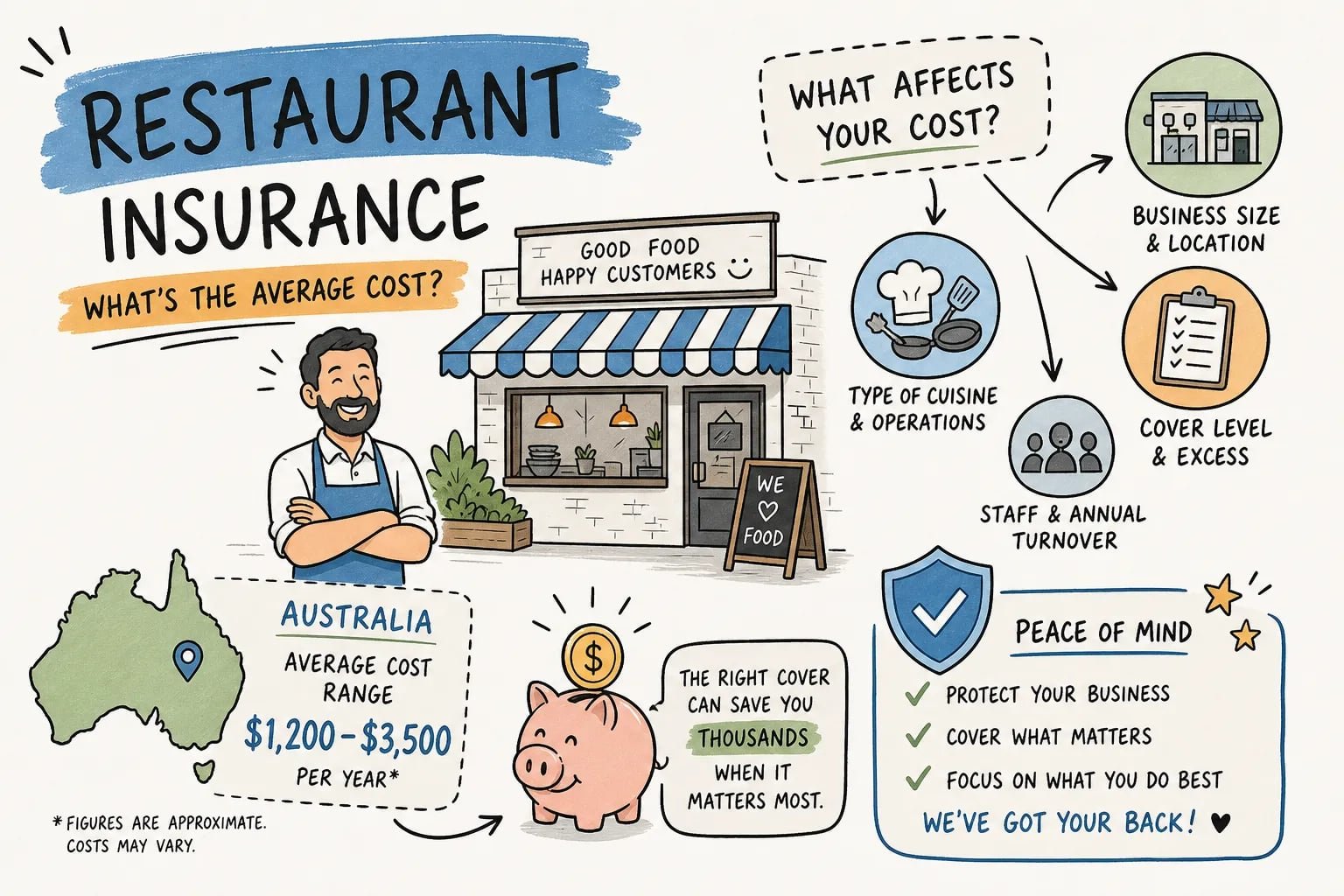
Understanding the insurance for restaurants cost average is the first step to knowing whether your current quote is fair. Across Australia, the average restaurant insurance cost sits around A$197 per month, based on pricing data from sources including BizCover and other market research tracked by NameTheCost.com. The problem is that this single figure covers everything from a three-table suburban café to a multi-level licensed venue with 80 seats and a full bar, so on its own, it tells you very little. This guide breaks down what restaurant and café insurance actually costs by venue size, what separates a lean policy from full cover, and which specific factors push hospitality premiums higher. By the end, you’ll have the numbers to assess whether your current quote is fair or whether you’re paying more than your risk profile warrants.
1. Insurance for restaurants cost average, what to expect in Australia
Costs vary significantly depending on venue size, annual turnover, and the level of cover you’re buying. The clearest way to make sense of the range is to split it into small versus medium-to-large venues, because the pricing logic is different at each level.
Small venues and cafés
A small restaurant or café typically pays between A$70 and A$150 per month for a basic business insurance package, which works out to A$840 to A$1,800 annually. BizCover data puts the café insurance average specifically at around A$180 per month, which reflects that many café operators carry more cover than the bare minimum. At this level, a basic package generally includes public liability and some property cover, but not necessarily business interruption or workers’ compensation. This is the starting point, not the ceiling.
Medium to large restaurants
Medium venues typically sit in the A$120 to A$260 per month range, or A$1,440 to A$3,120 annually. Licensed restaurants with high turnover or larger kitchen operations regularly push past A$3,000 to A$5,000 per year for comprehensive cover. The jump in cost is not arbitrary: it reflects the direct relationship between customer volume, payroll size, and claims exposure. More covers, more customers, and more staff mean more risk on the insurer’s books, and premiums move accordingly.
2. Bare minimum vs. comprehensive cover: what each actually costs you
Many restaurant operators don’t realise they’re choosing between a lean policy and a full package. They accept whatever they’re quoted without understanding what’s included. The gap in both price and protection is significant, and knowing the difference changes what you should be paying for.
The essentials-only approach
Public liability is the practical baseline for any venue that serves the public, and while it isn’t a statutory legal requirement across every state in every circumstance, it is widely required by landlords, local councils, and liquor licence conditions. Workers’ compensation, by contrast, is a legal obligation for any business with employees in Australia. In NSW, public liability for restaurants runs roughly A$66 per month for A$10 million cover and around A$77 per month for A$20 million cover. This is where many smaller operators start, particularly those renting premises from a landlord who already holds building insurance. The gaps left by a public liability-only policy are significant: your equipment, fit-out, stock, business income, and staff are all unprotected. It suits operators who are price-constrained and understand exactly what they’re taking on.
What a full cover package includes and costs
A comprehensive restaurant insurance package typically bundles public liability, property and contents cover, business interruption, and workers’ compensation. Property and contents adds roughly A$60 to A$170 per month depending on the value of your fit-out and equipment. Workers’ compensation is calculated as a percentage of total payroll: hospitality businesses in Australia generally sit in the 1% to 2.5% range, meaning a restaurant with A$500,000 in annual wages can expect a base workers’ compensation premium of around A$5,000 to A$12,500.
Taken together, a full package for a small-to-medium restaurant commonly lands in the A$3,000 to A$5,000 per year range. For any venue with significant foot traffic, staff, or a licensed kitchen, the full package is worth the cost. For a very small takeaway with minimal equipment and no employees, a leaner policy is a calculated and acceptable risk, provided you’re clear on the exposure.
3. The main factors driving hospitality insurance costs higher
Your premium is not random. Insurers price risk using specific signals, and understanding those signals is the first step to either questioning a high quote or avoiding the choices that push your premium up. Five factors consistently drive premiums higher in the hospitality sector.
How location, cuisine, and capacity affect your premium
Urban venues in inner-city Sydney, Melbourne, and Brisbane attract higher premiums than suburban or regional equivalents. Insurers factor in litigation risk, higher medical costs, and denser foot traffic. Sydney and Melbourne tend to be the most expensive markets, while Brisbane generally sits a little lower, though the difference is modest rather than dramatic. Cuisine type is a meaningful driver that many operators overlook: kitchens using open flames, deep fryers, wok stations, charbroilers, or wood-fired ovens are rated higher than lower-risk concepts because fire and grease exposure is materially greater. Seating capacity directly affects public liability exposure. More seats means more customers, more transactions, and more slip-and-fall risk. Insurers notice.
Turnover rate and claims history
High staff turnover raises workers’ compensation costs and employment practices liability risk because frequent hiring and departing staff increases the chance of workplace injuries and training gaps. Claims history, however, is often the single strongest pricing factor available to insurers. A clean record keeps premiums competitive; one serious slip-and-fall or fire claim can push rates up 20 to 30% and narrow the pool of insurers willing to quote you. Insurers typically review the last three to five years of loss history, so the decisions you make today follow you for years.
4. Why benchmarking the average restaurant insurance cost matters before you sign
Getting a quote from one insurer and signing it is one of the most common and costly mistakes restaurant operators make. The problem is not that insurers are dishonest. The problem is that without a market reference point, you have no way to know whether A$2,800 per year is competitive or A$800 too high for your venue profile. Most operators renew without checking. That’s expensive over time.
What an independent benchmark actually gives you
Knowing the real industry average for your venue size and cover type before you compare quotes gives you a basis for evaluation rather than guesswork. NameTheCost.com publishes cost guides for Australian business owners, covering what hospitality operators actually pay across different states and venue sizes. Published benchmarks give you a reference figure without a sales motive attached, something insurer websites and comparison platforms, which typically earn referral commissions on policies sold, aren’t structured to provide. That figure is what you bring to the table when comparing quotes or pushing back on a renewal increase.
Turning data into negotiating power
Knowing the average cost of restaurant insurance for your specific segment changes the conversation with a broker or direct insurer. If you operate a small licensed café in Melbourne and your quote is 40% above the sector average for a venue your size, you have a real basis to request a review, shop around, or adjust your cover structure. Without that benchmark, most owners simply accept the renewal figure. Information is leverage, and most restaurant operators walk into renewal negotiations without any.
5. Practical ways to bring your premium down without gutting your cover
There is no single action that halves your premium overnight. Several documented measures consistently signal lower risk to insurers, and that translates into more competitive pricing. Maintenance records and training documentation are what underwriters want to see when they’re pricing your risk, installation alone is rarely enough.
Physical risk controls that insurers reward
The hardware-based risk reductions that most consistently affect premiums include monitored burglar alarms, CCTV systems, commercial fire suppression systems compliant with Australian Standards for kitchen hood and duct suppression, and maintained fire extinguishers. These measures reduce both the frequency and severity of property and fire claims, and many insurers price them into the risk assessment even if they don’t advertise a formal discount rate. A venue with a monitored alarm, suppression system, and up-to-date fire protection equipment is simply a different risk profile from one without.
Documented procedures and a clean claims record
Written safety policies, cleaning logs, maintenance schedules, and staff training records demonstrate to underwriters that the business is actively managed rather than reactive. Training that specifically covers slip-and-fall prevention, responsible service of alcohol, knife handling, and food safety targets the claim types most common in hospitality. A claims-free history over three or more years is one of the strongest premium moderators available to any restaurant operator. Protecting that record by managing minor incidents internally, where appropriate and legally permissible, is a strategy worth considering before you call your insurer for a small claim that costs more in future premiums than the payout covers.
Frequently asked questions about restaurant insurance costs in Australia
How much does insurance for a small café cost?
A small café typically pays between A$840 and A$1,800 per year for a basic package covering public liability and property. BizCover data suggests the café average sits closer to A$180 per month when operators carry a more complete level of cover.
What is the average hospitality insurance cost in Australia?
Across all restaurant and café types, the average sits around A$197 per month. This figure aggregates a wide range of venue sizes and risk profiles, so comparing it against the ranges for your specific segment, small, medium, or large, gives a more useful reference point.
Is public liability for restaurants compulsory?
Public liability insurance is not universally required by statute across every state, but it is effectively essential. Most commercial landlords, councils, and liquor licence conditions require it. Workers’ compensation, by contrast, is a legal requirement for any business with employees.
What factors push café insurance prices up the most?
Claims history, cuisine type (particularly high-heat cooking), seating capacity, inner-city location, and staff headcount are the primary drivers. A clean claims record over three or more years is one of the most effective ways to keep costs down.
The numbers, summarised
A small café should expect to pay A$840 to A$1,800 per year for a basic package. A medium restaurant lands in the A$1,440 to A$3,120 range. A comprehensive package for a licensed venue with full cover commonly runs A$3,000 to A$5,000 or more. The overall market average across all restaurant types sits around A$197 per month. Compare your own quote against the insurance for restaurants cost average for your venue type, if it sits significantly above these figures, the factors covered in this guide are where you start looking.
Before renewing or signing a new policy, check what comparable operators are actually paying. NameTheCost.com publishes independent pricing data for Australian business owners across hospitality and beyond, giving you a reference point built around real market data rather than a sales outcome. Get at least three quotes, measure them against the industry average for your venue type, and make your decision from a position of information rather than habit.