How Is Property Value Determined in Australia?
Ask three different sources what your property value is and you’ll get three different numbers. The online estimate on a real estate portal, the land value on your council rates notice, and the figure your bank produces when you refinance can all point in completely different directions. That’s not a flaw in the process; it’s because each figure is answering a different question. The problem is most people treat them as interchangeable, and that creates real confusion when actual money is on the line.
This guide explains the main drivers of property value in Australia, what each type of estimate is actually measuring, and which one you should rely on depending on your situation. Whether you’re selling or refinancing, the framework below gives you something more useful than vague agent talk. It also helps if you simply want an honest read on where your property sits in the current market.
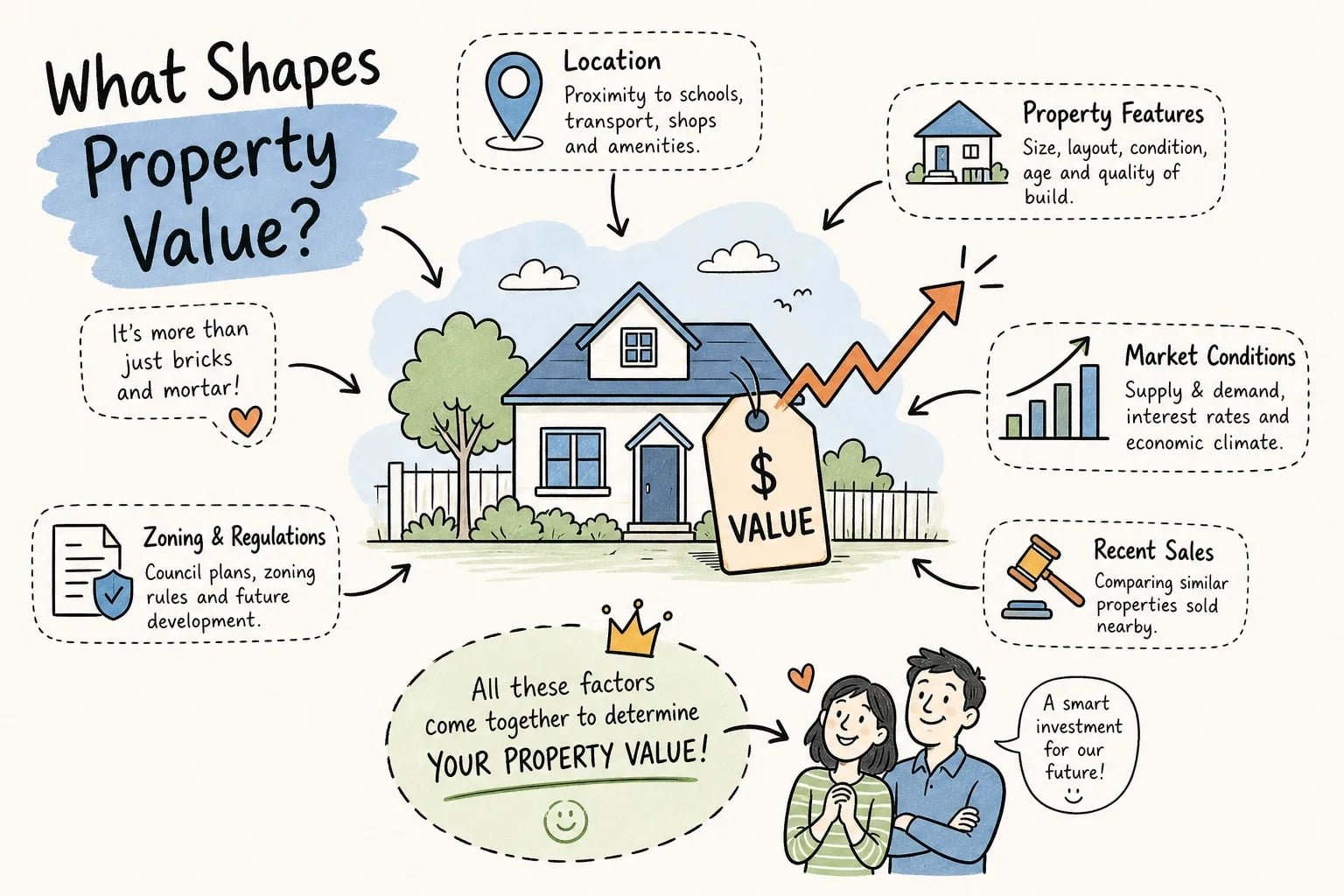
Main factors that drive property value
Location carries more weight than any other single factor, and that’s not likely to change. Proximity to quality schools, public transport, employment hubs, and coastline all feed directly into buyer demand, which is what ultimately sets the ceiling on price. Two structurally identical houses on different streets in the same suburb can have meaningfully different values simply because of what’s within walking distance of each one.
Once location is established, recent comparable sales are the most reliable anchor for any valuation. In practice, “comparable” means similar land size, similar bedroom and bathroom configuration, similar condition, and sold recently in the same suburb. In stable markets, valuers typically rely on sales from the last three to six months; in rapidly moving markets, a shorter window is standard, while thinly traded areas may require extending the window to find enough usable evidence. These comps are the foundation both registered valuers and automated tools use to establish a baseline.
Property attributes then adjust the estimate up or down from that comp baseline. Land size, build quality, condition, and whether the home has been updated all shift the number. A structurally sound four-bedroom home in original 1990s condition sits very differently on the scale than the same configuration with a renovated kitchen, new roof, and updated bathrooms. These attributes are what give a valuer or an algorithm room to make meaningful adjustments from the comparable sales evidence.
Free online tools and how accurate they really are
Automated valuation models, commonly called AVMs, pull together recent comparable sales, property attribute data, and suburb trend information to generate a house value estimate almost instantly. Some tools also layer in listing history and computer-vision analysis of property photos to detect condition and renovation status. The output is always a range, not a precise number, and better tools include a confidence level that reflects how much usable comparable sales data exists for the area.
The main tools Australians use include Domain, realestate.com.au, PropertyValue (which runs on CoreLogic/Cotality data), CommBank, and ANZ. Based on available independent comparative testing, Domain sits at roughly 6% average variance against actual sale prices, with realestate.com.au around 7%. The bank tools are designed primarily as lending guides, not market appraisals, so they should be read accordingly. All of them produce ranges, not prices, and all of them can produce outliers well above 20% variance on non-standard properties.
Put the error range in dollar terms and the picture sharpens. On a $1 million property, an AVM with a 10% to 15% margin of error represents a $100,000 to $150,000 spread. AVMs work best where comparable sales are plentiful and properties are relatively uniform. In prestige markets, rural areas, or suburbs with unique housing stock, the error range widens considerably. Use these tools as a starting reference for your home value, then verify with actual sold-price data before making any financial decision based on the number.
Market value, council land value, and bank valuations are not the same thing
Market value reflects what a willing buyer and a willing seller would agree on in a current, open-market transaction after proper marketing. Council land value is a statutory figure used to calculate rates and land tax; in NSW and Queensland it covers land only, excluding the dwelling, while Victoria’s capital improved value includes improvements. Council figures are based on periodic mass-valuation cycles, and the lag relative to the actual market varies by state, in some states valuations are updated annually, in others less frequently, so treating them as a current market guide can mislead.
A bank valuation is a conservative estimate a lender commissions to assess how much it’s prepared to lend, not what the property would actually fetch at auction. Lenders want a buffer if they need to sell quickly, so bank valuations routinely come in below agent appraisals and market expectations. The three figures answer three different questions at potentially different points in time, which is why they rarely match.
Match each figure to its purpose before you draw any conclusions from it. If you’re selling, market value is what matters. If you’re disputing your rates notice, council land value is the relevant figure to examine. If your bank valuation comes in lower than your agreed purchase price, you need to understand why the lender is being conservative and whether there are grounds to challenge it. Treating any one of these figures as a universal measure of your property value causes unnecessary confusion and, sometimes, costly mistakes in transactions.
Does renovation actually lift your property value?
Not every upgrade returns its cost. Some renovations genuinely add market value; others simply bring the property up to the standard buyers already expect in that suburb, without adding a dollar premium above the comp baseline. Cosmetic updates to a tired kitchen or bathroom generally perform better than highly personalised additions that reflect the owner’s taste rather than broad buyer demand. The real risk is overcapitalising: spending more on an upgrade than the market is prepared to reward in the final sale price.
Kitchens and bathrooms consistently rank among the highest-returning renovations in the Australian market. Returns vary widely depending on suburb, scope, and the property’s starting condition, published figures range considerably, so treat any single number as a guide rather than a guarantee. Structural repairs and energy efficiency upgrades are often necessary to prevent value discounting, but rarely deliver a visible premium at sale on their own. Improving indoor-outdoor flow in appropriate climates tends to resonate strongly with buyers and can be a cost-effective way to lift appeal without heavy construction spend.
Before committing to any renovation, the sensible step is to work out what the upgrade will actually cost versus how much it’s likely to move the property value in your specific suburb. Cost guides that break down trade pricing and material costs by renovation type, such as those available at NameTheCost.com, give homeowners a realistic spend figure to run against comparable sales data before a dollar is committed. If the numbers don’t stack up before the tradies arrive on site, they rarely improve once the work is underway.
Where to access official sold-price data in Australia
Official sold-price data in Australia comes from state land registry and Valuer-General sources, not from commercial platforms. In NSW, the Valuer General’s Bulk Property Sales Information dataset is updated weekly and covers settled sales back to 1990, downloadable by Local Government Area in a flat file format that imports into most spreadsheet programmes. Victoria’s Valuer-General publishes the Victorian Property Sales Report quarterly through DataVic, covering houses, units, vacant residential land, and commercial properties. Both datasets contain actual settlement prices rather than estimated ranges, a meaningful distinction when you’re trying to ground-truth a property price estimate.
Pulling three to five comparable sales from official datasets gives you a grounded benchmark to test against whatever an AVM produces. If government data and a commercial tool agree within a reasonable band, that’s a reasonable signal the range is credible. If they diverge significantly, the property likely has characteristics an algorithm hasn’t fully captured, and a professional valuer’s judgement becomes more relevant.
When a professional valuation is worth the cost
A registered property valuer physically inspects the property, assesses condition and build quality firsthand, and applies professional judgement to comparable sales selection and adjustment. The result is a formal written report that carries legal and financial weight in transactions, estate settlements, and disputes. An AVM estimates from data alone; it can’t stand inside the property, identify deferred maintenance, or assess the quality of a recent renovation the way a trained professional can.
Professional residential valuations in Australia typically range from around $350 to $650 for a standard metro property, with regional, complex, or high-value properties often running higher. Order one when you’re genuinely at financial risk without a precise, defensible figure. Pre-purchase due diligence on a property with unusual features, settling a deceased estate, disputing a bank valuation, or preparing for a property settlement in a separation all warrant the cost of a formal report. For a rough market check or casual curiosity, a free AVM tool is sufficient, provided you understand what margin of error you’re working with.
The professional valuation fee is almost always trivial relative to the financial decisions it informs. Getting the number wrong on a $700,000 purchase or a family law settlement is far more expensive than a $500 valuation report. Spend the money when the stakes justify it; use the free tools for everything else.
Getting clarity before you commit
Property value in Australia is shaped by location, comparable sales, property attributes, market conditions, and who is doing the calculating. Free online tools provide a useful starting range for your home value, but a 10% to 15% margin of error is material when real money is involved. Always verify against official sold-price data, understand which type of valuation you’re actually looking at, market, council, or bank, and if the stakes are high enough, commission a registered valuer’s report. That last step costs a few hundred dollars. Getting it wrong on a significant transaction costs considerably more.