Small Business Insurance Cost Australia: 2026 Complete Pricing Guide
On average, Australian small businesses pay $40 to $180 per month ($480 to $2,160 annually) for basic Public Liability coverage. Comprehensive business insurance packs, combining Public Liability, Contents, Business Interruption, and Cyber cover typically range from $150 to $550+ per month, depending on industry risk, annual turnover, and business location.
Get a Business Insurance Quote TodayAustralia Small Business Insurance Cost Matrix
The table below breaks down typical annual and monthly small business insurance costs across business risk tiers and coverage levels in Australia.
| Business Risk Profile & Type | Basic Public Liability ($5M – $10M Cover) | Standard Business Pack (Liability + Property/Contents) | Comprehensive Pack (+ Cyber & Professional Indemnity) |
|---|---|---|---|
| Low Risk / Micro Business (Sole Trader, Graphic Designer, Online Consultant, Tutor) | $35 – $65 / mo ($420 – $780 / yr) | $85 – $145 / mo ($1,020 – $1,740 / yr) | $160 – $280 / mo ($1,920 – $3,360 / yr) |
| Moderate Risk / Retail & Services (Boutique Retail, Hair Salon, Cafe, Accountant, Cleaners) | $60 – $120 / mo ($720 – $1,440 / yr) | $150 – $320 / mo ($1,800 – $3,840 / yr) | $310 – $580 / mo ($3,720 – $6,960 / yr) |
| High Risk / Trades & Hospitality (Electrician, Plumber, Builder, Restaurant with Commercial Kitchen) | $110 – $260 / mo ($1,320 – $3,120 / yr) | $280 – $650 / mo ($3,360 – $7,800 / yr) | $550 – $1,200+ / mo ($6,600 – $14,400+ / yr) |
How Much Does Small Business Insurance Cost in Australia?
Understanding business insurance cost starts with recognising that no two operations carry the exact same risk. For most micro-businesses and sole traders, insurance for small business cost averages around $60 to $90 per month. However, how much insurance for small business you actually need depends heavily on your daily operations, whether you interact face-to-face with clients, and if you manage physical property or valuable inventory. You may be eligible for an exemption for some insurance.
When asking how much does small business insurance cost, it helps to realise that Australian insurers evaluate your policy using a formula based on revenue, headcount, trade type, and location. A solo copywriter working from home might pay under $400 a year, while a commercial plumbing contractor with three vehicles and staff can easily see their cost for small business insurance exceed $4,500 per year.

Core Insurance Coverages and Their Costs
When building a small business insurance cover package, your total policy price is made up of individual insurance policies tailored to your risks.
Public Liability Insurance Cost
Public Liability is the foundation of almost every small business insurance policy in Australia. It protects you if a customer, supplier, or member of the public suffers an injury or property damage due to your business operations.
- Typical Cost: $40 to $180 per month ($480 to $2,160 annually).
- Common Cover Limits: $5 Million, $10 Million, or $20 Million.
- Key Driver: Foot traffic, site visits, and physical work risks.
Professional Indemnity Insurance Cost
If your business sells advice, design, or professional expertise, insurance for a small business cost will usually include Professional Indemnity. This covers legal costs and damages if a client suffers financial loss due to alleged errors, omissions, or negligent advice.
- Typical Cost: $50 to $220 per month ($600 to $2,640 annually).
- Common Cover Limits: $1 Million to $10 Million.
- Key Driver: The financial scale of the advice provided and potential loss claims.
Business Pack & Commercial Property Insurance Cost
A Business Insurance Pack rolls multiple covers into a single policy. It protects your physical asset investments, including building structures, stock, tools of trade, and machinery.
- Typical Cost: $80 to $350+ per month ($960 to $4,200+ annually).
- Includes: Fire and storm damage, theft, glass breakdown, and Business Interruption (which replaces lost income during an operational shutdown).
Cyber Liability Insurance Rates
With digital payments and cloud platforms becoming standard across Australia, cyber claims are rising rapidly. Cyber insurance covers data breach response costs, ransomware demands, IT forensics, and business interruption caused by cyberattacks. If you are expanding your business digitally or building a custom mobile platform, it is crucial to account for both liability protection and software build expenses—see our full breakdown on how much app development costs in Australia to budget effectively.
- Typical Cost: $45 to $150 per month ($540 to $1,800 annually).
- Key Driver: The volume of client records, credit card data, and online revenue generated.
Workers’ Compensation Insurance
If you employ staff in Australia, Workers’ Compensation is legally mandatory. Rates are regulated state-by-state and calculated as a percentage of your total employee wage bill.
- Typical Cost: 1% to 8%+ of total payroll (varying widely by occupation safety risk).
Industry Benchmark Costs across Australia
The table below outlines average small business insurance costs across popular Australian industries:
| Industry Sector | Primary Policy Needs | Average Monthly Cost |
|---|---|---|
| Allied Health | Public + Professional | $65 – $140 / month |
| Trades & Construction | Public + Tools | $120 – $350 / month |
| Retail & E-Commerce | Public + Stock | $90 – $220 / month |
| Hospitality (Cafes/Pubs) | Public + Property + BI | $180 – $520 / month |
| Professional Consulting | Professional + Cyber | $55 – $130 / month |
Tradies & Construction Industry Costs
Trades face high physical risk exposure. Whether you are a solo carpenter or a master electrician, principal contractors often won’t let you step onto a job site without at least $10M or $20M Public Liability cover.
- Electricians & Plumbers: $110 – $280 per month.
- Carpenters & Handymen: $80 – $180 per month.
- Earthmovers & Concreters: $180 – $450+ per month.
Retail Shops & E-Commerce Costs
Retailers face two distinct risk profiles: slip-and-fall injuries from physical shop visitors, and stock damage or cyber breach issues for online stores.
- Brick-and-Mortar Boutique: $110 – $260 per month (includes Public Liability and $50k Stock cover).
- Online-Only Store: $50 – $110 per month (Public & Products Liability plus basic Cyber cover).
Professional Services Costs
Consultants, bookkeepers, marketing agencies, and software developers generally enjoy lower small business insurance rates because they don’t operate heavy machinery or host hazardous public areas.
- Sole Management Consultant: $45 – $90 per month.
- Small Accounting Firm (3-5 staff): $160 – $380 per month.
Hospitality & Food Services Costs
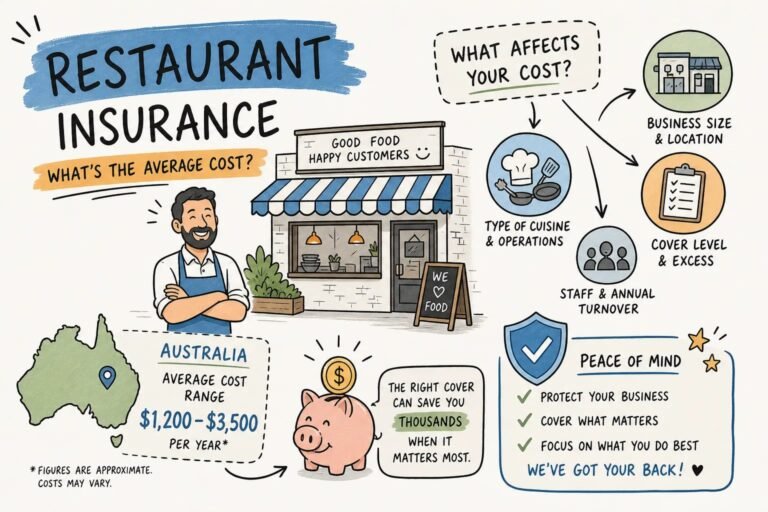
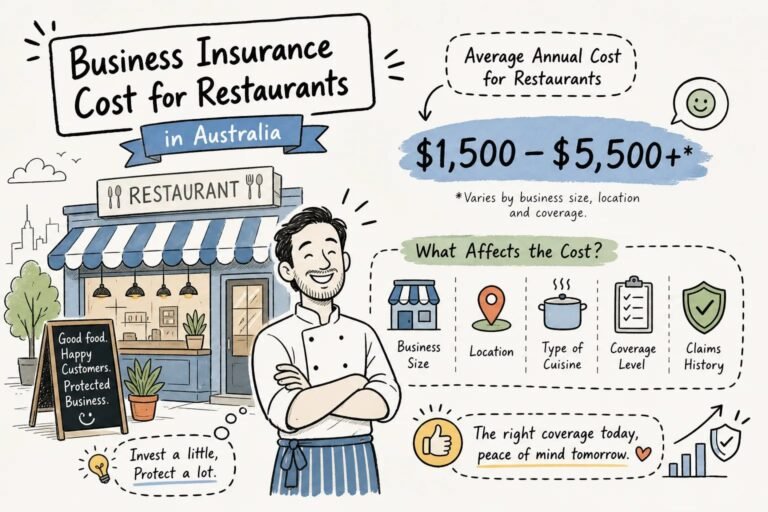
Cafes, bars, and restaurants incur some of the highest business insurance cost australia figures due to hot surfaces, wet floors, alcohol service liability, and high-value commercial kitchen fitouts.
- Suburban Cafe: $180 – $380 per month.
- CBD Restaurant / Licensed Bar: $350 – $950+ per month.
Regional Price Variations Across Australia
Location plays a massive role in small business insurance cost australia. Insurers use localised historical data to adjust premiums based on weather hazards, local crime statistics, and regional labor costs.
| Region | Cost Modifiers |
|---|---|
| QLD & NT Coastal Zones | +25% to +50% Climate Risk |
| SYD/MEL CBD Metro Zones | +10% to +20% Foot Density |
| Regional NSW & Victoria | Baseline Standard Risk |
| WA & SA Metro/Mid | -5% to +10% Stable Risk |
Sydney & Melbourne Metro Areas
In densely populated metropolitan centers like the Sydney CBD, Parramatta, Melbourne CBD, or Southbank, high foot traffic significantly increases slip-and-fall claims.
Local Surcharge Example: A cafe located on Sydney’s Pitt Street Mall faces far higher foot traffic volume than a cafe in regional Dubbo. Insurers apply a 10% to 20% premium loading on Public Liability in CBD zones to account for increased public exposure and higher commercial property replacement costs.
Queensland & Northern Territory Climate Loadings
Northern Australia faces frequent natural hazards, including tropical cyclones, severe flooding, and high-intensity storms.
Climate Loading Example: In coastal regions like Townsville, Cairns, or Darwin, commercial property insurance and Business Interruption coverage carry heavy risk loadings. Small businesses in these areas often pay 25% to 50% more for Business Insurance Packs compared to equivalent businesses in Adelaide or Melbourne due to elevated flood and storm risks.
Regional Victoria, NSW, and South Australia
Regional inland towns often benefit from reduced Public Liability baseline costs due to lower pedestrian traffic. However, businesses situated in high-risk bushfire zones or river floodplains may see higher property coverage excesses or specialized environmental premium loadings.
Location plays a massive role in small business insurance cost australia. Insurers use localised historical data to adjust premiums based on weather hazards, local crime statistics, and regional labor costs.
Hidden Costs and Extra Fees in Business Insurance
When comparing an insurance quote small business offer, the headline premium isn’t the only expense to keep in mind. Several subtle costs can affect your final bill.
1. Excess Structures and Deductibles
Your policy excess is the out-of-pocket amount you pay when lodging a claim. Choosing a higher excess will lower your monthly premium, while selecting a lower excess raises it.
- Standard Excess: $500 – $1,000 per claim.
- Specialist Excesses: Water damage, age-related driver excesses, or worker injury excesses can range from $2,500 to $5,000+.
2. Monthly Premium Funding Charges
Paying your insurance premium monthly rather than annually helps cash flow, but it comes with a fee. Premium funding companies typically add an interest rate of 5% to 9% (plus admin fees) to break your annual premium into 12 monthly installments.
3. Broker Service and Administration Fees
If you buy through an insurance broker rather than directly online, your invoice may include a Broker Fee ($50 to $250+ per policy renewal) alongside the commission the broker receives from the insurer. A good broker can save you money overall by negotiating better terms, but this fee adds to your initial outlay.
4. Annual Turnover Audits and Premium Adjustments
Insurers calculate your premium based on your estimated annual revenue. If your actual turnover at the end of the financial year exceeds your estimate by more than 15% to 20%, the insurer may retroactively charge an additional premium adjustment fee.
5. Sub-Contractor Vicarious Liability Loadings
If you hire sub-contractors, your insurer may require proof that they maintain their own active Public Liability insurance. If your subbies are uninsured, your insurer will classify them as employees, potentially increasing your premium by 15% to 35%.
Key Drivers of Small Business Insurance Rates
Insurers evaluate several core business metrics when calculating how much small business insurance cost figures will be for your policy:
| Cost Driver | Description |
|---|---|
| Annual Revenue | Higher turnover = higher risk volume and exposure |
| Total Staff/Pay | More employees = increased workplace injury risks |
| Occupation Type | High-risk activities (e.g. height work) raise costs |
| Claims History | A clean 5-year record unlocks 10-25% discounts |
- Annual Revenue & Turnover: Higher revenue means you handle more clients, products, or projects, which statistically increases your overall claim exposure.
- Staff Count & Total Payroll: Expanding your team increases workplace health, safety, and operational risks, which directly impacts your cost of insurance for a small business.
- Occupation & Risk Exposure: Working with hazardous materials, hot works, heavy machinery, or height exposure carries higher baseline rates than office work.
- Claims History: Maintaining a clean claim history for 3 to 5 consecutive years can earn you No Claim Discounts (NCD) of 10% to 25%.
How to Get an Insurance Quote for a Small Business
Getting an accurate insurance quote small business package doesn’t have to be complicated. Following a structured process ensures you secure appropriate coverage without overpaying.
Gather Key Business Data
Time: 10 mins
Collect your Australian Business Number (ABN), projected annual turnover, total payroll figures, and details on asset values, stock, and specialized equipment.
Determine Mandatory Coverages
Time: 15 mins
Identify required policies. Workers’ Compensation is required if you hire staff. Check client contracts or commercial lease agreements for specific requirements, such as a $10M or $20M Public Liability clause.
Compare Online Quotes vs. Broker Quotes
Time: 20 mins
Use direct online comparison portals for straightforward micro-business risks. For complex, multi-location, or high-turnover businesses, contact a qualified Australian insurance broker.
Review Exclusions and Deductibles
Time: 15 mins
Examine policy fine print for exclusions (such as flood exclusions, height limits, or work-type restrictions) and verify the excess amounts per claim.
Practical Ways to Reduce Your Small Business Insurance Costs
If you’re wondering how much should small business insurance cost and want to keep premiums down, these practical strategies can help reduce your bill:
- Pay Premiums Annually: Paying upfront in one lump sum saves 5% to 9% in interest and direct debit fees.
- Increase Your Voluntary Excess: Raising your default claim excess from $500 to $1,000 can lower your ongoing monthly premium by 10% to 15%.
- Bundle Coverages in a Business Pack: Grouping Public Liability, Contents, and Theft under one Business Pack is often significantly cheaper than purchasing standalone policies.
- Maintain Updated Property Valuations: Avoid over-insuring older equipment or obsolete stock that has depreciated in value.
- Implement Strong Risk Controls: Installing back-to-base security alarms, fire prevention systems, and documented safety procedures can earn risk mitigation discounts from top insurers.
- Review Turnover Figures Annually: Avoid overestimating projected revenue during slower trading periods so you don’t pay unnecessary risk premiums.
- Compare Quotes Every Year: Don’t let your policy auto-renew without shopping around. Renewal rates can increase even if you haven’t made a claim.
Recommended Insurance Setup by Business Size
Sole Trader/Freelancer:
- Public Liability ($5M – $10M)
- Professional Indemnity (If offering advice)
- Portable Equipment / Tools Cover
Small Business (2-10 staff):
- Public Liability ($10M – $20M)
- Business Pack (Contents, Glass, Theft)
- Workers’ Compensation (Mandatory)
Growing Enterprise (10+ staff):
- Full Business Pack + Business Interruption
- Cyber Liability + Management Liability
- Commercial Vehicle Fleet Policy
Choosing the Best Small Business Insurance in Australia
Finding the best small business insurance australia offers requires balancing competitive pricing with reliable claims support.
When evaluating Australian insurers, such as BizCover, QBE, CGU, Vero, Allianz, or NRMA, consider these three critical factors:
- Financial Strength & Payout Record: Choose established, APRA-regulated insurers with strong credit ratings and a proven track record of prompt claim payouts.
- Policy Flexibility: Ensure you can easily add end-of-year endorsements, update employee counts, or adjust coverage limits as your business grows.
- Local Claims Support: Having access to Australian-based claims teams speeds up response times during emergency events or property damage claims.
Frequently Asked Questions (FAQ)
How much is insurance for a business on average per month?
Across all industries in Australia, the average small business pays between $40 and $180 per month for standalone Public Liability cover, and between $150 and $450 per month for a broader Business Pack containing property and interruption protection.
Is small business insurance tax-deductible in Australia?
Yes. Business insurance premiums paid for protecting your business operations, assets, and liabilities are fully tax-deductible operating expenses according to the Australian Taxation Office (ATO).
Is Public Liability insurance legally mandatory in Australia?
Public Liability is not universally mandated by Australian federal law. However, it is effectively compulsory for many businesses because commercial landlords, trade head contractors, shopping centers, and government bodies routinely require proof of $10M or $20M Public Liability cover before signing leases or granting site access.
What happens if my business revenue increases mid-year?
If your revenue increases significantly during your policy term, contact your insurer or broker to update your projected turnover. This ensures your coverage limits remain valid and protects you from under-insurance penalties or claim adjustments.
Final Recap and Next Steps
Managing your small business insurance cost comes down to securing the right level of protection for your operational risks without paying for unnecessary extras.
By comparing quotes annually, selecting accurate revenue tiers, and bundling your policies into a Business Pack, you can keep your ongoing costs manageable while protecting your cash flow and assets.