Legal Aid vs Private Solicitor: How to Decide in Australia
Many people facing a legal problem jump to one of two conclusions: they assume they can’t afford a solicitor and either give up on proper representation, or they panic and sign a costs agreement without understanding what it’s going to cost them. Both responses are avoidable. The real question isn’t whether you can afford a lawyer, it’s whether you actually need to pay for one at all, and whether your matter is one that legal aid handles well.
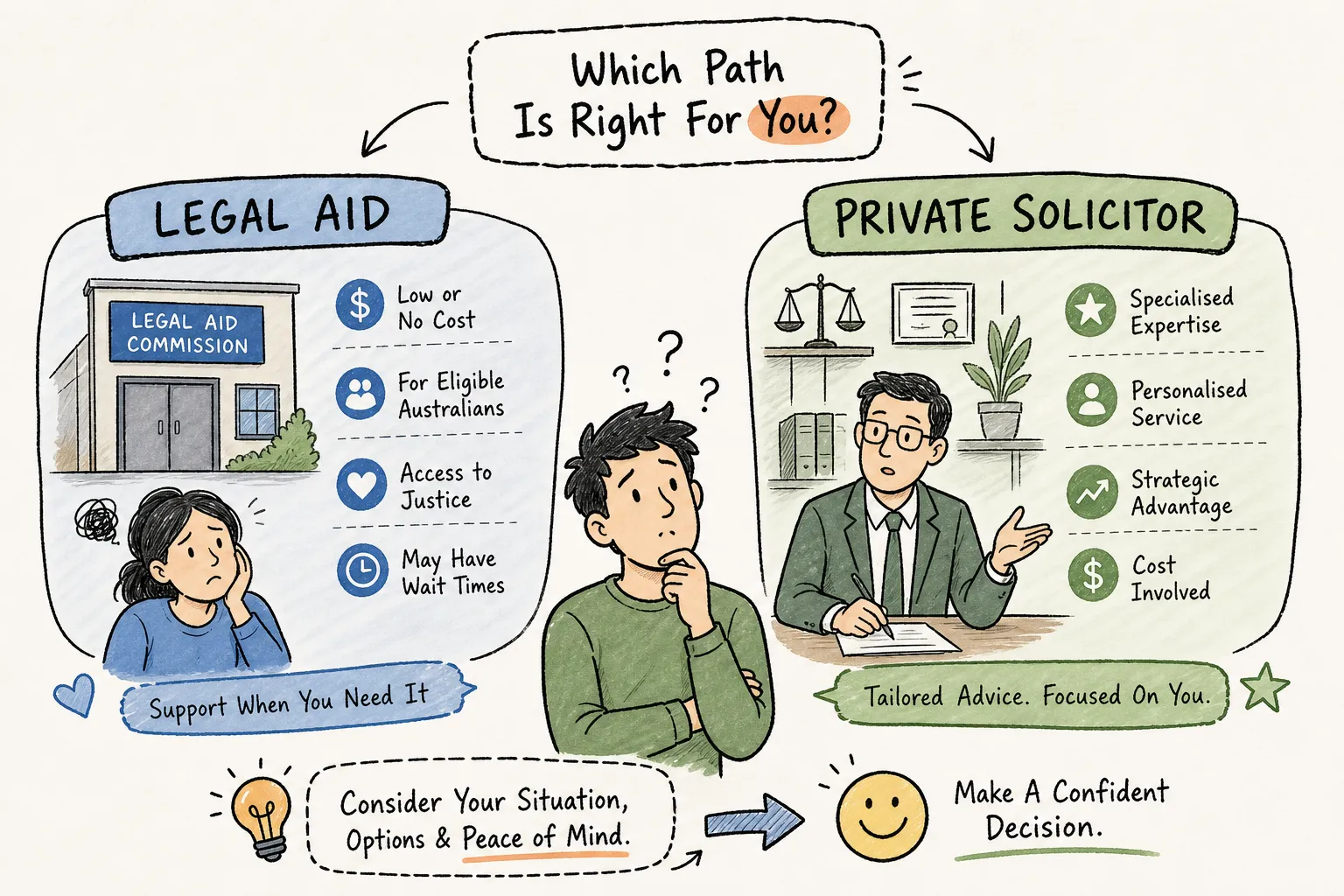
So when should you use legal aid instead of hiring a solicitor in Australia? There are two main paths, and neither is automatically better. Legal aid is free or heavily subsidised government-funded legal representation, available only if you meet eligibility criteria. A private solicitor is available on demand with no statutory gatekeeping, but you pay full commercial rates. They serve genuinely different situations, and choosing the wrong one costs you either money you don’t need to spend or representation you genuinely needed. Before you pick up the phone to either, it helps to know what each option actually delivers and what it costs. The independent legal services cost guides at NameTheCost.com exist precisely for this: to give you a realistic Australian dollar benchmark before you commit to anything.
What legal aid actually covers in Australia
Most people have a fuzzy idea of what legal aid is. They know it’s free, and they assume it’s for people who are really struggling financially. The reality is more specific, and the gaps are significant enough to matter.
Criminal and family matters: where legal aid is strongest
Legal aid commissions across Australia prioritise criminal matters where there is a genuine risk of imprisonment, and family law matters involving family violence, child safety disputes, or parenting arrangements where a child’s welfare is at stake. These are the areas where funding is most consistently available. A duty lawyer is often accessible on the day of your court appearance for routine mentions, bail applications, and first appearances in local courts. If your matter falls here, legal aid is a serious, professional option worth pursuing.
Civil and migration matters: where coverage gets thin
Civil law assistance is significantly more restricted. Commercial disputes, employment matters, and most ordinary civil claims are typically outside scope. Migration coverage is narrow, usually limited to detention challenges, specific protection visa matters, or cases with an arguable legal error. If your matter sits in either of these categories, don’t bank on legal aid as your first plan. You’ll likely need to look at private representation or the alternatives covered later in this guide.
How the means test and merits test determine your eligibility
Eligibility for legal aid isn’t just about being broke. There are two separate tests, and you need to pass both. Many people find out too late that they’ve cleared one but failed the other.
The means test: income and assets thresholds
Every legal aid commission runs a financial means test based on income and assets. In NSW in 2026, the simplified means test sets income limits at $1,157 per week for a single person and $1,933 per week for a single person with children, with a cash assets cap under $10,000, check the Legal Aid NSW website directly to confirm these figures remain current. Victoria uses assessable income bands: generally under $360 per week for standard matters, with higher thresholds for high-cost matters, as detailed on the Victoria Legal Aid website. Queensland uses a contribution-based scale, where a single person in the workforce with no children can earn up to $695 per week to qualify contribution-free, or up to $1,040 per week with a financial contribution required, Legal Aid Queensland publishes the full means test table online. Some services, including initial information sessions and duty lawyer assistance, are exempt from the means test entirely.
The merits test: does your case qualify?
Passing the means test isn’t enough on its own. Legal aid commissions also assess whether your case has sufficient legal merit to justify funding. Across most jurisdictions, the merits test applies a three-part framework: your matter must have reasonable prospects of success, a prudent self-funding litigant would spend their own money on it, and the likely benefit justifies spending limited public legal aid funds. If your prospects of success are low or the outcome doesn’t justify the cost, aid can still be refused. This is where many applicants get caught out after assuming the financial test was the only hurdle.
State-by-state variations to be aware of
Eligibility thresholds and the way each test is applied differ meaningfully across jurisdictions. NSW publishes its thresholds clearly and updates them regularly. NT uses a broader discretionary framework that goes beyond pure income figures, incorporating likely case costs and matter-specific benchmarks. WA, SA, and Tasmania each have their own frameworks, and exact thresholds change, so check your state legal aid commission’s website directly before assuming you’re in or out.
Legal aid vs private solicitor: understanding the real financial gap
This is where most people underestimate the stakes. Legal aid is free or heavily subsidised. A private solicitor is not, and published rates in Australia in 2026 vary considerably with limited transparency across the market.
What private solicitors charge in Australian cities in 2026
Private solicitor rates vary by city, seniority, and practice area. As a working baseline for 2026:
- Sydney and Melbourne: junior solicitors from $260/hr; mid-level $440, $600/hr; senior specialists up to $880/hr
- Brisbane: $240, $770/hr depending on seniority
- Adelaide: $220, $720/hr
- Perth and Canberra: broadly in line with Brisbane at $230, $770/hr
For fixed-fee matters, a straightforward criminal plea or local court appearance typically runs $2,200, $6,600. A contested family law matter can quickly exceed $15,000. A defended District Court trial, once solicitor and barrister fees are combined, commonly lands between $50,000 and $70,000 for a standard five-day hearing. Complex matters run higher. These are real figures, not worst-case scenarios.
Benchmarking a quote before you commit
Before you accept a private solicitor’s quote, know what the market rate actually looks like for your matter type and city. The independent legal services cost guides at NameTheCost.com break down realistic solicitor fee ranges by practice area across Australia, with no advertiser bias or referral commissions skewing the numbers. Use it as a baseline before your first meeting, not after you’ve signed a costs agreement.
When should you use legal aid or hire a solicitor in Australia?
The decision is less about income alone and more about what your matter actually involves, what’s at stake, and where it sits within your state’s priority guidelines. Here’s how to read your situation clearly.
When legal aid is the right call
Legal aid is well-suited for criminal charges where imprisonment is a genuine possibility, particularly for serious indictable matters. It also works well for family law disputes involving family violence, child safety concerns, or contested parenting arrangements, and for any matter where you clearly pass both the means test and the merits test and the issue falls within your state’s priority guidelines. For these situations, legal aid representation through an in-house solicitor or a private firm on a grant is a legitimate, professional outcome. It isn’t a compromise.
When a private solicitor is worth the cost
Pay for private representation when your income or assets exceed the means test thresholds, when your matter is civil, commercial, employment-related, or in an area legal aid rarely funds, or when you need strategic specialist advice rather than just court representation. Direct, uninterrupted access to your lawyer also matters on complex matters. Legal aid applications take time and involve a grant process; private representation starts when you engage. On high-value or technically complex matters, a private solicitor’s expertise can change the outcome in ways that make the fee entirely justified.
When legal aid isn’t available: your other options
Being ineligible for legal aid doesn’t mean your only option is a $500-per-hour solicitor. There’s a genuine middle tier, duty lawyers, community legal centres, and pro bono referrals, that most people overlook entirely.
Duty lawyers and court-based services
If you have a court date and no lawyer, go to the courthouse early and ask for the duty lawyer. Duty lawyers provide free, same-day legal help for people appearing in local and magistrates’ courts across Australia. The service is typically limited to that appearance, covering mentions, bail hearings, first appearances, and advice, rather than full case management. In many courts there is no means test for this service, though availability can vary by jurisdiction and court, contact the court registry or your state’s legal aid commission ahead of time to confirm arrangements. Arrive at least an hour before your matter is listed, bring all relevant paperwork, and ask court staff where to find the duty lawyer office if it’s not signposted.
Community legal centres and pro bono referrals
Australia has close to 200 community legal centres (CLCs) that assist people who don’t qualify for legal aid but also can’t afford private rates, the National Association of Community Legal Centres maintains a directory you can search by location and area of law. CLCs take cases based on merit, means, area of law, and available capacity. Many handle family law, housing, and consumer matters, and some specialist centres focus on women experiencing family violence, Aboriginal and Torres Strait Islander clients, and other priority groups. For referral to a pro bono solicitor, organisations like Justice Connect and state law society pro bono schemes act as clearing houses. Pro bono is a genuine last resort, and you’re expected to try legal aid and a CLC first, but it’s a real option that fills more gaps than most people realise.
Your next steps before you commit to either path
The worst thing you can do is make a financial commitment based on assumptions. Take these steps in order before you sign anything or pay anyone.
Check eligibility before anything else
Contact your state’s legal aid commission directly and request an eligibility check. Legal Aid NSW, Victoria Legal Aid, Legal Aid Queensland, and their equivalents in other states all offer a free initial enquiry or phone assessment, each commission’s website lists contact details and the information you’ll need to have ready. Do this before spending money on a private consultation. If you’re borderline on income thresholds, a community legal centre can often advise whether an application is worth pursuing and point you toward any other services relevant to your matter type.
Get an independent cost baseline before you hire anyone
If you’re leaning toward a private solicitor, get at least two quotes and compare them against the going market rate for your matter type and city. Solicitor fees in Australia vary significantly, and without a benchmark you have no way to tell whether a quote is reasonable or inflated. The legal services cost guides at NameTheCost.com give you that independent baseline, so you can walk into a solicitor’s office informed rather than just hopeful.
Making the right call
The choice between legal aid and a private solicitor isn’t about pride or preference. It’s about your case type, your financial situation, and what’s actually available to you in your state. Legal aid is genuinely good representation for the matters it covers well. A private solicitor is worth the cost when the stakes are high and the matter falls outside legal aid’s scope.
The middle ground, duty lawyers, CLCs, and pro bono referrals, fills more gaps than most people realise. Start with eligibility, understand the real costs, and make a decision from a position of clear information, not guesswork. That’s how you get the right outcome without paying more than you need to.
Frequently asked questions
When should I use legal aid instead of hiring a solicitor in Australia?
Use legal aid when your matter falls within a priority area, typically criminal charges with a genuine risk of imprisonment, or family law disputes involving family violence or child safety, and you pass both the means test and the merits test. If your matter is civil, commercial, or employment-related, legal aid is unlikely to be available and a private solicitor or a community legal centre will be the more realistic path.
What is the means test for legal aid in Australia?
Each state runs its own means test based on income and assets. NSW, Victoria, and Queensland all publish their thresholds online, and the figures vary by household size and matter type. Some services, such as duty lawyer assistance, are exempt from the means test entirely.
What if I don’t qualify for legal aid but can’t afford a private solicitor?
You have real options. Duty lawyers at local and magistrates’ courts provide free same-day advice with no means test in many jurisdictions. Community legal centres assist people in the gap between legal aid and private representation. Pro bono referral schemes through organisations like Justice Connect and state law society programmes can also connect you with a solicitor at no cost for certain matters.