How Much Is Contractor Insurance in Australia?
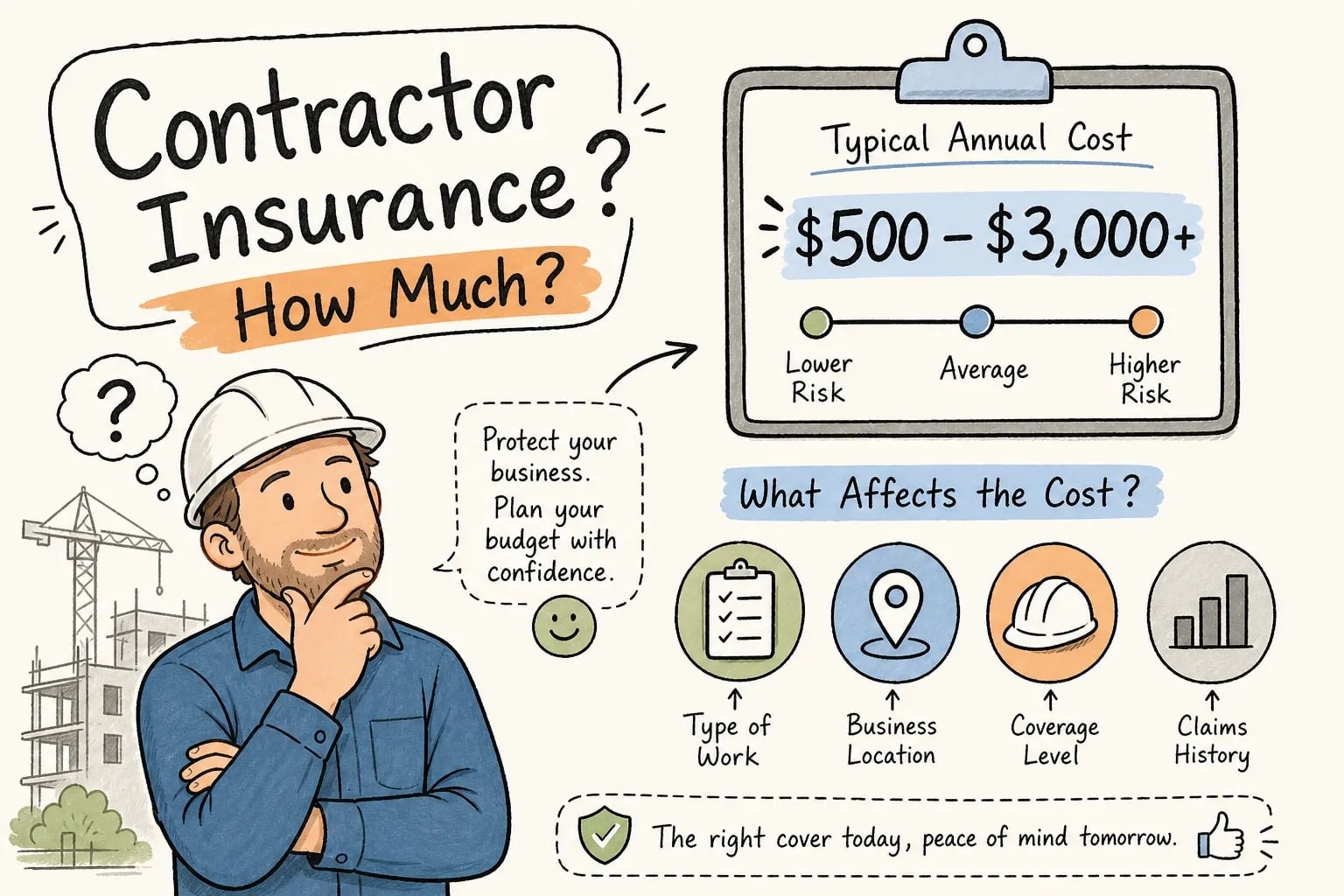
How much is contractor insurance in Australia? For most tradies, public liability cover costs between $500 and $1,500 per year, with small residential builders or higher-risk profiles running closer to $1,800. That’s the short answer, and it’s accurate. The exact figure shifts based on your trade, your annual turnover, your claims history, and how much cover you’re actually required to carry.
This guide gives you real premium ranges drawn from published broker quotes and current Australian market data, not a wall of “it depends.” Each section answers one question a contractor, client, or head contractor would genuinely ask. For independent, unbiased cost benchmarking across Australian trades and services, NameTheCost.com is built specifically so Australians can cross-check what they’re quoted against what things actually cost in the real market.
What does contractor insurance actually cover?
Public liability for contractors: the cover most tradies carry
Public liability insurance for contractors covers third-party bodily injury or property damage caused by your work. If a client trips over your equipment or your work causes damage to a neighbouring property, this is the policy that responds. It’s the most commonly held cover in the trades and the one most clients and head contractors require before work begins.
Standard cover limits in Australia are $5 million, $10 million, and $20 million. Most sole traders carry $5 million as the baseline; many commercial and government contracts require $10 million or $20 million. The $5 million limit is where most tradie premiums are benchmarked, and it’s the figure used throughout this guide unless noted otherwise.
Contract works: protecting the job itself
Contract works insurance, sometimes called contractors all-risk, covers the project under construction against damage, theft, or loss before handover. It is a separate policy from public liability and is typically priced per project rather than annually. It is most relevant on larger residential or commercial builds where the materials and labour on-site represent significant value at risk.
Professional indemnity and workers compensation
Professional indemnity is relevant to contractors who provide design, specification, or advisory services as part of their scope. It covers claims arising from errors in professional advice, not just physical damage. Workers compensation is a different matter entirely: it is mandatory across Australia as soon as a contractor moves from sole operator to employer status, regardless of the project’s value or type.
How much is contractor insurance by trade: the real premium ranges
Annual and monthly premiums across common trades
These figures are based on current market data from published Australian broker quotes for $5 million public liability cover, sole trader or micro-business scale, and standard excess levels. They represent realistic ranges, not best-case scenarios.
| Trade | Typical annual premium | Typical monthly premium |
|---|---|---|
| Electrician | $650, $1,200 | $54, $100 |
| Plumber | $650, $1,200 | $54, $100 |
| Carpenter | $550, $850 | $46, $71 |
| Builder (small residential) | $900, $1,800 | $75, $150 |
Published quotes from Australian brokers confirm that sole traders earning under $50,000 per year can access $5 million public liability from around $43 to $60 per month. Turnover is the biggest variable within any trade category: a carpenter running a two-person operation will pay more than a sole trader doing the same type of work.
What tradie insurance costs actually include at these price points
At the premium levels above, you’re typically buying $5 million public liability cover with a standard excess of around $500, structured for a sole trader or small business. That is the starting point. Contract works cover, higher limits, or professional indemnity each sit on top as separate premiums. Make sure you know exactly what’s included before you benchmark one quote against another, comparing a bare public liability policy against a bundled package is not a fair comparison.
How much does contractor insurance cost? What pushes premiums up or down
The factors insurers weight most heavily
Claims history and location have the biggest effect on price, often more than any other single variable. A clean claims record keeps premiums at the lower end of a trade’s range. One significant claim can push the next renewal up sharply and hold it there for several years. Location matters because insurers price regional loss patterns, weather risk, and local regulatory requirements into the base rate before any business-specific details are applied.
How turnover, cover limits, and subcontractors change the number
Higher annual turnover signals more activity and more exposure, so contractor insurance premiums rise with business size. Cover limits increase price, but not proportionally: doubling your limit from $5 million to $10 million does not double the premium, though it does add meaningfully to the annual cost. Subcontractor use is a factor many contractors overlook entirely. Insurers charge more when subcontractors are numerous or when they’re not managed under strong contract terms, because the liability exposure becomes harder to define and control.
One practical lever that’s underused: increasing your excess. Moving from a $250 excess to a $1,000 excess can reduce your premium by 5 to 15 per cent. It’s a straightforward trade-off between what you self-insure on smaller incidents and what you pay annually.
Contract works and professional indemnity: what these covers actually cost
How contract works insurance cost is calculated by project value
A commonly cited rule of thumb in Australia is roughly 1 per cent to 5 per cent of the insured project value, though some broker guides and insurers apply lower percentage ranges, particularly for standard residential work, where premiums closer to 0.3 to 0.8 per cent of project value are also quoted in the market. The range you land in depends on project class, insurer, and scope of cover. Using the 1, 5 per cent guide as a working benchmark: a $100,000 project might cost $1,000 to $5,000 to cover; a $500,000 project runs $5,000 to $25,000; a $1 million project can reach $10,000 to $50,000. These are single-project premiums, not annual figures.
Where you land within that range depends on project type, duration, and coverage scope. Residential and commercial work price differently. A policy that includes cover for existing structures, delay, and materials-in-transit sits at the higher end. A basic contract works policy covering materials and labour on a short-duration residential job sits toward the lower end of the range.
Professional indemnity: annual ranges for contractors
Professional indemnity is an annual policy, not a per-project one. It is most relevant when your scope includes design, specification, or advisory work. Typical annual premiums for smaller contractor businesses range from $785 to $1,800 at the lower end, rising to $1,000 to $5,000 for more complex service offerings or higher-risk project types. The premium is priced on the nature of the service you’re providing, not just the size of the project. A contractor who designs and builds is rated differently from one who builds to someone else’s specification.
State rules that make certain cover compulsory
NSW: where the thresholds are clearest
NSW has the most clearly defined statutory requirement. Home building compensation (HBC) insurance is mandatory for residential building work valued at more than $20,000 including GST. The cover must be in place before work starts and before any deposit is accepted. This is not optional and does not overlap with your existing public liability policy. The building contract must state the HBC cost separately, and the certificate must be provided to the homeowner before work commences. Failing to hold HBC cover when it’s required is an offence under NSW law.
VIC and QLD: requirements driven by contract and licence conditions
In Victoria and Queensland, mandatory insurance is more commonly driven by licensing conditions, contract requirements, or the head contractor’s specifications than by a single universal project-value threshold like NSW’s HBC rule. Workers compensation triggers consistently across all states: it is required as soon as a contractor employs workers, regardless of project type or value. In practice, clients and head contractors in VIC and QLD routinely require a certificate of currency before work starts, which makes public liability for contractors effectively compulsory even where it is not legislated as a universal requirement.
Checking whether a contractor’s quoted costs reflect real insurance overhead
Using independent pricing data to validate what you’re quoted
When a contractor includes insurance overhead in their quote, most clients have no reference point to judge whether the figure is reasonable. Consider this scenario: a carpenter quotes $1,500 in annual insurance costs as part of their job overhead. Based on the data in this article, a carpenter’s annual public liability premium typically sits between $550 and $850. A quoted overhead of $1,500 deserves a question, not automatic acceptance.
That’s the gap NameTheCost.com is built to close. It provides independent, unbiased pricing data for Australian trades and services, with no referral commissions or advertiser influence shaping the numbers. Before you accept any quote that includes vague “insurance and overhead” line items, use it as your benchmark. The data is there specifically so you’re not negotiating blind.
Practical ways to reduce what you pay in contractor insurance premiums
Four actions make a real difference. First, choose a higher excess: moving from $250 to $1,000 can cut your premium by 5 to 15 per cent. Second, pay annually rather than monthly, monthly instalments typically attract an instalment loading that increases the overall cost, so check your insurer’s terms before committing to that payment schedule. Third, protect your claims record by reserving your public liability policy for significant claims, not minor incidents you can absorb. Fourth, review your turnover declaration at each renewal. Overstating your revenue inflates the premium unnecessarily, and your declared turnover should reflect what you actually earned.
What these numbers mean for you
Most Australian contractors pay between $500 and $1,500 per year for public liability insurance, with small residential builders or higher-risk trades running closer to $1,800. The exact figure is shaped by trade type, annual turnover, claims history, and the cover level you select or are required to hold. Contract works insurance cost adds on a per-project basis, running roughly 1 to 5 per cent of project value for most project types, or lower for standard residential work depending on the insurer. Professional indemnity is a separate annual premium, typically starting around $785 to $1,800 for smaller operators.
State rules matter too. In NSW, home building compensation insurance is legally required before residential work above $20,000 begins. In VIC and QLD, contractor liability insurance is effectively compulsory through contract and licensing requirements even where the legislation is less prescriptive.
How much is contractor insurance in Australia? Now you have real numbers to work from. Cross-check them at NameTheCost.com before you accept any quote. Knowing what insurance actually costs means you’re not negotiating blind.
Frequently asked questions about contractor insurance costs
How much is contractor insurance for a sole trader in Australia?
Most sole traders pay between $500 and $1,500 per year for $5 million public liability cover. Sole traders earning under $50,000 per year can often access cover from around $43 to $60 per month based on published broker quotes.
How much does contractor insurance cost for a builder?
Small residential builders typically pay between $900 and $1,800 per year for public liability cover, reflecting higher risk exposure compared to other trades. This is for the public liability component only, contract works insurance and home building compensation (HBC) insurance in NSW are priced separately.
What is the contractor insurance cost for public liability?
Public liability for contractors costs between $550 and $1,200 per year for most common trades at the $5 million limit. Electricians and plumbers sit between $650 and $1,200 annually; carpenters typically pay $550 to $850.
How much does contract works insurance cost?
Contract works insurance cost depends on the project value and type. A commonly used industry guide puts premiums at 1 to 5 per cent of the insured project value for broader coverage, while some broker schedules quote lower percentages (around 0.3 to 0.8 per cent) for standard residential work. Get a project-specific quote for accurate figures.
Is contractor insurance tax deductible in Australia?
Generally yes, insurance premiums are ordinarily deductible as a business expense under Australian tax law when the cover directly relates to earning assessable income. Confirm with a registered tax agent for your specific situation.
Do I need contractor insurance if I’m a subcontractor?
Most head contractors require subcontractors to hold their own public liability cover before they come on site, regardless of whether the law mandates it directly. In practice, not holding your own policy will prevent you from winning most commercial or government work.
Can I reduce my contractor insurance premiums?
Yes. Choosing a higher excess, paying annually rather than monthly, maintaining a clean claims record, and accurately declaring your turnover at renewal are the four most effective ways to keep contractor insurance premiums down.
Where can I check if a contractor’s insurance costs are reasonable?
NameTheCost.com provides independent, unbiased pricing data for Australian trades and services. Use it to cross-check any insurance overhead included in a contractor’s quote against real market premium ranges.