Construction Insurance Costs in Australia: A Full Breakdown
Understanding construction general liability insurance cost is essential before you price your own cover or review a contractor’s quote. Public liability insurance appears on renovation quotes, tradie invoices, and contractor agreements across Australia, usually without any explanation of what it costs or whether the amount is reasonable. If you’re a builder pricing your own cover, you need a realistic benchmark before you approach a broker. If you’re a homeowner reviewing a quote, you need to know what this overhead actually represents. Both situations call for honest, independent numbers, not an insurer’s marketing page.
The construction insurance market in Australia is far from uniform. Premiums shift based on trade type, turnover, project mix, and the indemnity limit you select. That variability is why builders can end up overpaying at renewal or under-insuring without realising it, and why the spread between insurers for seemingly identical cover can be surprisingly wide. This guide cuts through that confusion with realistic premium ranges, the main cost drivers, and practical steps to bring your cover in line with your actual risk.
Construction general liability insurance cost: what tradies actually pay in Australia
The honest answer depends on your business size and trade. The numbers below represent the market as it actually stands in 2026, broken into three tiers: sole traders, small building companies, and mid-sized contractors. Each tier carries its own exposure profile, and the pricing reflects that.
Sole traders and owner-operator tradies
Most sole-trader tradies in Australia pay somewhere between $500 and $1,200 per year for public liability cover, which works out to roughly $42 to $100 per month. Low-risk trades working at modest annual turnover sit toward the lower end of that range. Higher-risk work, larger project volumes, or more complex sites push the premium toward the top. These figures reflect current market guidance from Australian brokers and insurers active in the construction sector, and they represent the baseline most owner-operators are comparing against when they shop the market.
Small building companies
Small builders doing residential and small-scale commercial work typically pay in the range of $900 to $1,800 per year. The step up from sole-trader pricing reflects the broader scale of work and higher average project values rather than headcount alone. A small builder running two or three concurrent renovation jobs carries more exposure than a single operator on one site at a time, and underwriters price that accordingly.
Mid-sized construction contractors
For mid-sized operators, the typical range is $1,500 to $3,000 per year. Above this band, pricing becomes highly individualised. Underwriting assessments at this level account for project type, subcontractor reliance, site complexity, and claims history in ways that make broad ranges less useful. Getting multiple quotes matters far more at this scale than it does for a sole trader.
How your trade type changes what you pay
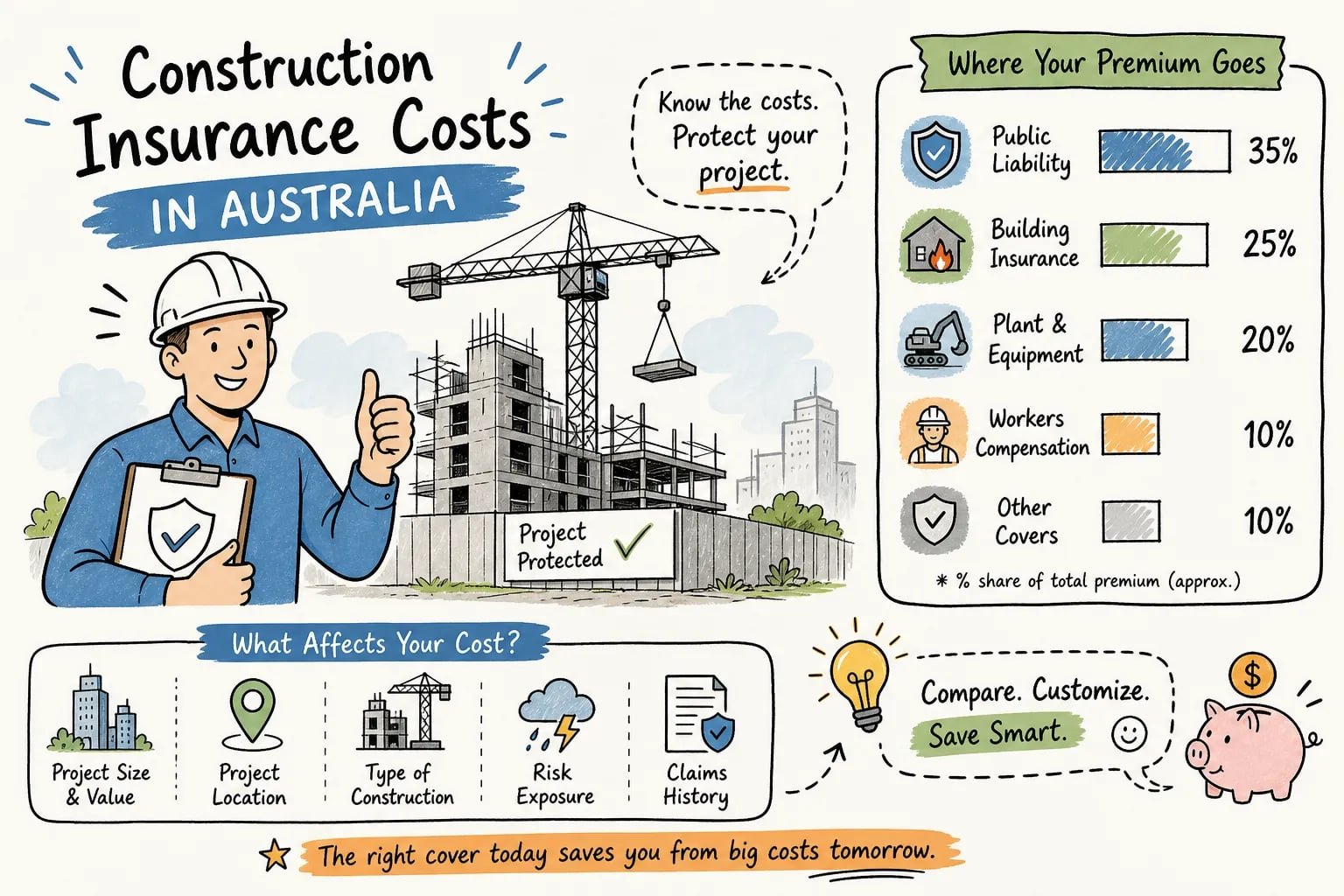
Trade classification is the single biggest pricing driver in the construction insurance market. Most tradies underestimate how much this matters, and the gap between high-risk and low-risk classifications can easily represent hundreds of dollars in annual premium for businesses of identical size and turnover.
Trades that attract higher premiums
Roofers, concreters, structural builders, and anyone working at height or with heavy plant consistently attract higher premiums. The logic is straightforward: insurers price the inherent risk of the work, not just the size of the business. A sole-trader roofer pays more than a sole-trader painter at exactly the same annual turnover, because the potential severity of a claim from roofing work is fundamentally different. Higher-risk trades can push well above $2,000 per year even at the sole-trader level.
Trades that sit in the lower-risk bracket
Carpenters, painters, tilers, and finishing trades that work in stable, completed environments attract lower risk classifications and generally sit at the bottom of the premium ranges. A painter with a clean claims history and modest turnover can reasonably expect to land toward the lower end of the sole-trader band. Lower risk classification is a genuine financial advantage, and it’s worth understanding where your trade sits before you accept a quote.
Why the type of project matters as much as the trade
The same electrician doing domestic installs and the same electrician working on commercial fit-outs face different underwriting treatment. Residential work is generally viewed as lower exposure than commercial or industrial projects. Subcontractor arrangements on larger sites also affect how an insurer views the risk. If your work mix has shifted toward more complex or commercial projects over the past year, your renewal premium should reflect that, and so should your declaration to the insurer.
The other factors insurers use to price your premium
Trade type explains a lot, but underwriters look at four other variables consistently when pricing a construction liability policy.
Why claims history has the biggest influence after trade type
A prior claim, particularly a paid claim, tells an underwriter something concrete about future loss probability. Industry underwriting data indicates a single claim can lift a renewal premium by 15 to 30 per cent. Multiple claims within a short period can result in higher excesses, added exclusions, or difficulty placing cover at all. Conversely, a clean claims record over three or more years is one of the most valuable assets a tradie carries into a renewal negotiation.
How turnover and project volume affect your exposure rating
Insurers use declared annual turnover as a core rating variable because higher revenue implies more work, more sites, and more opportunities for a third-party loss to occur. Accurate turnover declarations matter. Understating turnover to reduce premium creates a serious problem at claims time, when the insurer may reduce any payout proportionally to reflect the underreported exposure. Declare honestly and let the premium reflect reality.
The subcontractor problem most builders overlook
Heavy reliance on subcontractors introduces risk that isn’t fully transferred, even when subbies carry their own cover. If a subcontractor is uninsured or underinsured and causes a third-party loss, the principal contractor can be exposed. Insurers price this risk upward when subcontractors form a large portion of the business model. Maintaining current certificates of currency from all subbies, and verifying their cover limits, is both good risk management and a factor that underwriters notice at renewal.
Construction insurance premiums in Australia: choosing between $5M, $10M, and $20M indemnity limits
This is the part most tradies find confusing. The gap between limits is far smaller than most people assume, and understanding the pricing difference makes the selection decision much more straightforward.
What these three limits typically cost
For smaller trade businesses, $5M cover typically sits around $400 to $600 per year. Moving to $10M generally adds somewhere between $150 and $400 annually, putting the typical range at $700 to $1,200 per year. A $20M limit sits broadly in the $1,500 to $2,200 range for trade businesses. Doubling the indemnity limit does not double the premium. These figures vary by trade, turnover, and claims history, but the incremental cost of higher limits surprises most people who’ve assumed the pricing is linear.
What most residential builders and tradies actually need
Many residential contracts specify $10M as a minimum indemnity requirement, and this limit represents a reasonable baseline for most residential construction work. A $5M limit may be adequate for smaller domestic renovation jobs but is worth checking explicitly against the contract terms before you purchase. For commercial or government work, $20M is increasingly standard, and in many cases it’s not optional.
When the client or the contract decides for you
Head contractors, local councils, and government agencies frequently specify minimum indemnity limits as a condition of engagement. In these situations, the cover selection is a contractual obligation, not a matter of personal preference. Always read the contract before selecting a limit. Discovering the requirement after you’ve purchased cover means you’re either uninsured for that engagement or paying for a separate endorsement to lift the limit mid-term.
Practical ways to reduce your construction general liability insurance cost
There are three levers that actually work, and each comes with a trade-off worth understanding before you pull it.
Raising your excess to reduce the base premium
Accepting a higher excess lowers the insurer’s exposure to small claims and reduces the annual premium. This approach tends to suit businesses with strong cash reserves that can comfortably absorb a first loss, for example, some operators choose an extra excess in the low thousands. It’s not the right call for every business, but for established operators with clean claims histories, it’s a legitimate and often underused lever. Ask your broker to quote at two or three excess levels so you can see the actual dollar difference before committing.
Safety programmes, licences, and a clean record
Formal safety management systems, current licences, and relevant qualifications signal lower risk to underwriters. Some insurers factor in Safe Work Method Statements, White Card compliance, and documented site safety records during the underwriting assessment. A well-maintained safety programme is a legal obligation, and it can directly affect what you pay at renewal. If you’ve invested in safety processes, make sure your broker communicates that to the insurer.
Shopping the market properly at renewal
Most tradies renew on autopilot. Getting two or three competing quotes at renewal is the simplest way to avoid overpaying, and the premium difference between insurers for identical cover can be significant. Loyalty discounts exist with some insurers, but shopping the market at renewal often yields better outcomes unless your claims-free history or renewal discount materially outweighs the alternatives. Treat renewal as an active decision, not an automatic instruction to pay the new invoice.
How this cost sits inside a renovation budget
For homeowners, the practical question isn’t just what insurance costs in isolation. It’s what the number means when you see it absorbed into a builder’s quote.
What homeowners should expect to see in a builder’s quote
Public liability insurance is a real business cost that builders pass through to clients, either as a direct line item or as part of their overhead margin. A sole-trader carpenter paying $1,000 per year in insurance on a $40,000 renovation job is adding roughly 2.5% to their cost base from this line alone. Knowing this helps you assess whether the overhead margin in a quote is reasonable, or whether it’s being inflated above what the actual cost of cover warrants. It’s a small number in context, but it’s a number you can now benchmark.
Cross-checking renovation line items against independent data
Every component of a renovation quote can be benchmarked independently, and insurance overhead is no different. NameTheCost.com publishes cost guides across Australian trades and renovation categories so homeowners can pressure-test a quote before signing anything. If a builder’s overhead looks inflated, or if you’re not sure whether the insurance line item reflects market reality, independent cost references give you a useful starting point. Check the methodology and disclosure statements of any guide you use to understand how the figures were compiled.
Putting it all together
Whether you’re a tradie or a homeowner, the construction general liability insurance cost picture is clearer than most people assume once you see the actual numbers. Tradies now have a benchmark for where their premium should sit by trade type and business size, which factors move the number, and which levers reduce it. Homeowners can recognise the builder’s insurance cost as a legitimate overhead and roughly quantify what it represents as a fraction of the total job.
The practical next step is the same for both audiences: get real quotes, compare indemnity limits against your actual contractual requirements, and don’t accept the first number you’re given without checking it against the market. For everything else in your renovation budget, from trade rates to material costs to contractor margins, visit NameTheCost.com and cross-check before you commit. Keeping the full cost picture honest starts with knowing what each line item should actually cost.