What Is a Building and Pest Inspection and Do You Really Need One?
A building and pest inspection is one of the most consequential steps in buying property, yet many buyers treat it as a formality. Something to tick off between the offer and the settlement date. That’s a costly assumption, and it catches people out regularly.
A combined building and pest inspection is a single visual assessment of a property’s structural condition plus a check for timber pests: termites, wood borers, and decay fungi. One inspection, one report, covering two of the most significant risk categories you’ll face as a buyer. The findings directly affect what you pay, what you negotiate, and whether you should proceed at all. Before you sign anything, you need to understand exactly what that report covers, what it deliberately excludes, and what to do when the results aren’t clean.
What a building and pest inspection covers
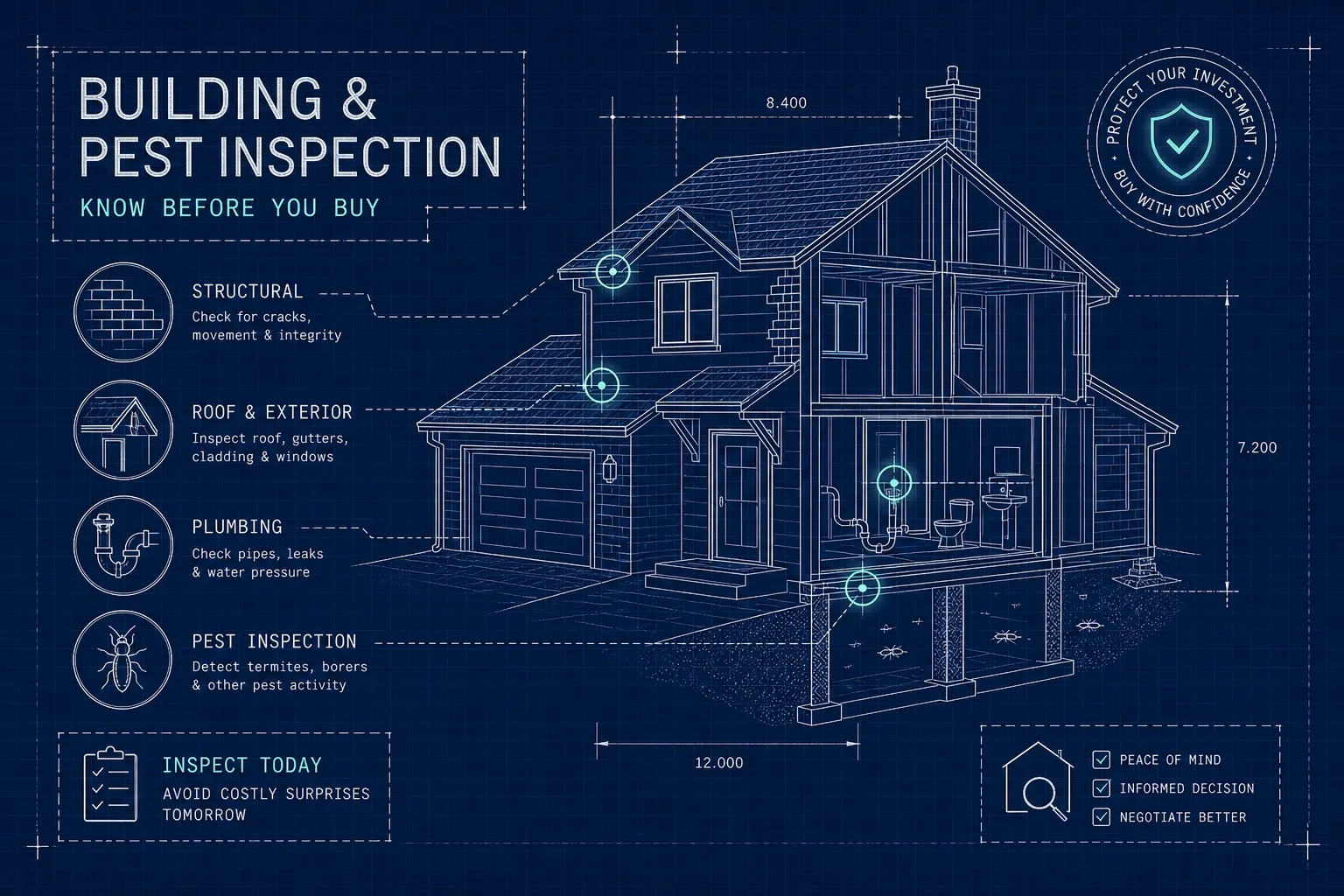
A building and pest inspection is a visual-only assessment. The inspector works across all reasonably accessible areas of the property. They are not drilling walls, pulling up floorboards, or testing electrical circuits. The scope is defined, the methodology is non-destructive, and the findings go into a single written report prepared in accordance with Australian Standards AS 4349.1 and AS 4349.3.
Standard assessed areas include:
- Interior rooms and wet areas
- Roof void and roof framing
- Subfloor space, including stumps, footings, and ventilation
- Exterior walls and cladding
- Site elements: decks, fences, retaining walls, driveways, and drainage
Where direct access is limited but visible signs suggest a problem, inspectors may use moisture metres or thermal imaging to investigate further.
What the report won’t include is equally important to understand. Plumbing systems, electrical wiring, appliance condition, asbestos identification, paint quality, and repair cost estimates are all outside the standard scope. Anything behind a locked door or in a space the inspector cannot safely access will be noted as inaccessible, not assessed. Those limits are built into the Australian Standard, and they matter when you’re reading the report.
Asbestos testing, engineering assessments, pool compliance checks, and methamphetamine testing are all separate engagements. If your property warrants any of those, you’ll need to commission them independently, your conveyancer or solicitor can point you toward appropriate specialists for each. A building and pest inspection does not replace them.
Is it a legal requirement or just strongly recommended?
In Australia, a building and pest inspection is not a legal requirement for a residential buyer in any state or territory. No legislation forces you to order one before purchasing an existing home. The ACT has the most formalised contractual framework around inspection reports, including specific requirements under AS 4349.1 and a 180-day reliance limit, but even there it is a contractual mechanism rather than a statutory obligation.
Some lenders make a satisfactory inspection a condition of their loan offer, so it’s worth checking your loan terms carefully. In Queensland and Victoria, the standard contract forms include or allow for an inspection clause. If your contract has no inspection clause and you want one, your solicitor or conveyancer can add it before you sign. Do not wait until after you’ve committed.
The practical case for ordering one is straightforward. A combined inspection for a standard house costs between $450 and $850 across most Australian capital cities. Active termite damage can cost tens of thousands of dollars to repair, and structural defects can run well beyond that. The risk-reward calculation is not subtle. Buyers who skip the inspection to save time or appear more competitive in a hot market often pay a heavy price for that decision.
What inspectors find most often, and what it costs to fix
Common timber pest findings
Australian housing stock is old in many suburbs, and older homes in high-humidity areas with inadequate subfloor ventilation are particularly prone to timber pest damage and moisture-related defects. These findings are far from uncommon, they turn up in pre-purchase inspections with considerable frequency.
Subterranean termites are the most destructive timber pest in Australia and among the most frequently found in pre-purchase inspections. Wood borers and timber decay fungi are close behind. For localised termite damage, remediation costs typically start in the low thousands once treatment and timber replacement are included. Where framing timbers, subfloors, or multiple structural elements are affected, repair bills can climb to well above $20,000. The extent of damage is what drives the cost, and you won’t know the extent without an inspection.
Typical structural defects
Structural defects cover a wide spectrum. Rising damp, cracked render, deteriorated roof flashings, and corroded gutters are common and, in most cases, manageable. Significant structural movement, failed footings, or compromised roof framing are a different matter entirely. The report will categorise defects, and your job is to understand which category applies to your specific findings before you react or renegotiate.
How to choose a qualified inspector
There is no single national licence for building inspectors in Australia. Licensing is managed at the state and territory level, and requirements vary. This means you need to know what to ask for in your specific location.
Ask any inspector for their current state or territory licence number, their relevant qualification (commonly a Certificate IV in Building and Construction or a recognised building surveying credential), and confirmation they carry both professional indemnity insurance and public liability insurance. Confirm their reports comply with AS 4349.1 for building inspections and AS 4349.3 for timber pest inspections. Holding membership with the Master Builders Association or the Australian Environmental Pest Managers Association is a useful additional check, but it does not substitute for the licence and insurance requirements.
Before you book, request a sample report. Ask whether they physically access the roof void and subfloor or rely on a camera. Clarify what tools they use, and confirm whether the pest inspection is carried out by the same person or a separate specialist attending at the same time. A combined inspection conducted by two qualified inspectors attending together is common and often preferable to a single person covering both disciplines. A lower quote sometimes reflects a narrower scope, so clarify what is included before you compare on price alone.
Building inspection checklist: what to ask before you book
Use this as a quick reference when vetting inspectors and reviewing your combined building and pest report:
- Does the inspector hold a current state or territory licence?
- Do they carry professional indemnity and public liability insurance?
- Do their reports comply with AS 4349.1 and AS 4349.3?
- Will they physically access the roof void and subfloor, or use a camera?
- Is the pest inspection conducted by a separate qualified specialist?
- Can you review a sample report before booking?
- What is the expected turnaround time for the written report?
What to do when the report flags problems
The report is a list of findings. It is not a verdict on whether you should buy. How you respond depends on the severity of the issues, the terms of your contract, and what the seller is prepared to do.
Most buyers faced with a concerning report have three options. You can negotiate a price reduction to offset remediation costs. You can request that the seller address specific defects before settlement. Or, if your contract includes an inspection clause and the findings meet the unsatisfactory threshold defined in that clause, you can withdraw within the specified period and recover your deposit. That inspection clause is the key document. Read it before you book the inspection so you understand the timeline you’re working within.
Negotiation works best when you have a clear remediation quote from a licensed contractor. A credible dollar figure gives you a factual basis for renegotiation rather than an emotional response to a report that sounds alarming. How a seller responds to a documented finding is itself useful information about their motivations and how well the property has been maintained.
Not every finding warrants walking away. Cosmetic defects, minor surface cracking, and ageing fixtures are unlikely to justify terminating a purchase. Active termite infestation without a current barrier system, significant structural movement, or substantial timber decay in primary framing timbers are a genuinely different category. Know which applies before you make any decision.
Building and pest inspection costs and how they fit into your budget
A combined building and pest inspection is one line item in a longer list of costs associated with buying property in Australia. Knowing the full picture stops buyers from being surprised at settlement, or worse, after it.
In 2026, a combined inspection for a standard house runs between $450 and $850 across most capital cities. Sydney and Melbourne tend to sit toward the upper end of that range. Perth, Brisbane, and Adelaide often come in slightly lower, though property size, age, access, and whether the pest inspection is conducted by a separate specialist will all affect the final quote. Most reports are delivered within 24 to 48 hours of the inspection, with same-day or next-business-day turnaround available in some markets.
The inspection fee is rarely the number that surprises buyers. Conveyancing fees, stamp duty, lender costs, and post-purchase renovation expenses are where the budget typically runs beyond expectations. NameTheCost.com publishes independent, no-spin cost guides covering the full range of Australian property purchase costs, from conveyancing fee breakdowns to realistic home renovation budgets, all benchmarked to actual local pricing without advertiser influence. If you want a clear view of what the complete purchase will cost before you exchange contracts, it’s a practical starting point.
The bottom line
Do you really need a building and pest inspection? Yes. The report gives you information you cannot get from an open-home walkthrough, a vendor statement, or a conversation with the selling agent. That information directly affects what you pay, what you negotiate, and whether you proceed at all.
Book the inspection before you waive your conditions, not after. Use a licensed and insured inspector. Read the full report, not just the summary page, and understand what each finding actually means before you react. The fee is small relative to the decisions it informs. The choice to skip it rarely turns out to be as minor as it seems at the time.