Landscaping Cost Australia: Complete 2026 Pricing Guide
Most Australians underestimate landscaping cost. Not by a little, but by tens of thousands of dollars. They get a rough number from a neighbour, Google something vague, and walk into their first consultation with a figure that’s half of what the job actually costs. Then the quote lands, and the gap feels like a betrayal.
It isn’t. Landscaping is genuinely complex pricing territory. Labour rates vary by city, material costs swing with supply chains, and a slope or clay soil can turn a $15,000 job into a $35,000 job before the first shovel goes in. The numbers in this guide are based on 2026 Australian market data across turf, paving, decking, retaining walls, irrigation, design fees, and labour. Before you call a single landscaper, you need an independent benchmark. That’s what NameTheCost.com was built to provide: an independent Australian pricing directory with no advertiser influence and no referral commissions. The numbers you read reflect what the market actually charges.
Use this guide to understand every line item that makes up a landscaping estimate. Apply those benchmarks before you commit to anything, and you’ll walk into every quote conversation with a reference point that can’t be talked away.
Landscaping cost by project size
The most useful way to frame landscaping cost in Australia is by project size. A small yard refresh under 50m² typically runs between $5,000 and $15,000 for basic softscape work, but a full build at that scale with paving and a feature wall can push to $32,500 or more. Medium projects between 50m² and 200m² sit in the $15,000 to $50,000 range for most residential jobs, and they can exceed that figure when the design leans heavily on hardscaping. Large projects over 200m² start around $40,000 for a complete build and regularly exceed $100,000 for complex or design-led transformations.
These ranges shift considerably based on what the project actually involves. A softscape-heavy job (turf, mulch, garden beds, and planting) costs significantly less per square metre than one dominated by paving, retaining walls, and decking. Site conditions amplify everything. A flat suburban block in Brisbane is a straightforward job. A steep hillside in Sydney with clay soil and limited access is a very different financial proposition, and the quote will reflect that.
The 5% to 10% property value rule gives you a useful ceiling before you engage anyone. Most Australian homeowners allocate 5% to 10% of their property’s value to a major landscaping project. High-end, design-led jobs can reach 10% to 15%. Use this as a sanity check on your budget, not as a planning target. If your property is worth $900,000, a realistic upper ceiling for a serious landscaping project is $90,000. That number focuses the conversation before you start selecting materials.
Breaking down landscaping cost per square metre
Softscape rates
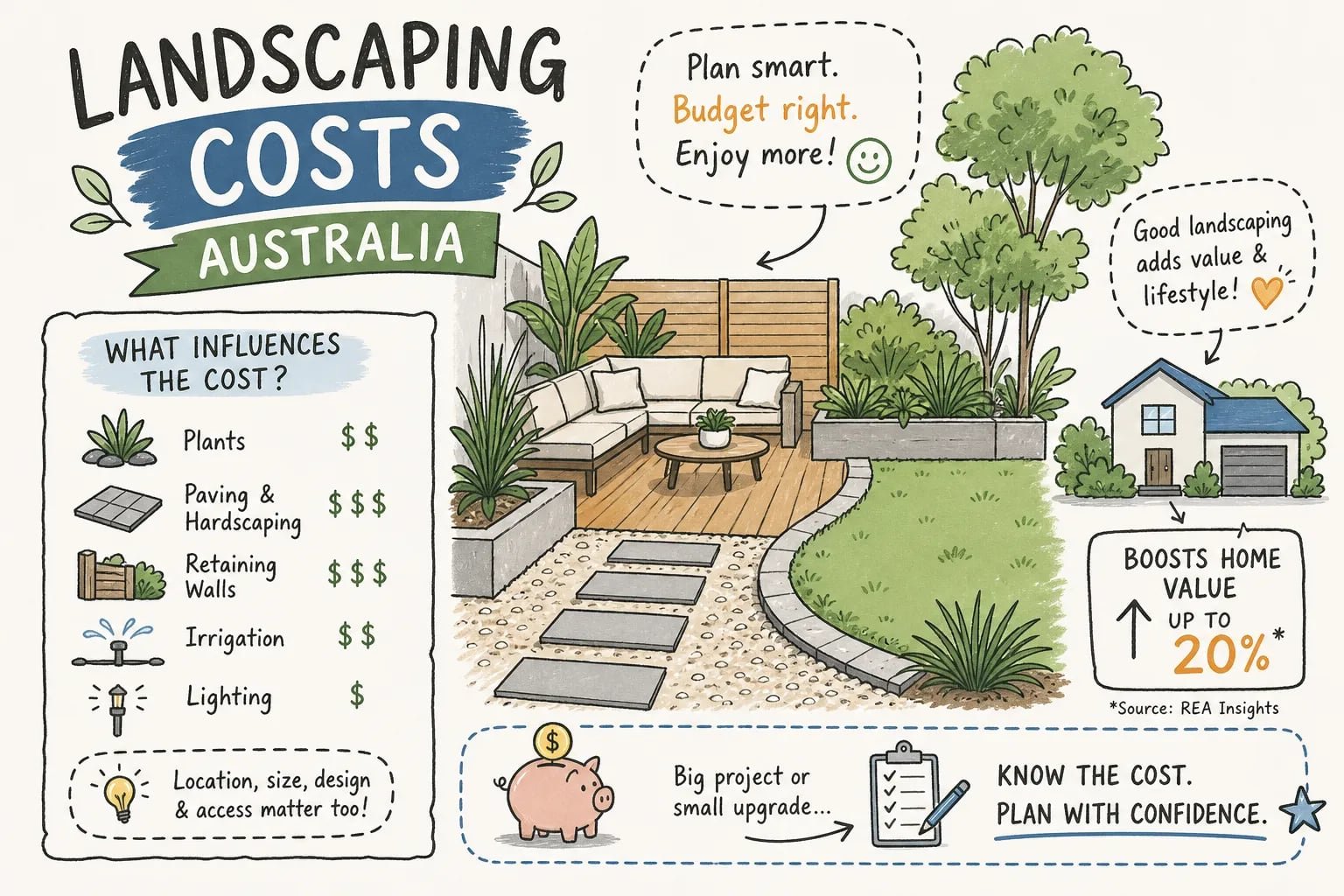
The living elements of a landscape, what the industry calls softscape, are the most affordable to install. Natural turf runs $15 to $40 per square metre installed. Garden bed preparation and planting sits in the $20 to $40 per square metre range, while broader soft landscaping across an entire project averages $50 to $80 per square metre. Irrigation is typically quoted as a project total rather than a per-metre rate, starting from around $1,000 for a basic system and scaling to $6,500 or more for a multi-zone residential setup with smart controls. Garden lighting follows the same pattern, ranging from $1,500 for a basic arrangement to $15,000 for a fully specified outdoor lighting design.
Hardscape rates
Hardscape is where the numbers jump, and where budgets most commonly blow out. Paving and concrete work runs $50 to $180 per square metre depending on material finish and base preparation. Decking sits at $200 to $350 per square metre for most installations, with composite materials at the higher end. Retaining walls are the most significant variable in any sloped-site quote, ranging from $250 to $850 per square metre of wall face depending on material, height, and whether the site requires engineering. Always ask what is and isn’t included in a landscaping estimate before signing anything. Subgrade preparation, drainage, and compaction costs are often not itemised clearly in a first quote, that’s where the overspend tends to occur.
Landscape design fees and labour rates across Australia
Landscape designers in Australia charge on either an hourly basis or through fixed design packages. Hourly rates nationally sit between $80 and $160 per hour for independent designers. In Sydney, the range is slightly tighter at $70 to $150 per hour, with some higher-end firms charging up to $200 per hour. Fixed residential design packages start at around $1,500 for a basic concept plan and rise to $5,000 or more for full documentation. Complex design-and-construct projects requiring detailed engineering documentation can reach $12,000 for the design phase alone. Many design-and-construct firms will credit the design fee back against the project cost if you proceed with them, so it’s worth asking upfront.
Labour rates for landscapers vary by location across the country. Here’s how capital city rates generally break down:
- Sydney: $63 to $125 per hour, with a common average around $92 per hour
- Melbourne and Canberra: generally $90 to $120 per hour
- Brisbane and Perth: national benchmarks suggest most capital city rates between $50 and $120 per hour
- Adelaide and regional South Australia: often $55 to $80 per hour
One important qualifier: jobs that require licensed trades, an electrician for outdoor lighting or a plumber for irrigation backflow prevention, add separate trade costs on top of the landscaping labour rate.
What specialised features add to your total bill
Retaining walls are the single most common cost surprise in Australian residential landscaping, particularly on any block with a gradient. Timber and basic low walls typically cost $250 to $350 per square metre of wall face. Concrete sleeper or block construction sits in the $330 to $700 per square metre range. Premium stone, gabion, or engineered walls run $450 to $900 per square metre or higher when structural engineering is required. A small decorative wall under five lineal metres can be as little as $1,000, but height and material choices can escalate that quickly to $10,000 or beyond. Any retaining wall over 600mm in height will generally require council notification and a structural engineering assessment in most Australian states. That’s not optional, and it adds cost that won’t appear in the contractor’s initial estimate.
Pergolas vary significantly based on whether they’re timber or steel, attached or freestanding, and whether they include roofing. A standard timber pergola typically adds $8,000 to $25,000 to a project, significant, but rarely the line item that derails an otherwise well-scoped budget. Water features tend to be quoted in the low thousands for decorative garden elements, but bespoke or integrated systems climb quickly once pumps, plumbing, and custom finishes are involved. Outdoor kitchens and pool surrounds are the additions that push large-project budgets well past $100,000. Outdoor kitchens involve cabinetry, benchtops, plumbing, electrical work, and appliances, each a separate scope item. Pool surrounds depend heavily on paving area, drainage compliance, and coping detail. Get these scoped separately from your main landscaping quote to avoid cost conflation in the final invoice.
What to DIY and what to hand to a professional
Certain parts of a landscaping project are accessible to a competent homeowner with the right tools and a weekend to spare. Mulching and top-dressing garden beds, planting shrubs and groundcovers from established nursery stock, basic lawn preparation and turf laying on flat ground, and painting or staining an existing fence or deck structure all fall into this category. None of these require a licence. Done well, they can save between $1,000 and $5,000 on a medium-scale project and give you better control over the final result in planting and garden design.
Structural and licensed work is a different matter entirely. Retaining walls over 600mm need a professional with knowledge of council compliance and structural load requirements. Irrigation systems require proper pressure testing and zoning to avoid future failures or water waste. Any electrical work for lighting or water feature pumps needs a licensed electrician. Excavation and grading on sloped or clay-heavy sites requires machinery and expertise that casual DIY doesn’t account for. Getting these wrong costs more to fix than to do correctly the first time. A failed DIY retaining wall can mean full demolition, re-engineering, and a rebuild at double the original cost.
Landscaping cost: how to build a realistic budget before you call anyone
The single biggest mistake Australian homeowners make is calling a landscaper before they’ve done any scoping work themselves. You walk in with no frame of reference, the first quote becomes your benchmark, and every decision flows from a number you can’t evaluate. Fix that before anyone sets foot in your backyard.
Follow these steps to build a working budget:
- Measure your total area and identify which zones will be hardscape and which will be softscape.
- List every feature you want in priority order, because something will have to come out when the quotes arrive.
- Apply the per-square-metre ranges from this guide to each zone to produce a floor-and-ceiling estimate.
- Add 15% to 20% contingency for site conditions, access constraints, and material price variation.
- Get a minimum of three quotes and compare them line by line, not just as total figures. A lower total that excludes drainage preparation is not a better quote.
Before you sign anything, cross-reference what you’re being quoted at NameTheCost.com. It’s an independent Australian pricing directory built to give Australians a realistic benchmark across trades, materials, and professional services, editorially independent, with no commercial relationships tied to the data. If a retaining wall quote or a paving contract comes in well above the ranges in this guide, that gives you specific, data-backed questions to ask before you commit. The difference between a well-run landscaping project and a blown-out one is usually just how much homework the homeowner did before the first conversation.
The bottom line on landscaping costs in Australia
Landscaping cost in Australia is predictable when you know what to look for. The numbers in this guide give you a legitimate baseline for any residential project, whether your budget is $10,000 or $100,000. The project that stays on budget is almost always the one where the homeowner understood the cost drivers before the first quote arrived.
Start with your measurements. Apply realistic per-square-metre benchmarks to each zone. Prioritise the features that add the most use and value to your property. Separate the DIY work you can genuinely handle from the structural and licensed work that needs a professional. And use independent tools like NameTheCost.com to verify that what you’re being quoted reflects real market rates, not a number inflated because you had no reference point. A good landscaping project transforms how you use your home. Going in informed is what makes it worth every dollar.