Contractor Liability Insurance Rates in Australia: What to Expect
Two tradies. Similar work. Similar turnover. One gets quoted $900 a year for public liability cover. The other gets $2,200. Neither knows whether what they’re looking at is reasonable. That gap isn’t unusual, it’s the norm. Contractor liability insurance rates in Australia don’t follow a single formula, and most tradies walk into the process without a reliable benchmark. That means they either overpay without realising it, or underinsure to cut costs and accept risk they haven’t properly thought through.
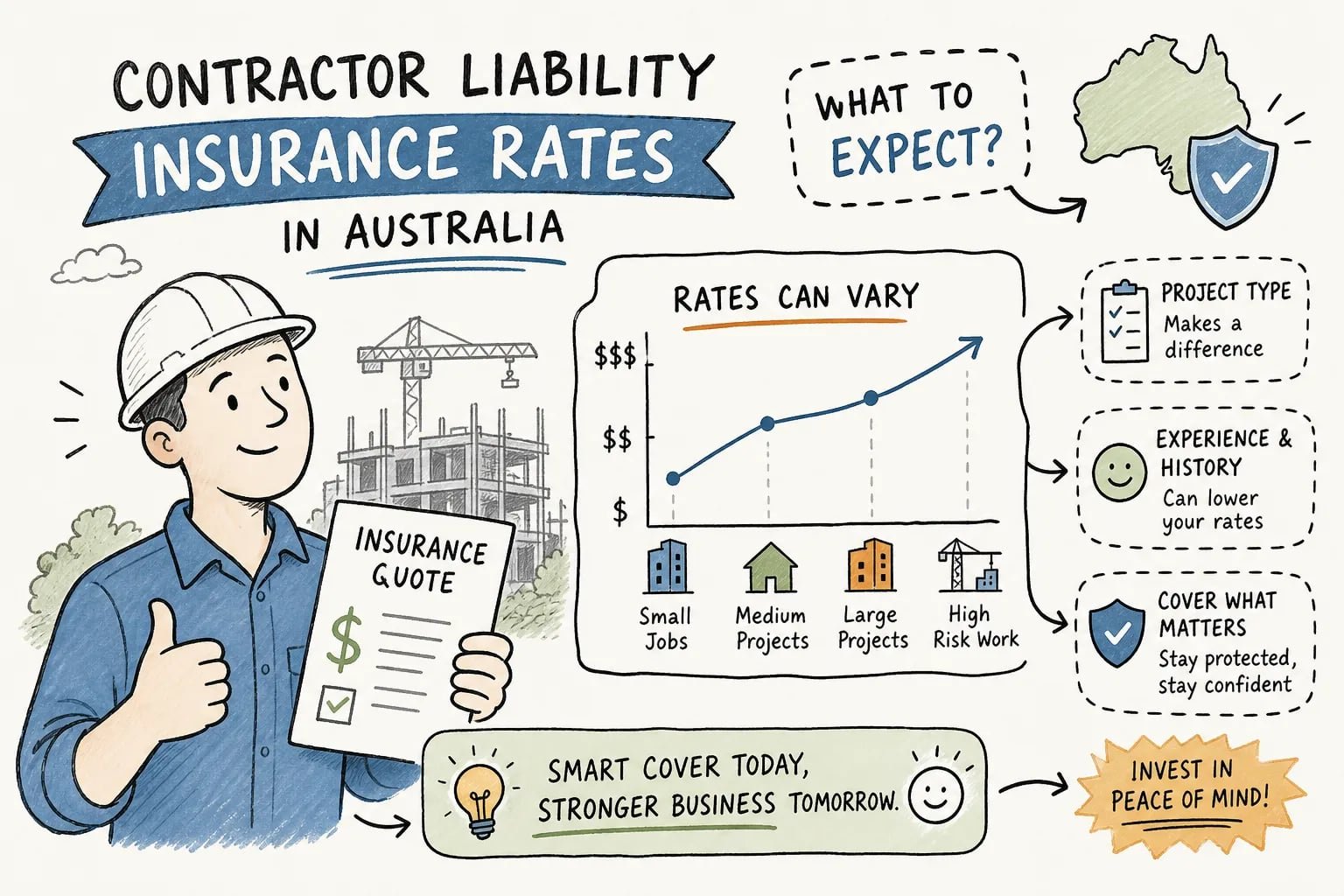
The price you’re quoted reflects a specific combination of variables: your trade category, your claims history, your annual turnover, where you operate, how you manage subcontractors, and the cover structure you choose. Change any one of those inputs and the number shifts. Understanding why it shifts puts you in a far better position to evaluate a quote, negotiate at renewal, or build a policy that actually fits your risk profile. Below you’ll find real premium ranges by trade, the underwriting factors that move your price, and three practical steps to reduce what you pay each year.
Contractor liability insurance rates: typical premium ranges by trade
The clearest benchmark available comes from the electrician market. Electricians average around $884 per year for public liability cover nationally, with monthly instalments sitting at roughly $105. That figure is more consistent than other trades because electricians have a well-defined risk profile, which makes underwriting more predictable across insurers. It’s a useful anchor point even if you’re not an electrician.
Builders and contractors on commercial or multi-storey sites sit toward the upper end of the pricing spectrum. Contractor insurance premiums for builders typically land in the $900 to $3,000 range for standard public liability cover, with commercial builders, those working on high-value sites or engaging uninsured subcontractors, often sitting well above that. The exposure is broader: higher project values, greater potential for third-party property damage, and stricter insurance requirements from principal contractors all push the price up. Larger or specialist commercial builders can see premiums extend significantly beyond that range.
Plumbers span a wide range depending on whether the work is residential or commercial. Domestic plumbing sits toward the lower end, closer to $800 per year, while commercial plumbing work can reach $2,200 or more. Carpenters and joiners typically fall in the $700 to $1,200 range. Landscapers generally sit at the lower end of the tradie spectrum given lower third-party risk, though any scope involving earthmoving or heavy machinery changes the calculation significantly, some Victorian market data, for instance, shows landscaper premiums around $1,276, while lower-risk landscaping work can fall well below that. These are indicative ranges, not capped figures. Your actual premium will depend on the factors covered in the next section.
How contractor liability insurance rates are calculated
Trade type is the baseline, but claims history is one of the most powerful levers on your premium. A clean record with no more than two minor claims over three years keeps you within standard pricing tiers, though this threshold varies by insurer and should be treated as a rule of thumb rather than a universal standard. In practice, each claim can push renewal costs up by 20 to 100 per cent depending on the trade and claim size, and the effect typically lingers for three to five years after the event. Frequent small claims often attract more concern than a single unusual incident because they signal a pattern, not a one-off.
Trade category anchors the baseline risk band. Roofing, demolition, and structural work sit in different risk tiers from painting or tiling, even when turnover is identical. Within those tiers, turnover functions as a proxy for the volume of exposure the insurer is accepting. More revenue generally means more work underway, more sites, more potential liability. Insurers use this to scale the premium proportionally.
Location adds a further multiplier. Urban centres and states with more active litigation environments tend to attract higher rates. Subcontractor usage is a frequently overlooked driver. If the subcontractors you engage don’t carry their own public liability cover, their work often gets rated as if you performed it directly. Insurers may also dispute or exclude claims arising from uninsured sub work, which compounds the problem well beyond just premium cost. Collecting certificates of currency before work starts isn’t just good practice, it directly affects what you pay.
How cover limits and excess levels affect the cost of public liability insurance
The jump from $5 million to $20 million cover is often more modest than tradies expect. Moving from $5M to $10M typically adds $150 to $400 per year. Stepping up to $20M may add another $300 to $500 on top of that. A concrete example: an electrician policy priced at $439 per year for $5M cover moved to $508 at $10M and $577 at $20M, a difference of $138 per year for four times the cover. For contractors working on commercial projects where principals routinely require $20M as a minimum, the upgrade cost is modest relative to the compliance requirement.
Adjusting your excess is one of the clearest ways to reduce your annual premium. Raising the excess from $500 to $2,500 commonly cuts the annual cost by 10 to 20 per cent, and that reduction compounds over time. The trade-off is straightforward: you absorb more of each claim yourself. For contractors with a clean claims history who are unlikely to lodge small claims anyway, this is often a sensible move. The risk is cash flow pressure if multiple incidents cluster in the same year, so the decision should reflect your realistic cash buffer, not just your optimistic one.
Add-on covers and what they actually cost
Tools and equipment cover typically adds $200 to $700 per year to a policy, depending on the value of the gear being insured and whether the policy covers theft from an unattended vehicle. Basic sole-trader policies often sit around $237 to $300 per year for moderate tool values. Plant and heavy machinery cover is a separate category entirely, and for contractors running excavators or specialised equipment, annual costs can reach several thousand dollars. Don’t assume tools are automatically included in a public liability policy, they rarely are.
Contract works cover, which protects physical work in progress against damage or loss before practical completion, commonly adds $500 to $3,000 or more per year. The range is wide because it scales with project value and contract duration, a small residential job carries very different exposure to a multi-month commercial fit-out.
Professional indemnity is less common for trades but increasingly required when design-and-construct contracts embed a layer of professional advice or specification. Where it’s needed, annual costs typically run from $600 to $2,000 depending on the scope of work. Price these covers separately and decide whether you genuinely need them, rather than accepting a bundled package without understanding what’s included and what’s not.
Three practical ways to reduce your contractor liability insurance rates
1. Get your subcontractor documentation in order
Collect certificates of currency from every subcontractor before work starts, not after. Insurers rate uninsured sub labour as direct exposure, which adds cost to your policy. Demonstrating at renewal that your subs hold their own cover removes that loading. It also protects you from the more serious risk of a claim being disputed or excluded because an uninsured sub was involved. Keep these records on file and make them part of your standard onboarding process for any contractor you engage.
2. Increase your excess to a level you can comfortably absorb
If you haven’t made a claim in three or more years, consider stepping your excess up to $1,000 or $2,500. The 10 to 20 per cent annual saving compounds meaningfully over time. Run the numbers: if your current annual premium is $1,000 and a higher excess saves $150 per year, that’s $450 saved over three years, which exceeds the out-of-pocket difference if one modest claim were to occur. This only makes sense if the higher excess amount doesn’t create a cash flow problem when you actually need to use it.
3. Compare contractor insurance quotes across multiple channels
Direct insurer pricing, broker-sourced quotes, and comparison platform results can vary by hundreds of dollars for identical cover. For straightforward, lower-risk trades, direct quotes are often the sharpest because there’s no intermediary margin. For complex operations, higher-risk trades, or contractors with a claims history, a specialist broker may access markets that aren’t available directly. The spread between the cheapest and most expensive quote for the same risk can run to hundreds or even thousands of dollars. Getting at least two or three quotes before committing is not optional, it’s the floor for making an informed decision.
Getting a quote that reflects your actual situation
Before you approach any insurer or broker, prepare the following: your annual turnover figure, a clear description of the work types you perform (residential versus commercial, ground-level versus at-height), a list of active subcontractors and their insurance status, and your claims history for the past three to five years. Vague applications attract conservative pricing because the underwriter has to assume the worst. The more specific your submission, the more accurately the insurer can price your actual risk rather than a generalised version of it.
Once you have two or three quotes in hand, the next question is whether those numbers are reasonable for your trade. That’s where independent pricing benchmarks matter. NameTheCost.com publishes cost and pricing guides across a wide range of services for Australians, including the kinds of trade and professional service costs that rarely appear in plain language elsewhere. Cross-referencing your quote against published rate ranges for your trade category gives you a credible position from which to negotiate, push back, or simply confirm that what you’re being asked to pay is fair.
What to take away from all of this
What you pay for contractor cover in Australia becomes predictable once you understand the variables driving it. Your trade category sets the floor. Your claims history, turnover, location, and subcontractor arrangements push that number higher or lower. Cover limits cost less to upgrade than most tradies assume, and a carefully chosen excess can cut your annual bill by a meaningful margin without significantly increasing your real risk exposure.
Add-on covers like tools and contract works are worth pricing separately rather than accepting whatever appears in a bundled quote. And the single most useful thing you can do before signing any policy is benchmark the quote against what comparable contractors in your trade are actually paying. Know your number. Then negotiate from there.