NDIS Price Guides Explained: What Participants Need to Know
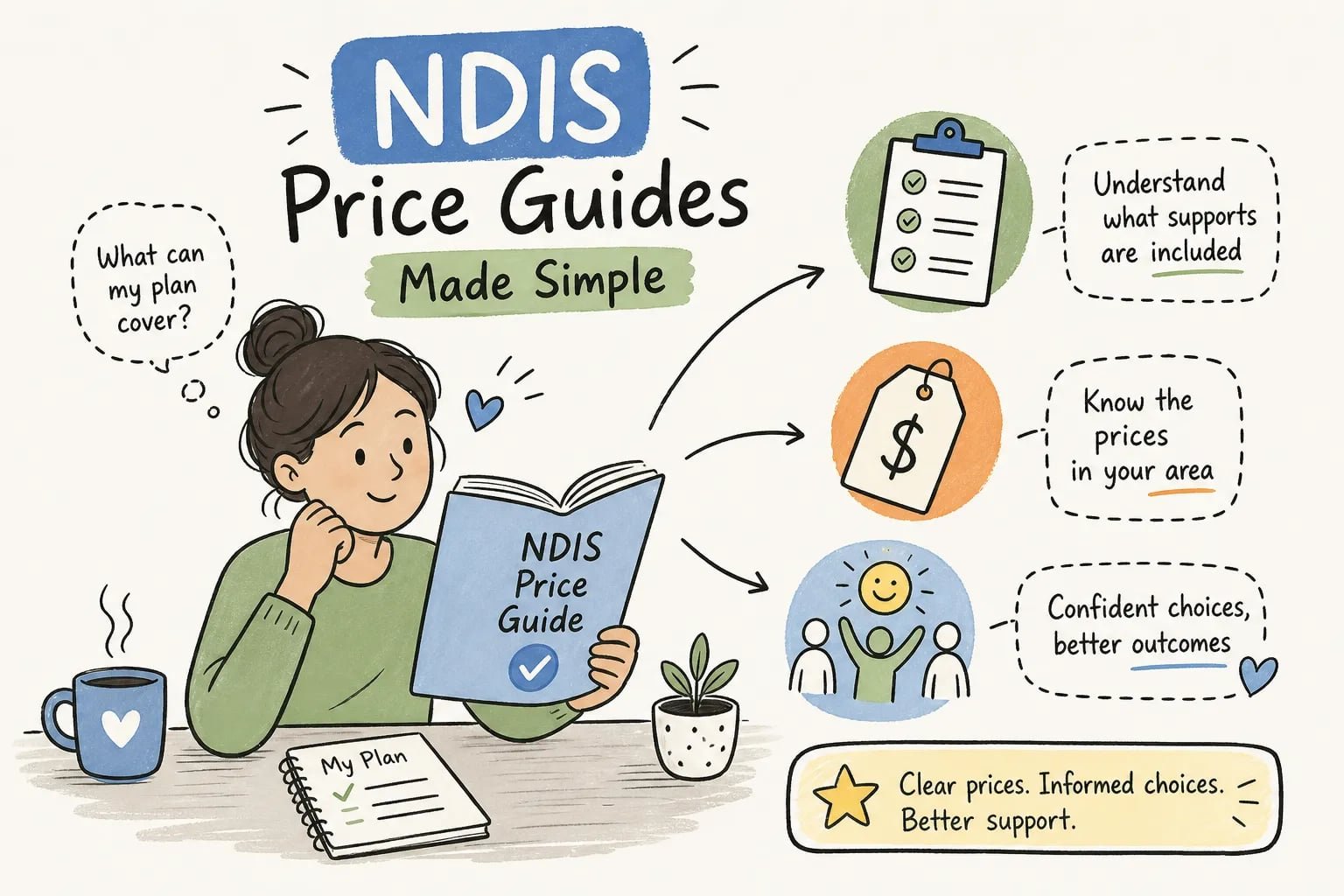
NDIS price guides give participants a clear picture of what their supports should legitimately cost, yet many participants receive invoices packed with line items and hourly rates they’ve never been taught to read. A code like “01_011_0107_1_1” sits on a payment request and can be approved without anyone verifying whether the rate falls within the legal maximum. That’s a problem, because knowing what a service should cost is the first line of financial self-defence, whether you’re hiring a tradie, engaging a conveyancer, or receiving disability support. It’s the same principle that drives independent cost-checking resources like NameTheCost.com, and it applies directly to your NDIS plan.
The National Disability Insurance Agency (NDIA) publishes official pricing documents that set the maximum a provider can legally charge for each support. The 2026-27 version brings meaningful rate changes across support worker and allied health categories, along with forward-looking adjustments that will affect unregistered providers from January 2027. This article covers how to find the current NDIS pricing schedule, what changed this financial year, how your location affects your rates, and how to spot a potential overcharge on your statement.
What NDIS price guides are and where to find them
From the old PAPL document to the 2026-27 pricing schedule
If you’ve been searching for the “NDIS Pricing Arrangements and Price Limits”, commonly called the PAPL, you may have noticed the terminology has shifted. For the 2026-27 financial year, the NDIA publishes this information under the name the NDIS Pricing Schedule, effective 1 July 2026. This matters because participants and providers searching under the old document title may land on outdated versions and rely on incorrect rate information. The 2026-27 Pricing Schedule is released alongside the Annual Pricing Review documents on the official NDIS website at ndis.gov.au, under the pricing arrangements section for providers.
The NDIA also provides a companion document called the Support Catalogue, which lists every individual support item code in spreadsheet format. If you want to look up a specific line item, the Support Catalogue is the faster tool. The Pricing Schedule PDF gives you the rules, caps, and context; the catalogue gives you a searchable database of codes and rates. Availability of the Support Catalogue spreadsheet is confirmed on the NDIA’s pricing arrangements download page, always download from there to ensure you have the current version.
What “price limits” actually means
These are not suggested rates or industry benchmarks. They are maximum enforceable price caps. Providers may charge less, but they cannot charge more for supports covered by the pricing arrangements. Each support has a unique code, a description, and a price limit expressed either as an hourly rate or a unit rate. Understanding this distinction is what turns a passive invoice recipient into someone who can actively verify their own plan expenditure.
The structure of a line item on a compliant invoice should reference the support item code directly. That code maps to a specific row in the Support Catalogue, which carries the price limit for that support. Matching code to catalogue entry is the core of any invoice audit, and it takes less time than most people assume once you know what you’re looking at.
What changed in the 2026-27 NDIS price guide updates
Support worker rates: the 4.75% increase explained
The most significant change in this year’s pricing review is a 4.75% increase in disability support worker prices. The standard weekday daytime rate now sits at $73.58 per hour, up from $70.23 in the previous financial year. High intensity support worker rates have also increased, and public holiday loadings now reach $163.46 per hour under the 2026-27 schedule. According to the NDIA’s Annual Pricing Review, these increases align with workforce pay outcomes and cost-of-living pressures affecting the disability sector, and they flow through to every plan that funds core support hours.
If you’re on an NDIA-managed or plan-managed plan, your budget capacity for support hours may need to be reviewed in light of these rate changes. An hour that previously cost $70.23 now costs up to $73.58 at the maximum rate, which compounds across a high-support plan. It’s worth asking your plan manager or support coordinator to walk through how the increase affects your remaining budget for the year.
Allied health and therapy rate adjustments
Not all allied health rates moved in the same direction this year. Psychology increased to $252.99 per hour. Dietetics decreased to $178.99 per hour, and exercise physiology dropped to $161.99 per hour. The “Other Professionals” category was reduced to $156.16 per hour. Support coordination and plan management rates remained unchanged.
These are not minor administrative tweaks. A drop in the exercise physiology cap, for instance, means providers in that space now have a lower maximum, which should flow through to participants as a lower or unchanged invoice rate. Therapy pricing has also become more profession-specific this year, with separate item structures for direct service, non-face-to-face time, cancellations, telehealth, travel, and report writing. If your allied health provider was previously billing travel or report time under a general code, you should now see those as distinct line items on your invoices. If they’re not appearing separately, it’s worth querying how those activities are being claimed.
The upcoming reduction for unregistered providers
A forward-looking change announced in this review is a 10% price reduction for Specialist Complex Community Participation (SCCP) supports delivered by unregistered providers, effective from 1 January 2027. Those items will also no longer receive annual indexation going forward. Participants using unregistered providers for these supports should factor this into their planning now. The rate environment for those specific supports is changing structurally, not just through the standard annual review cycle.
How your location affects the price limit on your supports
National, remote, and very remote loadings
The NDIS pricing schedule sets a single national price limit that applies across metropolitan and most regional areas. On top of this baseline, remote areas attract a 40% loading and very remote areas attract a 50% loading, as defined by the NDIA’s pricing guidance. The NDIA uses Modified Monash Model (MMM) categories to assign these classifications, with MMM 6 corresponding to Remote and MMM 7 to Very Remote. Certain offshore populated islands more than 5 km from the mainland are also classified as Very Remote.
To illustrate what these loadings mean in practice: the standard weekday rate of $73.58 per hour rises to approximately $103.01 in a Remote area (40% loading) and approximately $110.37 in a Very Remote area (50% loading). That is a significant difference for both provider pricing and participant budget planning, one worth confirming before assuming a national rate applies to your plan.
Specific postcodes and regions can be classified as remote enclaves even when their surrounding areas are not, including locations in NSW such as Broken Hill and Hay, and various regional centres in Queensland and Western Australia. If you’re uncertain about your area’s classification, the NDIA’s MMM lookup tool or a conversation with your plan manager will clarify it quickly.
Which location rate applies when a worker comes to you
A common source of confusion is which loading applies when a worker travels to a participant. The rule is clear: the applicable price limit is based on the participant’s location at the time the support is delivered, not the provider’s business address or home base. If you live in a metropolitan or regional centre, the national rate applies regardless of where the worker came from. Participants in remote communities should confirm their area classification with their plan manager or the NDIA directly, because this single data point determines the legitimate maximum across every support type in their plan.
Using NDIS price guides to review your invoices
How to read a support item on your statement
Every invoice or payment request from a provider should reference a support item code that corresponds to a line in the NDIS Pricing Schedule. To check whether you’re being charged correctly, match the code on your invoice to the current schedule and confirm the rate and number of units are both within the published limit. For NDIA-managed participants, the myplace portal records all payments and the support codes used. Plan-managed participants can request a full payment history from their plan manager at any time. This is your right, and a good plan manager will provide it without hesitation.
Practical signs a charge may exceed the price limit
Watch for invoices that don’t reference a support item code at all, rates that sit noticeably above the national benchmarks in the schedule, or additional fees bundled into the hourly rate rather than listed as separate approved claim types. Travel is a common one: it should appear as its own line item under the approved travel claim rules, not absorbed into the hourly support rate.
Registered providers are required under NDIA guidance to inform participants of their prices before delivering a support, including cancellation policies and notice period requirements, this obligation is clearest for NDIA-managed plans. Disclosure procedures may vary for unregistered providers and some plan-managed arrangements, so it’s worth asking your provider upfront regardless. If that disclosure hasn’t happened, that’s worth raising with the provider directly.
Applying an independent cost-checking mindset to your support plan
Just as Australians use resources like NameTheCost.com to benchmark tradesperson fees, conveyancing costs, and professional service quotes before committing, NDIS participants can apply exactly the same logic to their support invoices. The official NDIS price guide gives you a verifiable, publicly available benchmark for every support category. If a provider’s rates are at or below the cap and they’ve disclosed their fees clearly, that’s appropriate practice. If you can’t reconcile what you’re being charged against the published limits, contact your plan manager, support coordinator, or the NDIA directly, none of those conversations require you to be an expert first.
How providers must apply the pricing arrangements when billing
Rules differ between NDIA-managed and plan-managed plans
For NDIA-managed plans, providers must be registered with the NDIA, cannot charge above the published price limits under any circumstances, and must disclose their prices to participants before delivering the support. Claims are submitted through the myplace provider portal rather than via a direct invoice to the participant, and a service booking must be in place before supports begin. For plan-managed plans, both registered and unregistered providers may deliver supports, but the same price limits still apply. The plan manager is responsible for checking invoices against the caps before processing payment, which gives participants in this arrangement an important layer of built-in protection.
What compliant invoicing looks like in practice
A compliant invoice references the correct support item code, states the applicable rate and number of units, and doesn’t include undisclosed fees. Travel time, where claimed, appears as a separate approved line item rather than being bundled into the support hourly rate. Providers working across both registered and unregistered supports also need to be across the SCCP pricing changes taking effect from January 2027, since non-compliance carries consequences under the NDIS Quality and Safeguards framework. Understanding what a compliant invoice looks like is the most practical tool available for identifying one that isn’t.
Put this knowledge to work on your next invoice
NDIS price guides are the definitive, publicly available documents that set price limits for every support category, and the 2026-27 version brings real changes across support work, allied health, and upcoming SCCP arrangements. Knowing how to read a price limit and match it against an invoice puts you in a far stronger position to protect your plan budget over the full year. Location loadings, support item codes, and provider disclosure requirements are all part of the picture, and each one is documented in the official schedule.
Download the 2026-27 Pricing Schedule PDF from the NDIS website and keep it accessible whenever a new invoice arrives. Cross-reference the support item codes, check the rates against the published limits for your location, and ask questions early if something doesn’t reconcile. That habit, knowing what something should cost before accepting what you’ve been charged, is the most practical form of consumer self-protection in any service industry. For broader independent cost benchmarking across professional services, trades, and lifestyle expenses in Australia, NameTheCost.com is built around that same principle: giving you an honest benchmark before you hire, buy, or book anything.