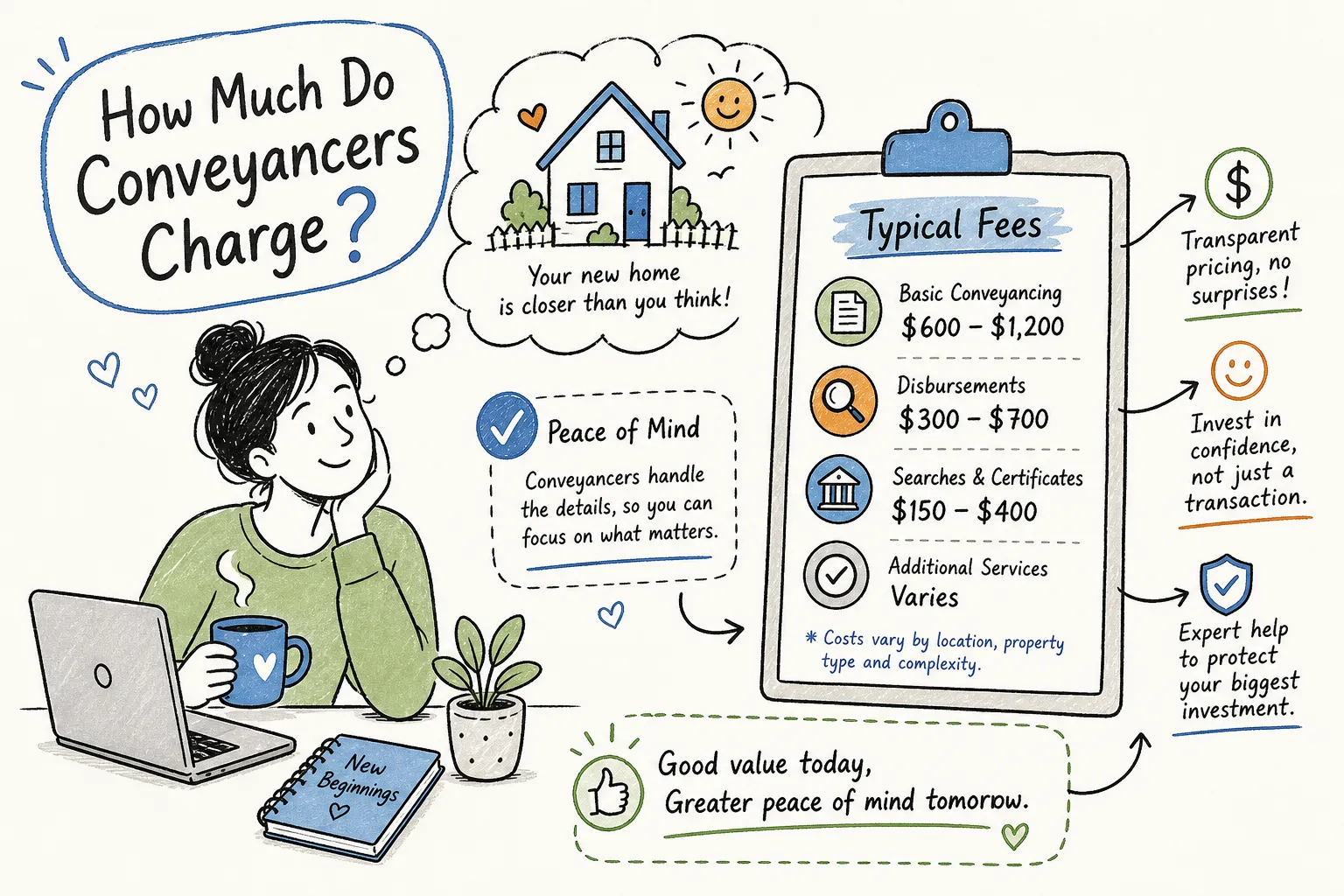
What Do Conveyancers Charge in Australia?
You get a conveyancing quote. You have no idea if it’s fair. And you feel too uncomfortable to push back on a professional who seems confident you’re getting a good deal. Many buyers, whether purchasing for the first time or returning after a decade away, find that conveyancer charges are genuinely hard to decode, they vary widely across states, between providers, and depending on property type. The industry doesn’t make that easy to read, and many buyers end up accepting whatever they’re given without a second look.
This guide breaks down what you should realistically expect to pay in 2026, what those extra line items actually mean, and how to tell a reasonable quote from one that’s been padded out. If you want an independent benchmark before you engage anyone, NameTheCost.com publishes conveyancing fee guides covering real Australian pricing, broken down by state and transaction type. Bookmark it before you call a single firm.
Conveyancer charges across Australia in 2026
The numbers vary more than most buyers expect, and your state is the single biggest driver of that variation. Understanding the range for your state gives you something concrete to push back with if a quote comes in well above it.
How professional fees break down by state
For a standard residential transaction, professional fee ranges in 2026 sit roughly as follows. New South Wales runs the highest, between $1,000 and $3,000, with an average closer to $1,650. Victoria comes in at $600 to $1,400. Queensland is typically $500 to $1,300, making it the most affordable mainland state. South Australia, Western Australia, Tasmania, and the ACT all sit in a similar band of $700 to $1,600. Northern Territory data is limited, but estimates broadly align with smaller-market states in the same range. These figures cover professional fees only and exclude government charges and third-party search costs.
Why NSW conveyancer charges consistently run higher
New South Wales conveyancing quotes tend to be higher for a few concrete reasons. NSW conveyancing typically requires a greater volume of searches than other states, a reflection of how property law and local government reporting requirements are structured there. Sydney’s professional services market also carries higher overheads generally, and many NSW providers quote a base fee separately from disbursements. A quote that looks competitive at first glance often grows substantially once disbursements are added. NSW buyers need to be especially careful about reading the fine print on what the headline number actually covers.
What “all-in” actually means on a conveyancing quote
There’s a meaningful gap between the professional fee and what you’ll actually pay. For a standard established home in NSW, the all-in figure once disbursements are included typically lands between $1,400 and $2,500. For other states, a standard transaction usually comes in at $1,100 to $2,200 all-in. Always ask for a full cost estimate, not just the professional fee. The headline number is not the number you’ll see on settlement day.
The disbursements most buyers don’t see coming
Many buyers focus entirely on the professional fee and get caught off guard when a list of extras appears at settlement. These charges are real, and most of them aren’t conveyancer margin, they’re government and third-party costs that your conveyancer pays on your behalf and passes through to you.
Common search fees and what they cover
A standard residential purchase attracts a predictable set of searches. A title search runs $20 to $100 and confirms legal ownership and any encumbrances on the property. A council planning certificate costs $43 to $250 depending on the type and council. Water and rates certificates typically sit at $20 to $70. A PPSR search, which checks whether any security interests are registered over the property, comes in at roughly $2 to $5. These costs are set by government agencies and property registries, they are statutory or third-party charges that your conveyancer passes through at cost, without adding margin.
Electronic settlement and PEXA fees
PEXA is Australia’s national electronic property settlement platform and is now widely used for residential settlements across the country. The PEXA fee in 2026 sits at approximately $146 for a single title transaction and around $167 for multiple titles, based on NSW pricing effective from July 2026. This is typically passed through as a disbursement. Some firms bundle it into their headline fee; most don’t. Ask specifically whether PEXA is included before you compare quotes side by side.
How disbursements stack up against the professional fee
For most standard residential purchases, disbursements total $300 to $800 on top of the professional fee. For complex matters involving strata, regional properties, or off-the-plan contracts, that number climbs. This is why two quotes with identical professional fees can differ by $500 or more at settlement, one provider may include more searches, or the property type triggers additional certificates the other quote didn’t account for. You need to compare total estimated costs, not just the professional fee line.
Fixed fee vs hourly billing: what the structure tells you
The majority of the residential conveyancing market in Australia now quotes on a fixed-fee basis. That’s mostly good news for buyers, but “fixed fee” doesn’t always mean what people assume.
Why fixed-fee dominates and when it works in your favour
Fixed-fee conveyancing became standard because buyers found hourly billing unpredictable and stressful. For a straightforward property purchase, a fixed-fee arrangement protects you from unexpected time charges.
The complication is that “fixed fee” almost always refers to the professional fee only. Disbursements, GST, and sometimes PEXA sit outside that number. The final bill is typically fixed fee, plus disbursements, plus GST. You need to know what is and isn’t included before treating any two quotes as genuinely comparable.
Sample conveyancer charges from major Australian cities in 2026
To give you a concrete sense of the market, here’s what providers are quoting in major cities for a standard residential purchase in 2026. Sydney quotes from established providers range from around $1,100 on the lower end to $1,800, with disbursement inclusion varying between firms. Melbourne professional fees sit around $1,290. Brisbane comes in around $990 for professional fees. Adelaide is around $825. Perth pricing is less transparent in current market sources, but broadly sits in the mid-range band. Use these as a baseline, not a guarantee, always get current quotes from at least two providers.
The “plus disbursements” catch
Even reputable fixed-fee quotes often carry the qualifier “plus disbursements” in the supporting detail. For a standard purchase, those disbursements typically add $300 to $800. A quote marketed at $990 can reasonably become $1,300 to $1,700 by settlement. That’s not deceptive, it reflects third-party costs your conveyancer doesn’t control. But it does mean the headline number consistently understates what you’ll actually pay, and buyers who don’t ask the right questions upfront are regularly surprised at the end.
Conveyancer or solicitor: does the cost difference justify itself?
For a standard residential transaction, most buyers have a genuine choice between a licensed conveyancer and a property solicitor. The price gap is real, and so is the difference in scope.
Where the fee gap actually sits in 2026
Licensed conveyancers typically charge $800 to $1,800 in professional fees for a standard purchase. Property solicitors generally charge $1,500 to $3,000 or more. Because disbursements run $300 to $800 either way, the all-in difference commonly lands between $800 and $2,000. For a standard freehold purchase in a metro area with a clean title, a conveyancer handles the work competently. The solicitor premium on a routine transaction is hard to justify on cost grounds alone.
When the solicitor premium makes sense
Complex matters are a different calculation. Off-the-plan contracts with unusual sunset clauses, properties with easements or covenants, deceased estates, trust purchases, and boundary disputes all benefit from a solicitor’s broader legal training. In Queensland, solicitors are also more deeply embedded in standard conveyancing practice than in other states, which shifts the comparison. If your transaction is anything other than a straightforward established property purchase, identify the complexity first and then decide which professional you actually need.
Transaction types that push the bill higher
Not all purchases are the same, and conveyancers price accordingly. Understanding the surcharges that apply to certain property types helps you budget realistically before you get your first quote.
Strata and off-the-plan purchases
Strata properties require additional searches and a strata inspection report. Combined, these typically add $200 to $750 to the base cost across professional fees and disbursements. Off-the-plan contracts are more complex to review because of staged settlements, sunset clauses, and developer variation rights. Professional fees for off-the-plan matters often run $400 to $1,200 higher than a standard purchase, and some firms price these transactions at $2,000 to $3,500 all-in as a starting point. If you’re buying off-the-plan, budget for a premium and confirm the firm’s fee upfront.
Rural parcels and complex title structures
Regional and rural properties frequently require more searches than metropolitan ones, covering additional water entitlements, easement checks, and council overlays. A reasonable allowance for additional search disbursements on a rural parcel is $200 to $800 above a standard metro transaction. Where a title carries multiple covenants, easements, or separate dealings, firms typically charge per-dealing increments, NSW guidelines, for example, reference an $18.50 per dealing charge for covenants or easements. Individually small, but they accumulate on a complex title.
Questions to ask before you sign anything
The quotes that cause problems at settlement are almost always the ones where the buyer didn’t ask enough upfront, and that’s a fixable problem. Knowing the right questions gives you control over a process that can otherwise feel opaque.
The three things every conveyancing quote should spell out
Any quote worth trusting should itemise three things clearly: the professional fee excluding disbursements, an estimated disbursements schedule based on the specific property and transaction type, and whether GST is included or excluded from both. A quote that bundles everything into a single number without breaking these out leaves you guessing at settlement. Ask for a written estimate showing all three line items before you sign a costs agreement.
If a provider won’t give you that, find one who will.
Red flags that suggest a padded or opaque quote
A few patterns are worth watching for. Watch for quotes that bundle everything into a single number with no itemisation; fees described as “starting from” without a ceiling; vague references to “miscellaneous searches” without a cost attached; and large unexplained gaps between the professional fee and the all-in total. These aren’t always signs of bad faith, but they are signs of poor transparency. Poor transparency, in conveyancing as in most professional services, tends to favour the provider.
How to benchmark conveyancer charges in your state
Before accepting any conveyancing quote as reasonable, cross-check it against an independent source that has no stake in your transaction. NameTheCost.com publishes conveyancing cost guides covering realistic 2026 Australian pricing, broken down by state and transaction type. It’s a free reference point that takes five minutes and gives you the confidence to either accept a quote or push back on one that doesn’t stack up.
The bottom line on conveyancer charges in 2026
Conveyancer charges in Australia range from around $500 in professional fees in Queensland to $3,000 or more in NSW once disbursements are included. Solicitors cost more and aren’t always necessary for a standard purchase. Fixed-fee quotes are the norm but routinely exclude disbursements, and certain transaction types attract meaningful surcharges that buyers rarely anticipate. The smartest move before engaging anyone is to get the quote in writing, ask the three non-negotiable questions, professional fees, disbursements, and GST, and benchmark the total against an independent source.
Knowing what conveyancing should cost before you sign anything is a reasonable expectation. Use NameTheCost.com as your free reference point, and walk into every quote with a clear sense of what fair looks like in your state.