Business Interruption Insurance Cost Per Month in Australia
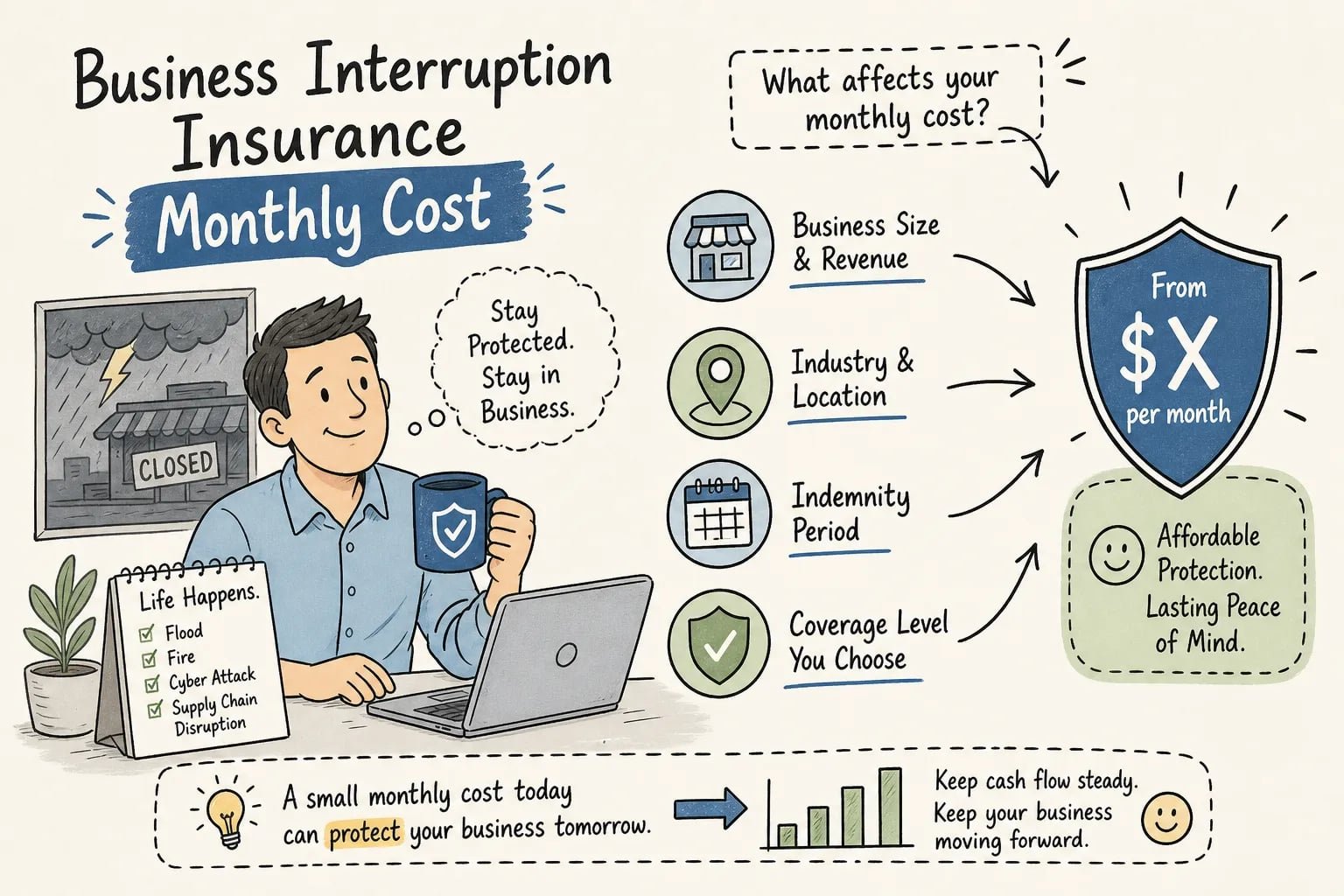
Many business owners have no idea what business interruption insurance costs per month, or they’ve assumed it’s expensive and quietly shelved the decision. Both approaches carry real financial risk. The reality is that monthly premiums for Australian SMEs sit anywhere from around $40 for a sole trader to $417 or more for a medium-sized operation, and the gap between those figures has everything to do with how the policy is structured, not just what industry you’re in.
This guide is a straight breakdown of what you’ll actually pay for business interruption insurance each month, what drives that number up or down, and whether the monthly spend makes sense for your situation. Before you sit down with a broker, know your own numbers. NameTheCost.com is an independent Australian resource for auditing real operating costs, and understanding your gross profit clearly is the single most important input to getting a BI quote right.
What business interruption cover actually pays for
Business interruption (BI) insurance replaces the income a business loses while it can’t trade after a covered event: a fire, a flood, storm damage to your premises. The sum insured is based on gross profit or gross earnings, which in insurance terms means revenue minus variable expenses. Fixed costs like rent, salaries, and loan repayments keep running during a shutdown regardless of whether the doors are open, and BI cover is designed to fill that gap so the business survives the recovery period rather than getting carved up by costs it can no longer service.
BI cover doesn’t kick in from day one. There’s a waiting period, sometimes called a deductible period. In the Australian market this commonly runs 48 to 72 hours, with options extending up to 14 days or more depending on the insurer. The business carries its own losses during that window. This is the most misunderstood feature of BI policies, and it directly affects what you pay each month. Many business owners think they’re covered from the moment something goes wrong; they’re not.
Beyond the base cover, most policies offer extensions: payroll cover to keep paying staff during downtime, increased cost of working (extra expenses like temporary relocation or running overtime), and suppliers or customers extensions for businesses whose interruption is caused by a third party’s problem rather than their own premises. Each extension raises the total sum insured and therefore raises the monthly BI premium. They’re worth considering carefully rather than ticking automatically.
Business interruption insurance cost per month: premium ranges by industry
For higher-risk industries, the monthly BI component sits in these approximate bands. Retail businesses typically pay $40 to $120 per month for the BI portion of their cover. Hospitality, including cafés and restaurants, runs $80 to $200 per month, with industry averages for food-business packages sitting around $145 per month total. Trades fall in the $60 to $180 per month range, reflecting higher property exposure and on-site risk. Real-world examples from the market include a restaurant paying $92 per month for the BI component and an electrical services business at $64 per month.
Professional services businesses sit at the lower end. Marketing consultancies pay as little as $16 per month for the BI component. Real estate agencies average around $29 per month, while accounting services can reach $110 per month, reflecting higher insured revenue rather than higher physical risk. The common mistake in this group is underinsuring gross profit because the business doesn’t carry physical stock and assumes it doesn’t have much to lose from a forced closure. That logic breaks down fast when you’re locked out of your premises for six weeks and client revenue stops entirely.
By business size, the approximate monthly BI-specific bands, assuming standard 12-month indemnity periods and typical sums insured for each business tier, are:
- Sole trader: $40 to $70 per month
- Micro business: $40 to $100 per month
- Small business: $50 to $150 per month
- Medium business: $100 to $417 or more per month
These figures represent the BI component only, not full package costs.
How insurers actually calculate your premium
Sum insured calculation
The standard Australian underwriting approach works like this: insurers set the BI sum insured from projected gross profit, which is revenue minus uninsured variable costs, multiplied by the chosen indemnity period. A business turning over $500,000 with a 40% gross profit margin and a 12-month indemnity period would insure a BI sum of $200,000. The premium then applies as a rate against that sum, typically 0.5% to 2% annually in most SME markets. On a $200,000 sum insured, that translates to roughly $83 to $333 per month. Some brokers use an interruption insurance premium calculator to model these scenarios before approaching underwriters, which can be a useful tool to benchmark your own numbers against.
Package vs standalone cover
Many small businesses hold BI cover as part of a combined business insurance package rather than as a standalone policy. In that structure, the monthly BI component often represents 20% to 40% of the underlying property premium. A café paying $2,000 per year in property cover might add $400 to $800 per year in BI cover, or $33 to $67 per month. This context matters because comparing package quotes directly against standalone BI quotes produces misleading comparisons. You need to isolate the BI component to understand what you’re actually paying for it. This cost of business continuity insurance, whether packaged or standalone, is the figure worth scrutinising at every renewal.
The policy features that move the monthly cost most
Indemnity period is the single biggest lever. Choosing between a 12-month and a 36-month indemnity period has the largest individual impact on your monthly BI premium. Longer periods mean the insurer is on risk for more months of potential loss, so the premium scales accordingly. For most small businesses in low-risk categories, 12 months is adequate. Businesses in specialist premises, manufacturing, or those reliant on imported equipment often need 24 to 36 months because physical rebuilds and supply chain recovery take longer than a year. The premium saving from choosing a shorter period is sometimes modest relative to the risk of finding yourself still in recovery with no cover remaining, so the decision deserves careful thought rather than defaulting to the cheapest option.
Waiting period is the discount most businesses overlook. A 24-hour waiting period costs substantially more than a 72-hour or 168-hour deductible. Extending your waiting period to 7 or 14 days can produce a meaningful reduction in your monthly business interruption cover cost, though the exact saving varies by insurer and policy wording. If you have cash reserves to self-insure the early loss window, you’re paying premium for cover you’d never actually draw on. Choose the longest waiting period your cash flow can comfortably absorb.
Extensions for payroll and increased cost of working raise the total sum insured and therefore the premium. These extensions are worth holding if staff retention during recovery is critical to the business restarting at full capacity. Small businesses often over-specify them when a leaner base policy would do the job. Review each extension against your actual recovery plan rather than accepting the default package, then decide what genuinely earns its place.
Three practical ways to lower your monthly premium
The easiest immediate reduction is extending your waiting period deliberately. If you have 7 to 14 days of operating expenses in reserve, elect a longer waiting period. Review your actual cash reserves: if they can cover a short disruption, shifting your deductible from 24 hours to 7 days can trim the BI component meaningfully. It’s a clean, low-effort lever that costs you nothing except a conversation with your broker.
Right-sizing your sum insured using accurate financials is the next step. Underinsuring creates claims problems; overinsuring wastes money every month. Use the gross profit basis properly: pull your most recent profit and loss statement, strip out variable costs, and declare a realistic BI sum based on what you’d actually lose during a closure, not your total revenue figure. Many small businesses set the sum insured based on total turnover, which dramatically inflates the premium without improving their position when a claim is made. This is also sometimes called business loss of income insurance cost, the key is matching the insured sum to your real income exposure.
The third lever is documenting your risk mitigation and putting it in front of your broker before renewal. Insurers reward businesses that can demonstrate business continuity plans, off-site data backups, fire suppression systems, and cybersecurity controls. Premium reductions are commonly cited as around 10% to 15% in some broker reports when businesses provide documented evidence of strong risk controls, though outcomes vary by insurer and policy. This isn’t a guaranteed result, but it gives a broker something concrete to negotiate with underwriters rather than accepting default pricing.
Is the monthly spend worth it for your business?
The question to ask is not “can I afford the premium?” but rather “could the business survive a six-week forced closure without it?” For a café earning $15,000 per week in revenue, three weeks of lost trade costs $45,000. A BI premium of $80 to $150 per month, or $960 to $1,800 per year, is a straightforward trade-off against that exposure. For a home-based sole trader earning $60,000 per year from a laptop-based service with minimal fixed overhead, the calculus is very different. If a three-week shutdown would cost more than a year’s worth of premium, the policy pays for itself.
When you’re ready to get a quote, approach a general insurance broker rather than going directly online, because the sum insured methodology requires a conversation about your financials. Before that conversation, audit your full cost base so you understand exactly how much revenue and gross profit you need to protect. NameTheCost.com’s business cost guides are built for precisely this: they help Australian business owners map out every operating cost line so you walk into a broker meeting knowing your actual numbers rather than estimating from memory.
Get at least two or three indicative quotes and compare indemnity periods on a like-for-like basis. Read the policy’s material damage proviso carefully before signing, many BI policies require an underlying property or material-damage claim to be accepted before BI benefits are triggered, so check your specific policy wording. That detail catches businesses out more often than almost anything else.
The bottom line on BI insurance costs
Business interruption insurance cost per month varies widely because premiums are built from your specific gross profit, indemnity period, and risk profile, not from a standard rate card that applies uniformly across your industry. Based on available market data, many Australian SMEs fall roughly between $40 and $333 per month for the BI component of their cover, though costs vary considerably depending on business size, industry, and policy structure.
The bigger risks are skipping cover entirely or buying a policy with the wrong indemnity period for your actual recovery timeline. A 12-month indemnity period looks fine on paper until your rebuild takes 18 months and you’re six months without cover. Do the maths on your gross profit, choose your waiting period based on your cash reserves, and get a broker to run the numbers properly. That’s the whole job.