Kitchen Remodel Costs in 2022 vs Today: What’s Changed
Kitchen remodel costs in 2022 told a very different story to what Australians face today. If you saved up $20,000 for a kitchen renovation back then, that number felt reasonable, it covered a solid flat-pack install, new benchtops, and a decent appliance upgrade in most parts of Australia. By 2026, that same $20,000 barely gets you started on a mid-range kitchen in a capital city. The gap between what Australians expected to pay in 2022 and what the same renovation costs now is significant, and most homeowners don’t realise how wide it’s become until they get their first quote.
This article walks through what kitchen renovations actually cost in Australia in 2022, where those budgets went, and what’s changed in the years since. Whether you’re reviewing old quotes, trying to understand the current market, or want a grounded baseline before you start planning, these figures give you a clear picture of how the numbers have moved and why.
What Australians actually paid for kitchen renovations in 2022
The national average for a kitchen renovation in Australia in 2022 sat somewhere between $17,000 and $20,000, depending on which industry source you consulted. Hipages placed the typical spend closer to $25,000 to $50,000 when accounting for full-scope renovations. That wide spread existed for a simple reason: “kitchen renovation” meant something different to every homeowner. Respraying cabinet doors and fitting a new benchtop is not the same project as reconfiguring a kitchen’s footprint, installing stone surfaces, and replacing every appliance.
When you break 2022 kitchen remodel costs into tiers, the picture becomes clearer. Budget renovations generally ran $10,000 to $25,000 and covered flat-pack cabinetry, laminate benchtops, and basic appliance upgrades. Mid-range projects sat between $25,000 and $45,000, introducing semi-custom joinery, stone benchtops, and quality freestanding appliances. Premium renovations pushed past $45,000 and frequently exceeded $90,000 in Sydney, where a fully custom kitchen with integrated appliances and structural changes was not unusual. Real homeowner figures from forum discussions in that period clustered around $20,000 for modest renovations, $35,000 for all-inclusive mid-range projects, and $50,000-plus for premium builds.
Sydney consistently sat above the national average, with budget kitchens starting around $13,800 and premium builds reaching $92,000. That top-end figure pulled the city-wide average well above what homeowners in Brisbane or Adelaide were spending on comparable work. The national figures often obscured this gap, which left many interstate renovators underprepared when local quotes came in above what they had read online.
How a typical 2022 kitchen renovation budget was divided
In a typical 2022 kitchen renovation budget, labour accounted for 25 to 35 per cent of the total spend. Cabinetry and materials took another 30 to 40 per cent, with appliances consuming 15 to 25 per cent. On a $30,000 renovation, that translated to roughly $9,000 to tradies and $10,500 to joinery and materials. Appliances typically absorbed $6,000 to $7,500, with the remaining margin covering design fees, waste removal, and finishing details that rarely appear in a headline quote.
Homeowners who opted for flat-pack cabinetry and managed some of the coordination themselves kept labour costs lower, sometimes under 20 per cent of the total. Those who commissioned custom joinery or undertook structural changes found labour creeping toward 40 per cent or higher, particularly in cities where trade rates were already elevated. The material-to-labour ratio was one of the clearest signals of whether a renovation was genuinely budget-priced or simply scoped to look that way.
The hidden costs that blew out 2022 renovation budgets
A Budget Direct renovation survey found that 72.7 per cent of Australian renovators cited unexpected costs as a major pain point. In kitchens specifically, the most common surprises in 2022 were electrical upgrades, plumbing reroutes, and structural problems uncovered after demolition. Outdated wiring, switchboard capacity issues, and new circuits for induction cooktops were routine findings in homes built before the 1990s. These weren’t edge cases, they were standard risks that most initial quotes made no allowance for.
Asbestos removal was a significant unplanned expense for older homes, particularly in splashbacks and behind wall linings. Permit and inspection fees, load-bearing wall assessments, and subfloor repairs added thousands to projects that were already underway and difficult to pause. Temporary living costs, particularly takeaway meals and makeshift cooking arrangements during a renovation, added up faster than most people anticipated. A realistic 2022 kitchen renovation cost estimate included a contingency buffer of 15 to 20 per cent on top of the quoted figure. Many homeowners skipped that buffer entirely and absorbed the cost later.
Regional pricing gaps in 2022 kitchen remodel costs
The documented gap between Sydney and the rest of Australia was significant in 2022, but regional disparities existed across all states. Labour rates in regional areas could be lower than in capital cities, but availability was the trade-off. Tradies in regional Queensland or Western Australia were frequently booked out months in advance, and some homeowners paid near-capital-city rates just to secure a tradie willing to travel. Material costs in remote areas were also higher due to freight, and some product lines weren’t stocked locally at all.
Melbourne was the closest eastern-state comparator to Sydney in cost. Brisbane and Adelaide came in modestly lower for comparable projects. Perth saw supply-driven inflation earlier than the eastern states, partly due to geographic isolation. The mining sector’s sustained pressure on trade availability across Western Australia compounded the effect further. Understanding these state-level variations before seeking quotes was the difference between a realistic budget and a genuine shock when the numbers arrived.
What’s shifted between 2022 and 2026
Materials
The pandemic-era supply chain disruptions that started pushing material costs upward in 2021 hadn’t fully resolved by 2022, and in several categories they continued climbing through 2024 and into 2026. Australian building material input costs rose substantially across this period. According to the ABS Producer Price Index for construction materials, cumulative input cost increases from 2021 to 2026 exceeded 20 per cent across key categories. Timber, steel, and engineered stone all saw sustained price pressure. Some materials that were delayed in 2022 due to shipping backlogs are now simply more expensive as standard pricing, with no expectation of returning to pre-2020 levels.
Labour
The construction labour shortage that was already visible in 2022 has remained a structural issue in Australia rather than a temporary disruption. Qualified kitchen fitters, electricians, and plumbers are in higher demand than the trades sector can currently supply. According to the Master Builders Association, labour rates in metro markets are now running 15 to 30 per cent above pre-COVID levels, with some areas recording further increases of 5 to 7 per cent from 2025 to 2026. Projects that moved quickly in 2022 are now being quoted with longer lead times, and the cost of delays compounds the overall budget impact.
What these shifts mean for your budget
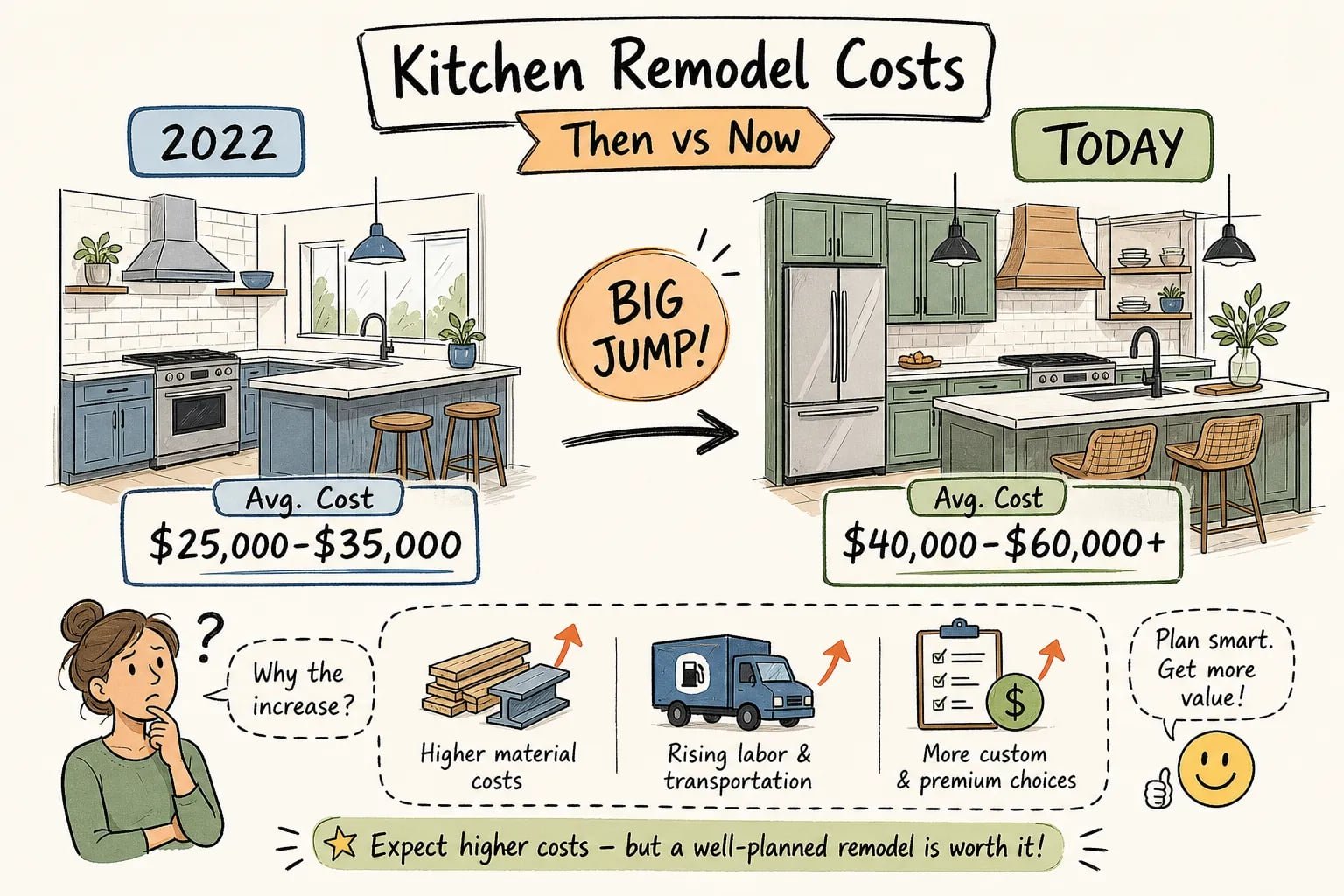
The practical result is a meaningful shift in what each tier of renovation costs. The $20,000 that covered a respectable budget kitchen in 2022 buys a more limited project today. Mid-range projects that sat around $30,000 in 2022 are now more commonly quoted at $40,000 to $50,000 for comparable scope and finishes, with the national average for a full kitchen renovation in 2026 sitting closer to $42,000. Homeowners using 2022 kitchen remodel costs as a planning baseline are consistently underprepared when actual quotes arrive.
Getting accurate benchmarks for a kitchen renovation today
The kitchen renovation cost figures from 2022 are useful for understanding how the market has moved. They aren’t a reliable foundation for budgeting a 2026 project. Using outdated figures creates a false sense of what a renovation should cost and puts homeowners in a weak position when reviewing quotes. The risk isn’t just overpaying, it’s under-scoping because the budget feels fixed at a number that no longer reflects reality.
NameTheCost.com publishes independent, up-to-date kitchen renovation cost benchmarks specifically for the Australian market, covering realistic price ranges by tier and by state without advertiser influence or referral commissions. Unlike comparison platforms that earn money from the trades they recommend, the guides at NameTheCost.com exist to give homeowners a neutral pricing benchmark before they request a single quote. If your last reference point for kitchen renovation costs was 2022, check what the current numbers actually look like before you commit to anything.
Kitchen remodel costs 2022 vs today: the gap that matters
The kitchen remodel costs Australians paid in 2022 were already variable and frequently underestimated. By 2026, that picture has shifted further: material prices are higher, labour is scarcer, and the all-in cost of a full renovation has climbed across every tier. Understanding what 2022 kitchen renovation projects actually cost, and why budgets blew out even then, gives you better context for what to expect when you start planning now.
Use the historical figures as a reference point for how the market has moved, and use current, independent benchmarks to plan what you’re actually spending. The two are very different things. The gap between them is where most renovation budgets go wrong.