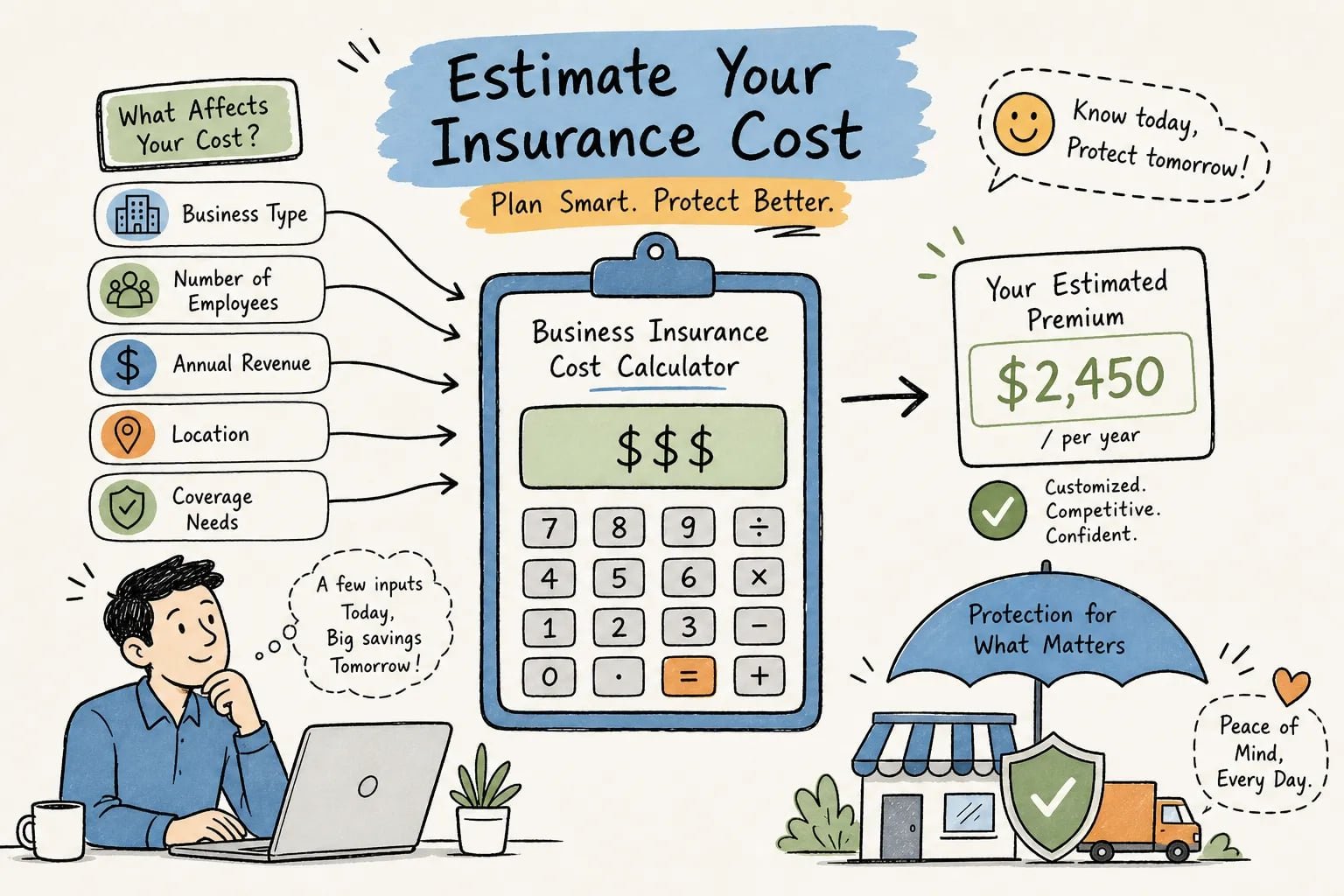
Business Insurance Cost Calculator: How to Estimate Your Premium
Many Australian business owners pull a number out of thin air when budgeting for insurance. They guess, they Google vaguely, and then they’re blindsided when the actual quote arrives. A business insurance cost calculator, whether a dedicated online tool or a manual framework, works from the same core variables that every insurer uses. Once you understand those variables, you can produce a realistic figure yourself before you speak to a single insurer or broker.
This guide breaks down exactly how business insurance premiums are calculated in Australia, what each cover type costs in 2026, and how to estimate your own costs using a straightforward DIY framework. If you’re launching a business and want to treat insurance as part of a complete cost picture rather than a single line item, NameTheCost.com’s startup cost guides walk through the main expense categories, from software subscriptions to trade fees to insurance benchmarks, in one place.
What actually drives the cost of your business insurance
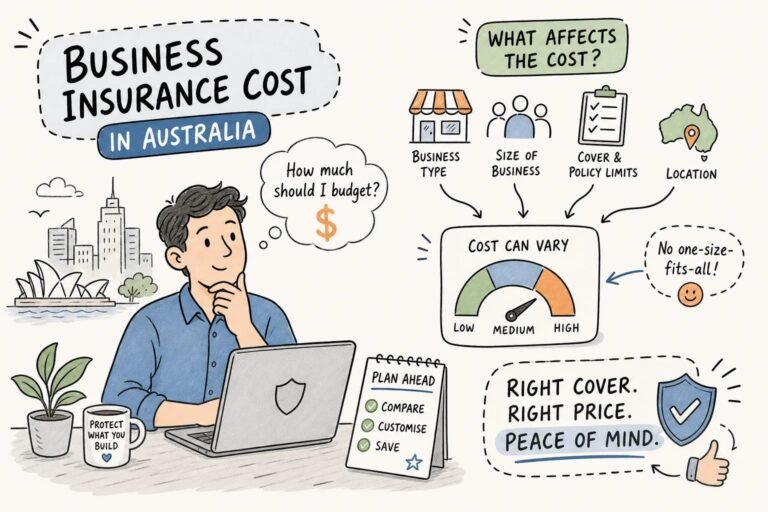
Premiums don’t come from thin air. Every insurer applies a structured underwriting logic to your business, and once you understand that logic, the quote you receive stops feeling arbitrary.
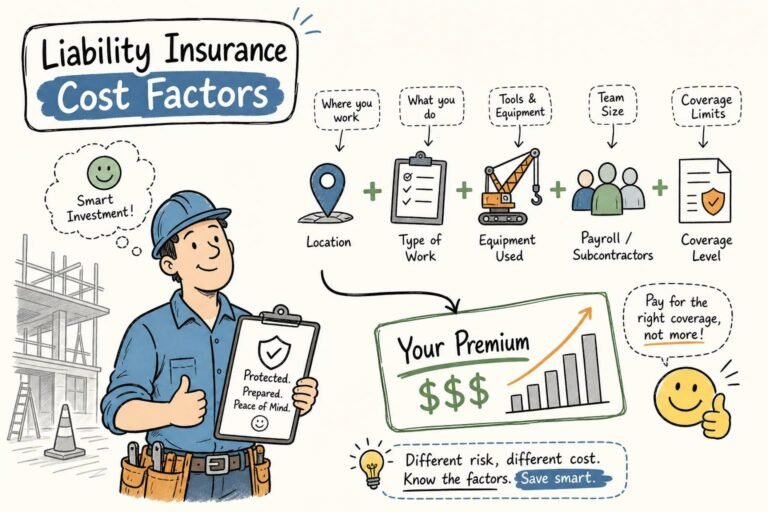
Industry classification is one of the biggest variables
Every insurer assigns your business a risk class based on what you actually do. A graphic designer and a commercial cleaner might both have three employees and $300,000 in annual revenue, but their premiums will be materially different. Industry classification drives the base rate an insurer applies to everything else: payroll, revenue, cover limits. The higher the risk class, the higher the starting point for every other calculation.
How revenue, payroll, and employee headcount factor in
Revenue acts as a proxy for exposure. More turnover typically means more customers, more transactions, and more potential for a claim. Payroll is the primary rating base for workers’ compensation and influences liability premiums across many other lines. Employee count matters because it signals the scale of your operation and the likelihood of workplace incidents or third-party claims. These three inputs are the most common fields you’ll find in any small business insurance cost estimator or business insurance quote estimator tool.
Location and claims history as cost multipliers
A business in a flood-prone area or a high-crime suburb pays more for property cover than an equivalent business in a lower-risk postcode. Claims history functions similarly: a clean record keeps your rate stable, while prior claims push it up and can narrow your policy options. Both factors are applied on top of the base rate your industry class sets, which means a business with a poor claims record in a risky location can face a premium that’s dramatically higher than the industry average.
What each cover type costs in Australia in 2026
These are indicative ranges, not hard guarantees. But they’re grounded in real market data and give you a legitimate reference point before you build your own estimate.
Public liability and professional indemnity ranges
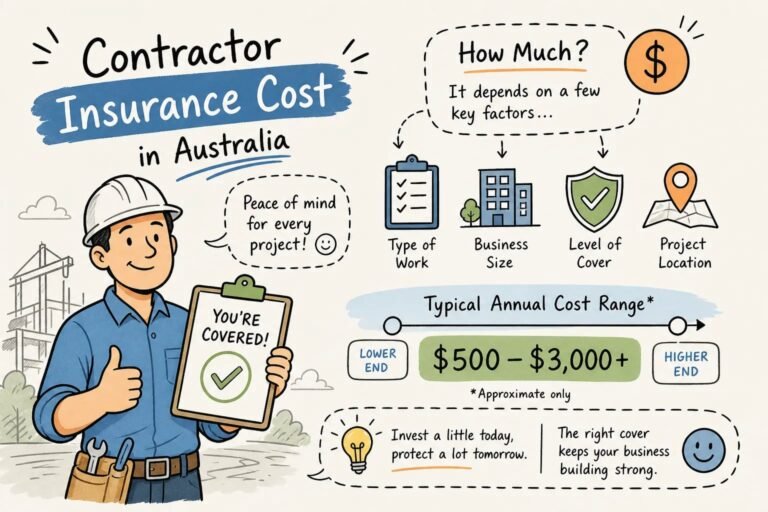
Public liability is usually the cheapest core cover for low-risk businesses. For a small retail shop, expect to pay roughly $350 to $600 per year for a standalone policy. Hospitality businesses typically land between $500 and $1,800 per year depending on venue type. Tradies, who carry higher physical risk, often pay $700 to $2,000 per year for public liability alone. For professional services businesses that need both public liability and professional indemnity bundled, the combined cost typically sits between $750 and $1,200 per year, though a broader programme for a mid-sized firm can run $5,000 to $15,000 per year. These ranges are indicative and based on commonly cited figures from Australian insurance comparison platforms; your actual premium will depend on your specific cover limits and risk profile.
Contents, plant, equipment, and business interruption cover
Contents and plant insurance premiums are calculated as a percentage of your sum insured. The higher the replacement value you’re covering, the higher the premium. Business interruption cover is priced off your gross profit and the length of your indemnity period, and it’s almost always bundled with property or contents cover rather than sold standalone. As a cross-industry benchmark, data from comparison platforms including BizCover and Compare the Market puts the average Australian business insurance package at approximately $89 per month for 2026, with retail averaging around $103 per month and hospitality around $145 per month. These averages typically reflect packages combining public liability, contents, and business interruption cover, the exact mix affects where any individual business lands.
Package deals versus separate policies
Bundling cover types into a business insurance package is commonly cheaper than buying each cover separately, and comparison platforms generally support this as the more cost-effective approach for most small businesses. For most small businesses, a package that combines public liability, contents, and business interruption is both cheaper and simpler to manage. The trade-off is less flexibility in choosing limits and deductibles for each cover type individually, but for most SMEs, that’s an acceptable compromise.
How to set the right sum insured so you don’t underinsure
This is where most business owners make costly mistakes. Setting your sum insured incorrectly doesn’t just affect your premium. It affects what you actually receive if you make a claim.
Replacement cost for contents and plant and equipment
The cardinal rule: insure contents and plant at their current replacement cost, not their book value or market value. Replacement cost is what it would cost you today to buy equivalent items and reinstall them, not what they’re worth on the secondhand market or what you paid for them three years ago. Insurers can apply underinsurance clauses that reduce claim payouts proportionally if your sum insured falls short of the true replacement cost at claim time. That’s a penalty you don’t want to discover mid-crisis.
Valuing stock correctly
Stock should be insured at cost price, not at the selling price that includes your profit margin. For raw materials, that means the landed cost including freight. For work in progress, it’s the cost of materials and labour incurred to that point. For finished goods, it’s your manufacturing or acquisition cost. Unless your policy wording specifically says otherwise, exclude profit margin from your stock sum insured entirely.
Business interruption: it’s about gross profit, not assets
Business interruption cover is not calculated on the value of your physical assets. It’s based on the gross profit your business would lose during the time it takes to recover from an insured event, plus the ongoing fixed costs that continue whether you’re trading or not. A practical formula: calculate your insurable gross profit, turnover less variable costs, for your chosen indemnity period (commonly 12 or 24 months), then add any extra expenses you’d incur to keep operating during recovery. This gives you a working sum insured figure for business interruption purposes. Your broker can help you stress-test it against your actual fixed cost structure.
Using a business insurance cost calculator: a DIY framework
This is the practical core of the process. Three steps, worked through in order, give you a figure you can actually use.
Step 1: classify your risk and identify your exposure base
Start by determining which risk class your industry falls into. Trade and construction businesses are high risk. Retail and hospitality are medium risk. Consulting and professional services are generally lower risk for liability purposes, though they carry professional indemnity exposure. Once you know your risk class, identify your primary exposure base: for liability covers, that’s revenue; for workers’ compensation, that’s payroll; for property and contents, that’s replacement value.
Step 2: apply cover-specific formulas to your numbers
Each cover type uses a different calculation method, and conflating them produces a useless estimate. Here’s how to approach each one:
- Public liability: annual revenue multiplied by an industry-specific rate. Rates vary by insurer and risk class, but indicative effective rates typically sit around 0.5% to 2% of revenue, lower for office-based businesses, higher for trades or businesses with significant public interaction. Use this as a starting range, not a fixed rule.
- Workers’ compensation: payroll multiplied by your state’s rate per $100 of payroll for your occupation code. State averages vary, with Queensland averaging around 1.17% and Western Australia around 1.33%, according to Safe Work Australia data, but occupation-specific rates can differ significantly from these averages, so check your state regulator’s current schedule.
- Property and contents: replacement value multiplied by a base rate per $1,000 of insured value.
- Business interruption: calculate your insurable gross profit for the chosen indemnity period and add estimated ongoing fixed costs and extra expenses. This is your target sum insured, the premium itself is then priced by the insurer based on risk factors.
To illustrate how these combine: a retail business with $500,000 in annual revenue, $150,000 in payroll (in Queensland), and $80,000 in contents replacement value might estimate public liability at roughly $2,500 to $5,000 per year (using a 0.5%, 1% rate), workers’ compensation at around $1,755 per year (at the Queensland average), and contents cover at a few hundred dollars per year, before bundling discounts. Running each calculation separately first gives you a per-cover breakdown to take into any broker conversation.
Step 3: sense-check against 2026 Australian industry benchmarks
Once you have your calculated estimates, compare them against the industry averages outlined earlier in this article. If your estimate comes in well below the retail average of $103 per month or the hospitality average of $145 per month for a comparable business, it’s worth checking whether you’ve underestimated your cover needs or sum insured. That said, legitimate variance is possible, lower cover limits, higher deductibles, or a genuinely low-exposure operation can all produce below-average premiums. Treat the benchmarks as a prompt to verify your assumptions, not as a hard floor. This cross-check step is the difference between a useful estimate and a number that will surprise your broker when they come back with an actual quote.
What to pull together before you call a broker
Walking into a broker conversation unprepared is the fastest way to end up with a quote that needs revision. Arrive with the right information and the process is far more efficient.
The numbers and documents every insurer will ask for
Before you request a quote, have the following ready. This list reflects standard underwriting practice across most Australian insurers and brokers:
- Annual revenue for the most recent financial year
- Total annual payroll broken down by employee type
- A full inventory of contents and plant with estimated replacement values
- Your business address and any other locations
- Your ABN and industry or trade classification
- A five-year claims history if available
The more accurate these inputs, the more accurate the quote. A broker who has to estimate your payroll or guess your contents value will produce a quote that may need significant revision once underwriting is completed.
Using your estimate as a negotiating reference
Your DIY estimate gives you a benchmark before you receive any quotes. If a quote comes in materially higher, you can ask the insurer or broker to walk through which factor is driving the difference. It might be a classification issue: some businesses sit on the border of two risk classes, and the lower one may legitimately apply. Your estimate also helps you identify where adjusting a deductible or cover limit produces meaningful premium savings without leaving you exposed. That’s a conversation you can only have if you understand the underlying calculation.
Insurance is just one line in your full business cost picture
Getting your premium estimate right is a useful discipline. But it’s only one cost in a list that’s longer than most new business owners expect.
The costs most new business owners forget to budget for
Insurance gets attention because it’s visible and often required. But it sits alongside a long list of costs that are just as real and far easier to miss: trade licence fees, accounting software, industry registrations, workers’ compensation premiums that vary by state, professional memberships, and the operational subscriptions that quietly compound every month. Many business owners discover these costs one at a time, usually after they’ve committed to a budget that didn’t account for them.
Where to audit your full cost picture before you launch
NameTheCost.com is built to help Australians map these costs before they commit. The business and startup cost guides on the site cover expense categories from SaaS subscriptions to operational overhead and insurance benchmarks, all presented in Australian dollars. If you’re applying the same methodical approach to your premium estimate that you’ve used in this article, it’s worth running that same rigour across every other cost category before you finalise your budget.
How a business insurance cost calculator fits into your broader planning
Estimating your premium, whether through an online business insurance cost calculator or a manual DIY framework, doesn’t require a broker call to get started. It requires the right inputs and a clear understanding of how each cover type is calculated. Know your industry risk class, your revenue and payroll figures, your accurate replacement values, and your claims history. Apply the cover-specific formulas, cross-check against industry benchmarks, and you’ll have a working estimate that holds up against any quote you receive.
The estimation logic in this guide works for most standard SME cover types across Australia. Where your situation is more complex, multiple locations, specialist equipment, or a mixed-risk operation, a broker remains the right next step. But you’ll arrive at that conversation informed rather than guessing. And if insurance is the first startup cost you’re tracking seriously, use it as the prompt to audit every other cost category too. Businesses that build that habit early tend to have fewer financial surprises in year one.