How Much Does Restaurant Insurance Cost in Australia?
Restaurant insurance cost in Australia is not a fixed number, it is a range, and most operators have no reliable way to know whether the quote sitting on their desk is sharp or 30% over the odds. Policies are commonly renewed annually: the broker sends a figure, it looks roughly similar to last year, and the owner signs. No single, comprehensive industry-wide public tariff exists to check it against. That is the problem this article fixes.
By the end, you will know what a realistic annual premium looks like for a small café and a medium restaurant in Australia, which cover types are building your invoice, what moves the price up or down, and what a proper comparison process actually looks like. Having an independent reference point before you commit to any number from a single provider or broker is exactly where most operators fall short.
Restaurant insurance cost: what Australian operators actually spend
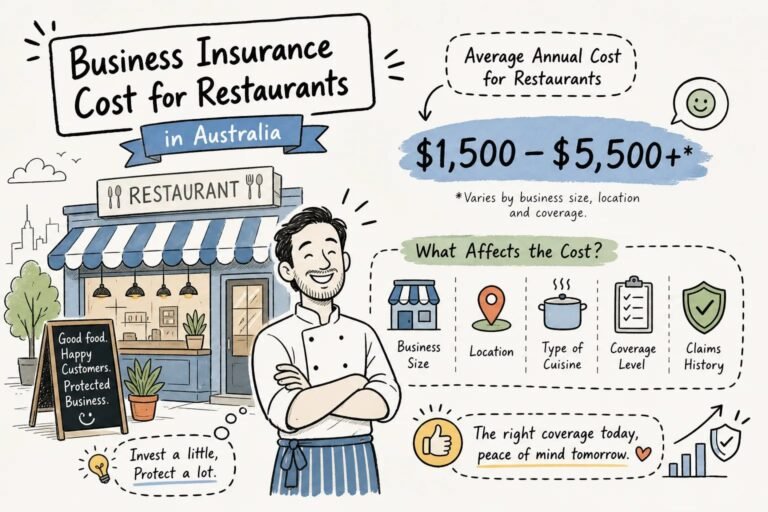
The number you need to plan around is this: a small café with a realistic, practical insurance package should budget A$2,000 to A$5,000 per year. That is not the bare minimum; that is what sensible cover actually costs for a small food venue in Australia. Public liability alone, for a small operation in NSW, averages around A$74 per month, roughly A$888 per year for that one cover only.
If you are only buying basic public liability and nothing else, you can spend as little as A$480 to A$960 per year. But basic cover leaves dangerous gaps: no contents protection, no business interruption, no stock cover. The A$2,000 to A$5,000 figure is the more honest planning target for a venue that actually wants protection, not just a certificate. Café insurance cost tends to sit at the lower end of this band, while larger venues with more complexity push toward the upper end.
Medium-sized restaurants with more staff, higher annual turnover, or a liquor licence typically sit at the upper end of that range or beyond it. Catering operations that run events, transport food off-site, or work across multiple locations often push further still, because mobile and event-based exposure is priced higher than a fixed venue with predictable foot traffic. Location matters too: urban, high-traffic precincts and areas with elevated claims frequency attract higher premiums than regional operations, and NSW data is the most publicly available benchmark for state-specific pricing in Australia.
The three cover types that build most of your premium
A restaurant insurance package is not one thing. It is several covers bundled together, each with its own pricing logic. Understanding each component means you can read a quote critically rather than simply reacting to the total.
Public liability: the non-negotiable
Public liability covers customer injury on your premises, third-party property damage, and the legal costs that follow a claim. For an average Australian restaurant, this cover alone runs roughly A$1,200 to A$1,700 per year depending on your limit and risk profile. Higher indemnity limits, say A$10 million versus A$5 million, push the premium up, but the increase is proportional rather than dramatic. This is the one cover that almost no operator should reduce or remove. The frequency of slip-and-fall and food-related liability claims in hospitality makes this the foundation everything else sits on.
Property and contents cover
This covers your fit-out, commercial kitchen equipment, refrigerated stock, signage, and building contents. For a small café, adding commercial property cover to a standalone liability policy adds roughly A$1,500 to A$2,000 per year. Commercial kitchen insurance cost varies with the replacement value of your equipment, whether you own or lease the building, and how your insurer treats refrigerated goods. Over-insuring your fit-out inflates this premium without adding genuine protection, so accurate sums insured matter.
Workers’ compensation and business interruption
Workers’ compensation is not optional in Australia if you employ staff. It is a legal requirement in every state and territory, calculated on your industry classification rate applied to your total wages bill. For a small restaurant, the average sits around A$1,360 per year, but this climbs directly with payroll. NSW cafés and restaurants carry a workers’ comp rate of 2.25% of rateable wages in 2025, 26; the ACT rate for the same category is 2.50%. Business interruption cover is often bundled into a broader policy package rather than priced as a separate line item. Confirm business interruption is included in your quote rather than assumed to be. A kitchen fire that closes your venue for two months is exactly what this cover was designed for.
What actually drives your restaurant insurance price up or down
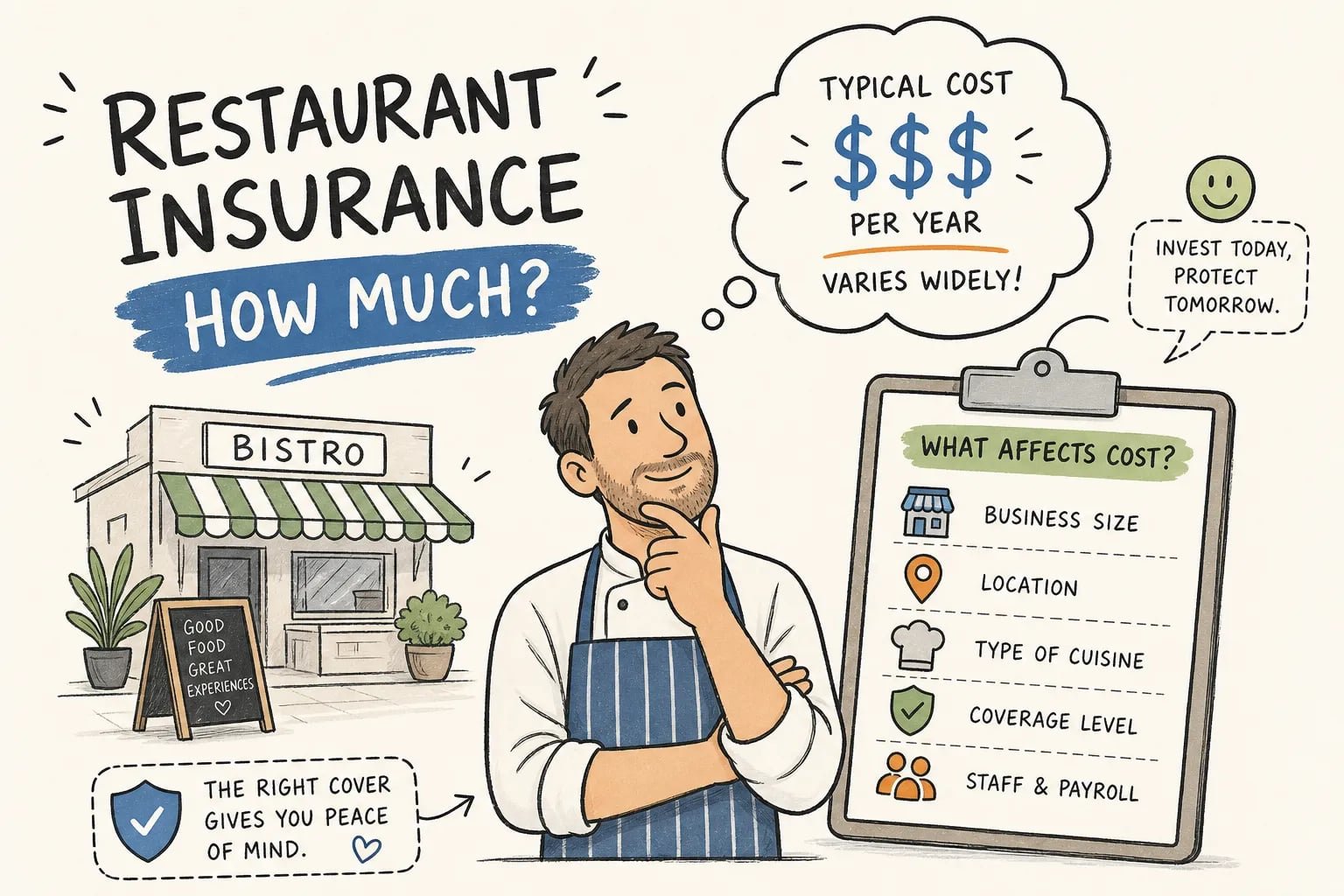
Once you understand what moves the dial, you can make deliberate decisions rather than simply accepting whatever a broker presents. Five factors dominate the underwriting conversation for hospitality businesses.
- Turnover and business activity: higher revenue signals more transactions and more exposure; some insurers rate liability directly on gross sales figures
- Number of employees: more staff increases workers’ comp exposure and signals a larger operation overall
- Location: urban premises, high-traffic areas, and weather-exposed sites attract higher rates; regional operators may pay less but face fewer insurer options
- Cover limits: requesting higher indemnity limits raises the premium, though the increase is often less dramatic than operators expect
- Alcohol service: holding a liquor licence adds a material loading to a hospitality policy; it increases both the frequency and severity of liability claims, and insurers price accordingly
Claims history sits above all five of those factors when it comes to renewal pricing. A single significant claim can raise your next renewal by 25 to 40%. Multiple claims in a short period can push you out of the standard market and into specialist or non-standard cover, which costs more and offers fewer options. Maintaining a clean claims record is the single most effective long-term cost control strategy available to a restaurant operator, underwriters weigh it more heavily than almost any other variable when pricing a renewal.
How to compare restaurant insurance cost and quotes
Many operators obtain only one or two broker quotes and choose between them, that is not a comparison process; it is a coin toss with a few thousand dollars at stake.
The structural problem is that different brokers have access to different insurer panels. Two brokers quoting on genuinely similar cover can return materially different premiums because they are drawing from different markets. Beyond that, the cover terms buried in the product disclosure statement matter as much as the premium figure on the front page. Exclusions, sub-limits on specific events like equipment failure or food spoilage, and excess levels can make a cheaper policy significantly more expensive the day you actually need to use it. Comparing premiums without comparing cover is a common and costly mistake.
Before approaching any broker, know what a business insurance for restaurants of your size and type should realistically cost in Australia. Independent cost guides covering realistic price ranges, with no insurer affiliation and no referral revenue influencing the numbers, give you a benchmark figure to validate a quote against rather than starting from zero. Once you are in the market, get at least three quotes from different brokers. When comparing, check each of the following:
- Cover limits and indemnity amounts
- Excess levels for each cover type
- Sub-limits on equipment failure, food spoilage, and refrigeration
- Exclusions specific to food-related liability claims
- Whether business interruption and refrigeration cover are included or excluded
Ask each broker to confirm exactly what exclusions apply to food-related liability claims and property damage caused by equipment failure. Those two gaps are where hospitality policies frequently diverge.
Practical moves to reduce your premium without gutting your cover
There are legitimate ways to reduce your annual spend. Most require a small amount of upfront effort, and the savings compound across multiple renewals.
Increasing your excess is the most direct lever. Accepting a higher out-of-pocket cost at claim time can reduce your annual premium, sometimes materially, insurers commonly quote reductions in the low double-digit percentages depending on cover and insurer. Bundling your covers with a single insurer, rather than buying public liability, contents, and business interruption from separate providers, is almost always cheaper than purchasing each component independently. Insurers reward consolidated placements with better pricing.
Risk documentation is underrated. Evidence of current food safety certification, working CCTV, fire suppression maintenance records, and an incident log signals a lower-risk operation to underwriters. It may not shift your first quote, but it becomes negotiating material when your broker goes back to market. Review your sums insured every year: an overvalued fit-out or inflated stock estimate inflates your property premium without adding genuine protection. Accurate sums insured are free to correct and can meaningfully reduce your annual cost.
Three covers warrant careful thought before you reduce them. Public liability limits should reflect your contractual obligations and exposure, many venues and hirers expect A$10 million, though some acceptable commercial policies operate at A$5 million; choose limits based on your actual exposure and any contractual requirements. Workers’ compensation must stay current with your actual wages bill because it is a legal obligation in every state and territory. Business interruption cover is easy to overlook, but a flood or fire that closes your venue for weeks is precisely the scenario it was built for.
What is happening with hospitality premiums in Australia right now
Public liability costs for Australian hospitality businesses rose roughly 55 to 60% between 2019 and the mid-2020s. That increase was driven by higher claims costs, social inflation, and tightening insurer appetite for hospitality risk. Some live music venues saw premiums move from A$20,000 to A$160,000 across that period, an extreme example, but one that illustrates how quickly the market moved.
By 2025, 26, the broader commercial market has softened. Pacific region commercial property rates eased by around 14% in early 2026, and some liability lines have started to stabilise. However, hospitality liability remains stubbornly elevated because claim costs have not eased at the same rate as premium competition. High-risk venues, particularly those with live entertainment, extended trading hours, or a heavy liquor focus, continue to face either significant premium increases or reduced insurer appetite.
For a mid-tier restaurant with a clean claims record and no material change in operation, a flat renewal is a reasonable outcome in the current market. If your premium has jumped more than 15% with nothing in your business changing, request a re-market across a broader panel of underwriters rather than accepting the first renewal figure. Quality risks with good claims history are seeing improved terms in 2026. The operators who benefit from that shift are the ones who actively go back to market rather than automatically accepting renewal.
The number is a range, not a fixed fact
Restaurant insurance cost in Australia is shaped by what you cover, where you operate, how many people you employ, whether you serve alcohol, and whether you have made claims before. A small café should budget A$2,000 to A$5,000 per year for a practical, realistic package. A medium restaurant sits at the higher end of that range and often beyond it.
The operators who pay the least are not the ones who strip cover down to a single liability certificate. They benchmark the cost of restaurant insurance before approaching a broker, compare cover terms rather than just premiums, and revisit their policy every year rather than rolling it over on autopilot. Managing your risk profile deliberately, clean claims record, accurate sums insured, documented safety practices, is what earns better terms at renewal.
Use the figures in this article as your starting point. Get at least three quotes. Treat any number your broker gives you as a proposal worth scrutinising, not a verdict worth accepting.